


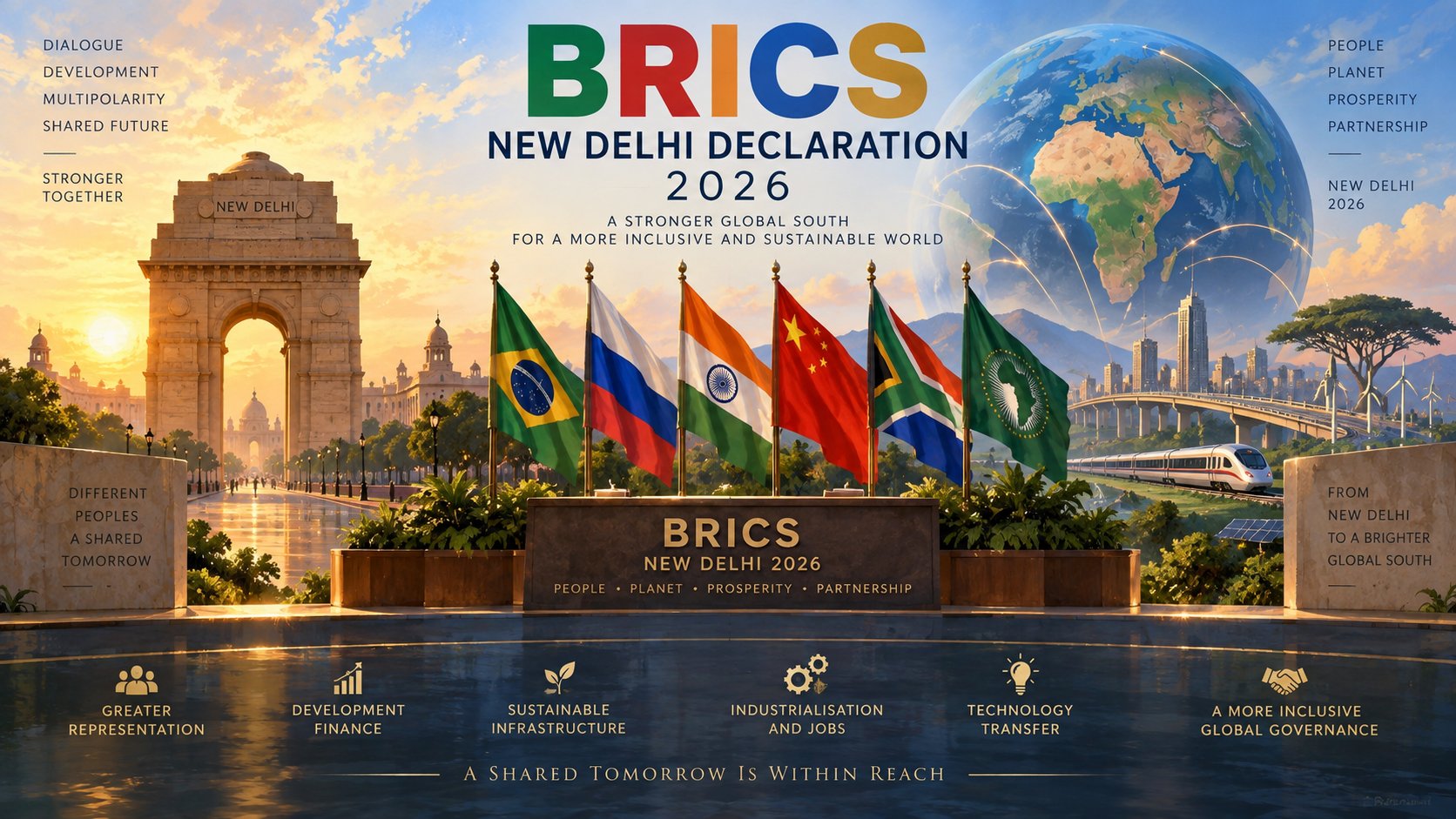
For South Africa and the wider African continent, the 2026 BRICS New Delhi Declaration is potentially significant because many of its central priorities align directly with Africa’s long-standing structural challenges: inadequate infrastructure, restricted access to development finance, dependence on commodity exports, vulnerability to external shocks, limited influence in global institutions, and uneven access to technology.
The Declaration does not create immediate economic benefits by itself. Most commitments still depend on implementation, financing, institutional follow-through and individual national policies.
However, it clearly positions Africa as one of the principal regions BRICS intends to support politically, economically and institutionally.
For South Africa specifically, the document reinforces the country’s unusual position as both a BRICS member and an important gateway between the organisation and the African continent.
The greatest potential benefits lie in six areas:
global political representation, development finance, critical minerals and industrialisation, infrastructure, intra-BRICS trade, and technology transfer.
1. South Africa’s geopolitical importance inside BRICS is strengthened
The Declaration repeatedly argues that Africa remains underrepresented in global decision-making.
It specifically supports greater participation of developing countries from Africa, Asia and Latin America in international institutions and recognises African aspirations for stronger representation on the United Nations Security Council.
This is particularly significant for South Africa.
South Africa already occupies a prominent diplomatic position because it participates simultaneously in BRICS, the African Union, the G20 and numerous multilateral institutions.
The New Delhi Declaration effectively reinforces the idea that South Africa can act as one of the important conduits through which African priorities are brought into BRICS discussions.
That creates opportunity, but also responsibility.
South Africa will increasingly be expected to demonstrate that its BRICS participation produces benefits not only for itself, but contributes to wider African development.
2. Africa could gain a stronger voice in global institutions
One of the clearest African interests in the Declaration is BRICS’ support for reform of the international governance system.
The Declaration calls for greater representation of emerging and developing countries in:
the United Nations;
the UN Security Council;
the IMF;
the World Bank;
and other international institutions.
For Africa, this addresses a fundamental imbalance.
The continent contains more than a quarter of UN member states, yet its influence within many of the institutions governing global finance and security remains limited.
BRICS therefore potentially provides African countries with an additional diplomatic coalition through which to press for reforms that African governments have pursued for decades.
The Declaration’s recognition of the Ezulwini Consensus and Sirte Declaration is particularly important because these documents represent the African Union’s long-standing position on Security Council reform.
In practical terms, BRICS support gives African demands greater diplomatic weight.
3. South Africa’s G20 position receives explicit political backing
One particularly noteworthy provision concerns the G20.
The Declaration explicitly emphasises South Africa’s status as a founding and full member of the G20 and states that changes to G20 membership should be based on consensus.
This is politically significant.
South Africa remains one of the principal African participants in global economic governance, while the African Union’s participation in the G20 has also strengthened the continent’s collective representation.
BRICS therefore appears determined to protect and expand African participation in institutions such as the G20 rather than withdraw from them.
For South Africa, this reinforces a diplomatic strategy based on participation in multiple overlapping institutions rather than choosing between “Western” and “BRICS” systems.
4. Development finance could be one of Africa’s biggest practical opportunities
Perhaps the most tangible opportunity for Africa lies in finance.
The Declaration assigns an increasingly important role to the New Development Bank.
BRICS wants the Bank to:
increase development financing;
expand infrastructure investment;
increase lending in local currencies;
mobilise private capital;
broaden its membership;
and strengthen its role across the Global South.
Africa has an enormous infrastructure financing requirement.
Transport networks, energy systems, water infrastructure, telecommunications, housing and logistics all require levels of investment that many African governments cannot finance through national budgets alone.
If the NDB substantially expands its operations in Africa, it could provide another important source of long-term development finance.
This would not replace the World Bank, African Development Bank or commercial lenders.
Rather, it could provide African governments with another financing option, potentially increasing competition among lenders and improving negotiating flexibility.
5. Local-currency financing could reduce foreign-exchange pressure
The Declaration encourages greater local-currency financing through both the NDB and BRICS financial mechanisms.
This could become particularly important for African economies.
Many African infrastructure projects are financed in dollars or euros while generating revenue in local currency.
That creates substantial foreign-exchange risk.
If a country’s currency depreciates, the cost of servicing foreign-denominated debt rises sharply.
Greater use of local-currency financing could therefore reduce one of the structural risks associated with development borrowing.
For South Africa, whose financial markets are considerably deeper than those of many African economies, this could also create opportunities for Johannesburg’s financial sector to participate in the development of BRICS-Africa capital markets and financial instruments.
6. Critical minerals could become one of Africa’s greatest strategic opportunities
The Declaration gives considerable attention to critical minerals.
This is particularly important for Africa.
The continent possesses substantial reserves of minerals required for:
electric vehicles;
battery storage;
renewable energy;
electronics;
advanced manufacturing;
and other strategic technologies.
Historically, however, much of Africa’s mineral wealth has been exported with relatively little processing or manufacturing taking place locally.
The Declaration takes a different position.
It explicitly supports:
value addition and economic diversification in resource-rich countries.
That principle could be highly consequential for Africa.
Instead of exporting lithium, cobalt, manganese, copper, platinum-group metals and other strategic resources primarily as raw materials, African countries could increasingly seek investment in:
mineral processing;
battery manufacturing;
component production;
industrial chemicals;
renewable-energy equipment;
and associated manufacturing.
South Africa is particularly well positioned because of its established mining industry, industrial base, financial system, engineering capability and reserves of strategically important minerals.
7. The real prize is industrialisation, not simply mineral exports
The Declaration repeatedly states that developing economies should move into higher-value segments of global value chains.
That is potentially one of the most important ideas in the document for Africa.
Africa’s long-standing economic problem has not been lack of resources.
It has been the relatively low value captured from those resources.
A tonne of exported ore generates far less economic activity than the finished technologies produced from it.
BRICS cooperation therefore creates an opportunity for African governments to negotiate investment on different terms.
Instead of:
extract → export
the objective could become:
extract → process → manufacture → export higher-value products.
Whether that happens will depend heavily on domestic policy, infrastructure, electricity supply, skills and investment conditions.
But the Declaration gives African governments significant political backing for pursuing that strategy.
8. South Africa could become an industrial bridge between BRICS and Africa
South Africa has several structural advantages within this emerging framework.
It possesses:
a developed financial system;
a significant manufacturing base;
major ports;
extensive transport infrastructure;
advanced engineering and professional services;
large mining industries;
and established commercial relationships across Africa.
This creates the possibility that South Africa could become an important BRICS industrial, financial and logistics gateway into the African Continental Free Trade Area.
Companies from China, India, Brazil, Russia and other BRICS economies seeking African expansion could potentially use South Africa as a regional base.
However, that opportunity is not guaranteed.
South Africa would need to maintain competitive infrastructure, reliable electricity, efficient logistics, regulatory certainty and investment attractiveness if it wants to capture that role.
9. The African Continental Free Trade Area could become increasingly important to BRICS strategy
The Declaration does not make the AfCFTA its central focus, but its wider strategy strongly complements it.
BRICS wants:
more resilient supply chains;
greater developing-country participation in global manufacturing;
stronger trade links;
improved logistics;
greater industrial capacity;
and more cross-border investment.
These are also fundamental objectives of the African Continental Free Trade Area.
The combination could be powerful.
BRICS countries provide:
capital;
technology;
large consumer markets;
industrial experience;
and investment.
Africa provides:
resources;
a rapidly growing population;
expanding consumer markets;
industrialisation opportunities;
and a continent-wide trade framework.
If effectively aligned, BRICS investment and AfCFTA integration could reinforce one another.
10. Infrastructure investment could have very large African consequences
Infrastructure is one of the Declaration’s strongest recurring themes.
It covers:
energy infrastructure;
transport;
railways;
ports;
logistics;
digital networks;
cities;
water;
housing;
and telecommunications.
Africa’s infrastructure deficit remains one of the largest barriers to industrialisation and intra-African trade.
BRICS cooperation could therefore have disproportionate value on the continent.
Transport corridors connecting mines, industrial centres, ports and neighbouring countries could improve both export capacity and intra-African commerce.
Similarly, investments in electricity generation, grids and storage could remove one of the principal constraints on industrial growth.
For South Africa, infrastructure cooperation could be particularly relevant to:
electricity transmission;
renewable-energy integration;
rail freight;
ports;
urban transport;
water infrastructure;
and digital connectivity.
11. Digital infrastructure could become another major African opportunity
The Declaration places considerable importance on digital infrastructure and technological sovereignty.
It discusses:
digital public infrastructure;
AI;
cybersecurity;
future telecommunications;
digital payments;
research networks;
digital education;
and submarine cable connectivity.
Africa’s digital transformation has already advanced rapidly in areas such as mobile payments, but major infrastructure gaps remain.
BRICS cooperation could potentially accelerate investment in:
data centres;
telecommunications infrastructure;
submarine cables;
cloud infrastructure;
digital identification;
payment systems;
and government digital services.
This could substantially improve productivity and access to services.
But it also introduces questions around:
data sovereignty;
cybersecurity;
technology dependence;
privacy;
and control of critical digital infrastructure.
African governments will therefore need to balance rapid digital expansion with long-term technological sovereignty.
12. Artificial intelligence could either narrow or widen Africa’s development gap
The Declaration strongly promotes broader access to AI technologies and emphasises the needs of the Global South.
That is important because AI presents both an opportunity and a risk for Africa.
If African economies become merely consumers of foreign AI systems, technological dependence could increase.
But if BRICS cooperation provides:
computing infrastructure;
research partnerships;
AI education;
technical standards;
local-language development;
and technology transfer,
African countries could become more active participants in the AI economy.
South Africa has comparatively strong universities, research institutions, financial technology capabilities and telecommunications infrastructure.
It could therefore play an important role in African AI research, governance and commercial development.
13. BRICS payment systems could eventually help intra-African trade
The BRICS Cross-Border Payments Initiative may initially appear distant from everyday African economic concerns.
In reality, it could become important.
Cross-border payments within Africa remain comparatively expensive and complicated.
Many transactions between African countries still indirectly depend on currencies and correspondent banks outside Africa.
BRICS efforts to develop more interoperable payment systems could complement African initiatives designed to reduce these inefficiencies.
For South African banks and fintech companies, this could create substantial opportunities.
The ideal outcome would not necessarily be a single BRICS payment system replacing existing systems, but greater interoperability between African and BRICS payment networks.
14. Agriculture and food security present major opportunities
The proposed BRICS Grain Exchange could have implications for African agriculture and food security.
Africa contains enormous agricultural potential but remains vulnerable to:
food-price volatility;
fertiliser shortages;
climate shocks;
poor transport infrastructure;
and supply disruptions.
BRICS cooperation could improve access to:
grain markets;
fertilisers;
agricultural technology;
climate-resilient seeds;
digital agriculture;
irrigation technologies;
and food storage.
The Declaration also emphasises support for smallholders, family farmers and rural communities.
For African governments, the real opportunity would be to ensure that BRICS agricultural cooperation increases African production capacity rather than simply increasing imports.
15. Energy cooperation suits Africa’s diverse requirements
The Declaration’s energy position is particularly compatible with African realities.
Rather than insisting on a single energy transition model, BRICS supports a broad mix including:
renewables;
gas and other fossil fuels;
nuclear;
hydropower;
hydrogen;
bioenergy;
and energy storage.
For Africa, this flexibility matters.
Different countries possess radically different resources and development needs.
South Africa, for example, must simultaneously address:
energy security;
coal dependence;
renewable expansion;
grid capacity;
industrial competitiveness;
and decarbonisation.
The BRICS approach provides political support for country-specific energy transitions rather than a uniform model.
16. Climate finance could become a major area of African leverage
Africa contributes relatively little to historical global emissions but faces substantial climate vulnerability.
The Declaration strongly argues that developed countries should provide:
climate finance;
adaptation finance;
technology transfer;
and capacity building.
BRICS also places considerable emphasis on adaptation rather than focusing only on emissions mitigation.
That aligns closely with African priorities.
For many African countries, drought, flooding, heat, water scarcity, agricultural disruption and infrastructure resilience are more immediate concerns than long-term carbon targets.
The Declaration therefore strengthens an international argument increasingly advanced by African governments:
climate policy must include development and adaptation, not simply emissions reduction.
17. South Africa could benefit from a stronger BRICS role in green industry
South Africa is unusually well positioned at the intersection of:
critical minerals;
renewable energy;
hydrogen;
manufacturing;
mining;
and industrial decarbonisation.
BRICS cooperation could therefore support emerging industries involving:
green hydrogen;
battery manufacturing;
solar components;
electric vehicle supply chains;
energy storage;
and low-carbon industrial technologies.
But the crucial issue will again be local value creation.
If South Africa simply exports the minerals required for the global energy transition, the economic benefit will be limited.
If those resources support domestic manufacturing and technology industries, the effect could be transformative.
18. Tourism, education and professional mobility could expand
The Declaration also places considerable emphasis on people-to-people cooperation.
Areas include:
education;
student exchanges;
skills;
tourism;
professional mobility;
research;
sport;
culture;
and entrepreneurship.
For South Africa, these may initially seem secondary compared with finance and infrastructure.
In the long term, however, they could create substantial networks between African universities, companies and professional communities and those of other BRICS economies.
Greater mutual recognition of qualifications and academic cooperation could be particularly valuable.
19. South Africa also faces risks
BRICS membership is not automatically beneficial.
There are several risks.
Dependency could simply change direction
Replacing dependence on Western finance, technology or markets with dependence on another group of countries would not constitute genuine economic sovereignty.
Africa must diversify relationships rather than substitute one dependency for another.
Resource extraction could remain the dominant relationship
BRICS countries have major requirements for African minerals and commodities.
Without strong African industrial policies, the relationship could remain primarily extractive.
Local industries could face stronger competition
Increased imports from highly competitive BRICS manufacturing economies could place pressure on African producers.
Debt must remain sustainable
Additional infrastructure financing is valuable only when projects generate sufficient economic returns.
Poorly selected projects could increase sovereign debt without delivering meaningful development.
Technology transfer is not automatic
Foreign investment does not necessarily produce domestic technological capability.
Governments need policies that develop local skills, suppliers, intellectual property and research capacity.
20. The key question for Africa is whether BRICS becomes transactional or transformational
The central issue is therefore not simply whether BRICS invests more money in Africa.
The more important question is what type of economic relationship develops.
A transactional model would look familiar:
Africa exports minerals and agricultural commodities.
BRICS countries sell manufactured goods.
Foreign companies build infrastructure.
African governments borrow money.
The structure of African economies changes relatively little.
A transformational model would be very different:
African minerals are increasingly processed locally.
Manufacturing expands.
African suppliers enter international value chains.
Technology is transferred.
Universities participate in research networks.
Regional infrastructure connects African economies.
Intra-African trade grows.
And African economies capture progressively larger shares of the value generated from their own resources.
That distinction will determine whether BRICS ultimately changes Africa’s economic trajectory.
What This Means for South Africa
South Africa potentially occupies one of the most strategically valuable positions in the expanded BRICS system.
It is simultaneously:
an African industrial economy;
a major mining country;
an important financial centre;
a member of BRICS;
a member of the G20;
a leading African Union state;
and a gateway into one of the world’s fastest-growing regional markets.
This creates an opportunity for South Africa to position itself as a BRICS-Africa interface for:
finance;
infrastructure;
technology;
mineral beneficiation;
manufacturing;
energy;
professional services;
research;
and trade.
But the opportunity will only be captured if South Africa improves its own productive capacity.
BRICS cannot solve South Africa’s electricity, logistics, skills, governance or investment problems from outside.
It can provide capital, markets, technology and partnerships.
South Africa must create the conditions that convert those opportunities into growth.
Bottom Line
For Africa, the New Delhi Declaration is potentially important because it supports many of the changes the continent has sought for decades:
greater political representation, more development finance, stronger infrastructure, industrialisation, technology transfer, greater control over natural resources and a larger role in global economic governance.
For South Africa, the opportunity is even greater.
Its position inside both BRICS and Africa gives it the potential to become one of the principal bridges between the two.
The biggest strategic opportunity, however, is not simply attracting more BRICS investment.
It is using that investment to change Africa’s economic model from one based predominantly on the export of resources to one increasingly based on the export of value.