


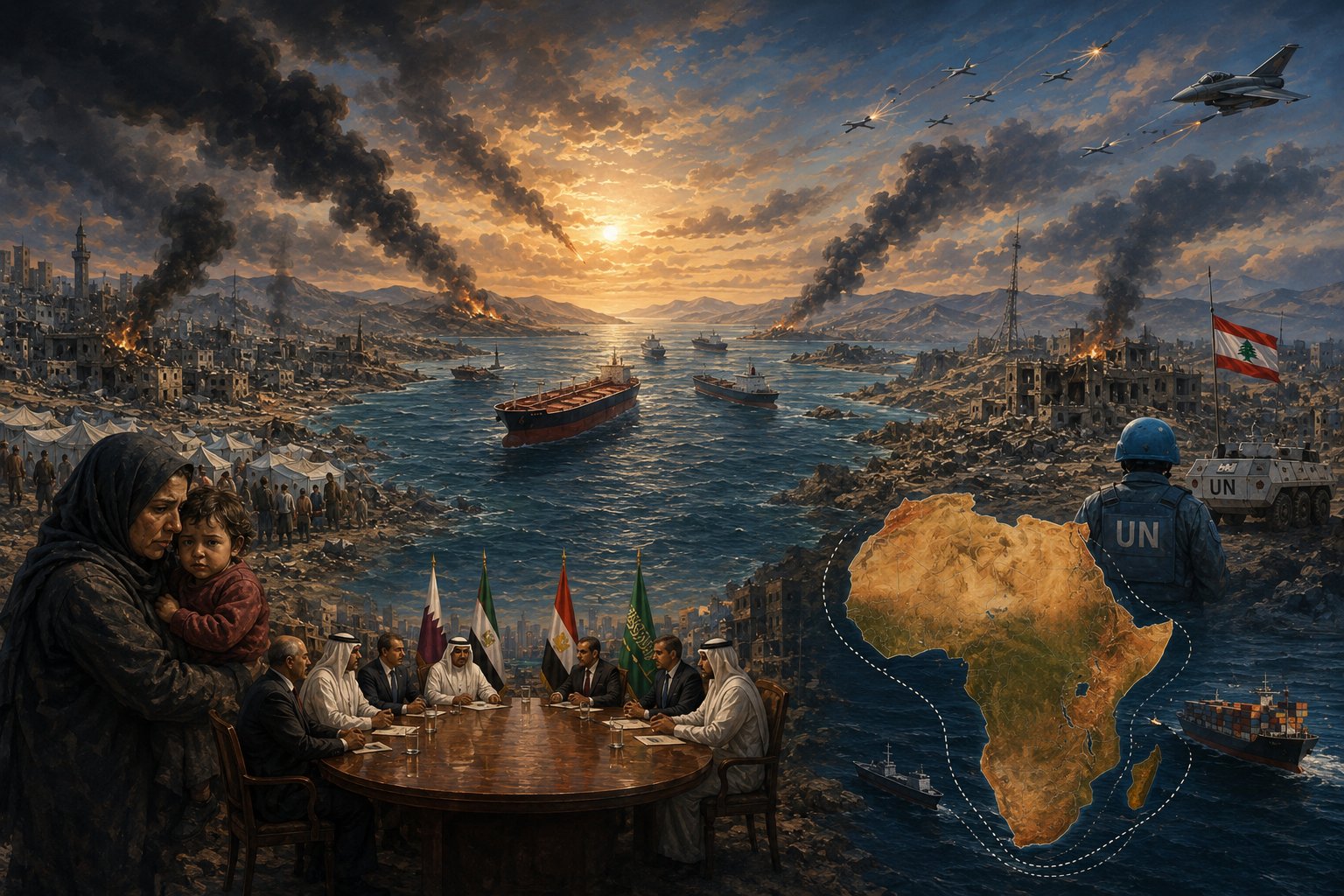
The central analytical judgement is that West Asia is no longer balancing on the edge of an Iran–Israel war; it is living through an unstable pause after two rounds of direct interstate escalation layered on top of the Gaza war, the Israel–Hezbollah war, Syrian fragmentation, Iraqi militia activity, and Red Sea disruption. As of 22 May 2026, the region is defined by partial ceasefires without political settlement: Gaza is under a nominal ceasefire but not a true cessation of hostilities; Lebanon has an extended ceasefire but continuing strikes and exchanges; Syria and Iraq remain permissive spillover theatres; and the U.S.–Israeli/Iran ceasefire is fragile, with public threats of renewed attacks within days if negotiations fail. [1]
Israel’s current official line is maximalist across all fronts: Hezbollah must be disarmed; Gaza must be demilitarised and Hamas disarmed; Israel intends to preserve deep security belts on multiple borders; and Prime Minister Netanyahu has said the Iran war cannot be considered over until Iran’s enriched uranium is removed, proxy support ends, and ballistic-missile capabilities are eliminated. Iran’s current official line is equally hard: the war must end on all fronts, guarantees against renewed attacks must be credible, sanctions and blockades must be lifted, Iran’s enriched uranium should remain in-country, and any renewed attack will trigger broader retaliation. Those positions are not close enough to support a durable peace; they support only coercive bargaining under threat of renewed violence. [2]
The most likely path over the next one to six months is neither comprehensive settlement nor immediate all-out regional war, but an extended period of violent bargaining: rolling ceasefires, selective assassinations, militia attacks, airstrikes, maritime coercion around Hormuz, and periodic crises in Lebanon and Gaza. The best case is a narrow diplomatic stabilisation built around an interim U.S./Iran arrangement, a continued Lebanon truce, and modest improvements in Gaza aid access. The worst case is a second, broader round of direct war involving renewed Israeli and possibly U.S. strikes on Iran, Iranian missile salvos, full Hezbollah re-entry, Iraqi militia attacks on Gulf energy sites and Western bases, and renewed Houthi-style mass disruption in the Red Sea. These scenario judgements are analytic inferences drawn from present red lines, ceasefire fragility, and observed proxy activity. [3]
For Africa, the largest near-term risks are not military contagion in the Levant itself but second-order shocks through shipping, fuel, inflation, remittances, and diplomacy. Egypt is the most exposed large African state because it combines Gaza adjacency, Suez dependence, energy import pressures, and Gulf-linked remittance exposure. Among sub-Saharan importers, Kenya, Tanzania, Ghana, Malawi, Mauritania, and others have already seen visible fuel-price shocks; Morocco has already registered transport-cost inflation from the conflict; Somalia is highly exposed through remittance dependence and Red Sea migration/security channels; and African troop contributors to UNIFIL, though limited in number, face real force-protection risk if Lebanon relapses into war. [4]
Current strategic picture
The current regional picture is best understood as a multi-front coercive equilibrium. Israel is trying to convert battlefield gains in Gaza, southern Lebanon, and the Syrian borderlands into enduring security depth; Iran is trying to convert survival, residual missile leverage, Hormuz disruption, and proxy deterrence into a settlement that preserves regime security and at least some nuclear and regional bargaining assets. Between them sit fragile Arab mediators, damaged proxy networks, and states such as Lebanon, Iraq, and Syria whose sovereignty is increasingly shaped by war spillover rather than by stable internal control. [5]
A key change since 2023 is that the old “shadow war” frame is no longer adequate. The conflict has evolved from proxy harassment and covert operations into repeated direct exchange: Iran’s direct missile-drone attack on Israel in April 2024; Israel’s retaliatory strike on Iranian soil days later; Israel’s June 2025 campaign against Iranian nuclear and military targets; and the much larger U.S.–Israeli war with Iran beginning on 28 February 2026. The present question is therefore not whether Iran and Israel can fall into direct war, but whether the present pause becomes a restrained deterrent balance or collapses into a second, wider round. [6]
Recent official positions
| Actor | Current official position | Analytical reading | Evidence |
| Israel | Netanyahu has said the Lebanon talks rest on two demands: Hezbollah disarmament and a sustainable peace agreement. He has also said Gaza must be demilitarised and Hamas disarmed, and has highlighted “deep security buffer zones” on multiple fronts. Reuters additionally reports Netanyahu’s position that the Iran war is not over until enriched uranium is removed from Iran, proxy support ends, and ballistic-missile capabilities are eliminated. | Israel’s current policy is not limited deterrence; it seeks structural rollback of hostile armed actors and durable security belts, making ceasefires instrumental rather than final. | [7] |
| Iran | Iran’s Supreme Leader has directed that highly enriched uranium remain in Iran. Tehran says its priority is a permanent end of hostilities, guarantees against renewed attack, compensation, and sanctions relief; Foreign Minister Araghchi warns that a resumed war would bring “many more surprises”; the IRGC warns renewed attacks would expand war “beyond the region”. | Iran is signalling readiness to negotiate, but only from a position that preserves core sovereignty claims and some strategic leverage, especially on uranium and maritime access. | [8] |
| Lebanon | President Joseph Aoun says the ceasefire should become “permanent agreements” that preserve rights, sovereignty and territory; his stated aims include ending Israeli attacks and securing Israeli withdrawal. | Beirut wants de-escalation and state sovereignty, but its leverage is limited by Hezbollah’s independent posture and Israel’s military pressure. | [9] |
| Qatar and partner mediators | Qatar has insisted on full implementation of the Gaza ceasefire and opening crossings for sustainable aid. Qatar and Türkiye have warned against renewed regional military escalation and backed Pakistan-led Iran ceasefire efforts; a joint statement by Qatar, Egypt, Jordan, the UAE, Indonesia, Pakistan, Türkiye and Saudi Arabia condemned repeated Israeli violations of the Gaza ceasefire. | Mediators are trying to keep the conflict compartmentalised, but they do not yet have formulas that reconcile Israeli demands for disarmament with Iranian, Hamas, or Hezbollah red lines. | [10] |
| Iraq | Iraqi officials have stressed that weapons should be restricted to state control, and Baghdad has publicly signalled that neighbouring states’ security is a red line and that violators will face legal or military consequences. | Iraq is trying to avoid becoming the forward operating ground for Iranian retaliation, but the state still lacks full coercive control over all armed factions. | [11] |
| UAE and Gulf states | UAE presidential adviser Anwar Gargash says chances of a U.S.–Iran deal are only “50-50” and warns that a ceasefire without a political solution invites renewed conflict. Saudi Arabia and the UAE were also drawn into direct defensive and retaliatory action during the 2026 war. | Gulf states now have a direct stake in preventing renewed war, but they are no longer mere bystanders; they are potential co-belligerents if infrastructure is hit again. | [12] |
Escalation timeline since 2023
The timeline below condenses the events that moved the regional system from a Gaza-centred war to a multi-front confrontation involving Lebanon, Syria, Iraq, the Red Sea, and direct Iran–Israel war. The key pattern is cumulative: each theatre repeatedly fed the next, and each pause proved narrower than the previous one. [13]
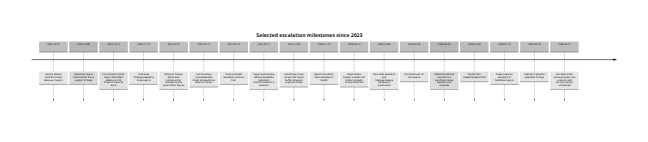
Two features of this timeline matter most for forward assessment. First, escalation has repeatedly jumped theatres: Gaza triggered Lebanon; Lebanon and Syria provided routes and targets for Iran-linked actors; the Damascus strike triggered Iran’s first direct attack; Iran war then re-energised the Lebanon and Gulf fronts. Second, the system now has serial ceasefires without agreed end states, which is why resumption risk remains high even when headline violence falls. [14]
Ceasefires, violations and indicators of renewed fighting
Current status by theatre
| Theatre | Formal status | What is happening in practice | Main indicators of renewed escalation | Near-term judgement |
| Gaza | The October 2025 ceasefire framework remains nominally in force. Qatar still calls for its full implementation and open crossings. | Reuters reports implementation has stalled; Israel keeps troops in roughly 60% of Gaza; Hamas refuses disarmament; high-profile targeted killings continue; aid remains constrained. OCHA reports only 296 of 683 health service points operational as of 25 April and continuing severe humanitarian strain. | Continued Israeli precision strikes; Hamas refusal to disarm; reconstruction funding gap; limited aid and movement; possible further killings of senior Hamas figures. | High probability of continued “ceasefire under fire”, with a medium probability of broader resumption in the next 30–90 days. [15] |
| Lebanon | A U.S.-brokered cessation that began on 16 April 2026 was extended 45 days on 15 May. | Hostilities have dropped from wartime peaks but have not stopped. Reuters says Israel and Lebanon agreed the extension, yet further meetings are needed; Reuters and AP report ongoing Israeli airstrikes, Hezbollah attacks, about 3,000 Lebanese deaths, and roughly 1.2 million displaced during the war. Hezbollah has called the ceasefire “meaningless” while Israeli strikes continue. | Israeli insistence on Hezbollah disarmament; Hezbollah rejection of direct talks; Israeli security zone in south Lebanon; recurring strikes within hours or days of ceasefire extensions. | Very high risk of renewed heavy combat if diplomacy stalls or Iran talks collapse. [16] |
| Syria | No new comprehensive Israel–Syria settlement; the old UNDOF framework still exists, but the strategic environment has changed after Assad’s fall. | After Assad’s ouster in December 2024, Israel moved into the buffer zone and carried out extensive strikes on Syrian strategic assets. UN reporting says spillover from the 2026 regional war has eased somewhat since the Iran ceasefire, but Syria’s transition remains volatile and exposed to external pressure. | Israeli military presence near and beyond the former buffer lines; internal Syrian transition fragility; local communal flashpoints; reduced U.S. presence; re-entry attempts by militias or jihadist actors. | Medium-high risk of episodic escalation, especially if Lebanon or Iran reignites. [17] |
| Iraq | No ceasefire framework binding all armed actors. | Iraqi territory remains a spillover platform. Reuters reports Iraq-based militias were initially muted and divided during the war, but attacks have still come from Iraqi territory against Gulf targets; Saudi strikes on militia sites in Iraq and attacks on Kurdish oilfields show that Iraq is both a launchpad and a target. | Further drone/missile launches by Iran-backed factions; Gulf retaliation; weak state control over PMF-linked actors; attacks on oil and logistics infrastructure. | Medium-high risk of escalation by proxy, especially if direct U.S./Israel–Iran fighting resumes. [18] |
| Iran–Israel direct front | The early-April ceasefire is still formally in place, but both sides openly treat it as reversible. | Reuters reports “some good signs” in talks, but the key gaps remain Iran’s uranium stockpile and Tehran’s control of the Strait of Hormuz. Trump has repeatedly said strikes could resume within days; Iran has warned of broader retaliation and refuses to send enriched uranium abroad. | Collapse of talks over uranium, Hormuz, proxy rollback or sanctions; further U.S./Israeli military preparations; Iranian perception that diplomacy is a cover for renewed strikes. | High risk of crisis recurrence; the most dangerous single escalator in the region. [19] |
Taken together, these ceasefires are operational pauses, not stable political settlements. None of the core disputes has been resolved: Hamas’s future, Hezbollah’s weapons, Israel’s buffer zones, Iran’s uranium stockpile, Hormuz’s status, or Iraq’s militia question. That is why incident rates can fall temporarily without materially reducing strategic risk. [20]
Scenarios for a wider Iran–Israel war
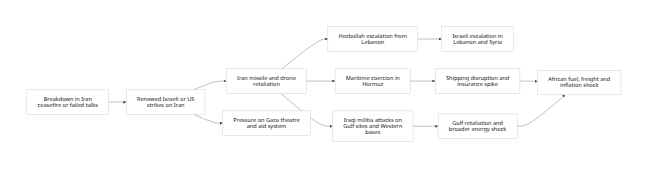
The most useful way to think about “wider Iran–Israel war” now is as a renewed direct phase that reactivates multiple fronts simultaneously. The pathway diagram below summarises the main contagion routes suggested by current activity in Lebanon, Iraq, the Gulf and the Red Sea. [21]
Actor and capability matrix
| Actor | Current capability picture | Main strengths | Main constraints |
| Israel | Retains regional air superiority, strong intelligence reach, layered missile defence, and a demonstrated willingness to sustain buffer zones in Gaza, Lebanon and Syria. Its June 2025 campaign reportedly hit more than 900 Iranian sites and killed over 30 senior Iranian security figures. | Precision strike capability; intelligence penetration; ability to escalate across several fronts; operational depth with U.S. backing. | International isolation costs; force strain across multiple theatres; dependence on U.S. political and military support for the deepest Iran option. [22] |
| Iran | Despite war damage, Iran retains missile-drone strike capacity, maritime leverage in Hormuz, some uranium stock, and surviving proxy links. Reuters reports the IAEA believes slightly more than 200 kg of 60%-enriched uranium may remain at Isfahan, with some also at Natanz. | Retaliatory missile-drone salvos; coercive leverage over Hormuz; ability to activate partners in Lebanon, Iraq and Yemen. | Damaged military infrastructure; economic pressure; uncertain surviving nuclear inventory; risk of provoking a larger coalition response. [23] |
| Hezbollah | Still able to strike Israel with drones and missiles and to resist disarmament politically and militarily, but heavily degraded by attrition and diplomacy that increasingly treats its disarmament as a precondition. | Remaining rocket/drone arsenal; entrenched local presence; deterrent value for Iran. | Israeli attrition; Lebanese political pressure; exclusion from state-led talks; risk of national backlash if it triggers wider war. [24] |
| Iraqi Iran-backed militias | Capability persists, including drone and missile launches from Iraqi territory, but Reuters reports many groups have been muted, divided, and reluctant to join full war. | Geographic reach into Gulf and Levant theatres; deniability; links to PMF structures. | Fragmentation; Iraqi state pressure; exposure to Gulf and possibly U.S./Israeli strikes; limited appetite for open war. [25] |
| Houthis and Red Sea axis | The Red Sea front demonstrated durable disruptive capacity from late 2023 onward. Even after partial easing, major shipping lines were cautious in returning. | Ability to impose shipping and insurance costs disproportionate to force size; strategic link to Gaza and Iran crises. | Vulnerable to sustained counterstrikes; dependent on wider war narrative for political legitimacy of renewed attacks. [26] |
| Lebanon, Iraq, Syria states | All three states seek de-escalation and sovereign control, but each has limited ability to fully suppress armed non-state actors or foreign military action on its soil. | Diplomatic channels; legitimacy in negotiations; desire for reconstruction and relief. | Weak coercive monopoly; external intervention; domestic fragmentation. [27] |
Scenario matrix
| Scenario | Likely triggers | Main actors | Indicative timeline | Judgement |
| Best case | Pakistan/Qatar-backed talks lock in an interim U.S.–Iran arrangement; some formula is found on uranium handling under IAEA oversight; Hormuz is reopened without tolling; Lebanon’s ceasefire extension yields workable security arrangements; Gaza aid access improves and high-visibility killings decrease. | U.S., Iran, Israel, Pakistan, Qatar, Egypt, Lebanon, Board of Peace. | Two to twelve weeks for an interim diplomatic stabilisation; three to six months for visible de-escalatory effects. | Possible, but not the base case, because current Israeli and Iranian red lines remain far apart on uranium, proxies and demilitarisation. [28] |
| Most likely | Talks continue, but no final settlement is reached; Israel maintains buffer zones and selective strikes; Gaza and Lebanon remain under violated ceasefires; Iraqi and maritime incidents recur episodically; markets stay volatile. | Israel, Iran, Hezbollah, Hamas, Iraqi militias, Gulf states, mediators. | Immediate to six months. | This is the highest-probability path: unstable partial ceasefires, coercive diplomacy, and contained but chronic escalation. It fits both the present battlefield pattern and current official rhetoric. [29] |
| Worst case | A breakdown over enriched uranium, Hormuz, or renewed Israeli/U.S. strike planning; an Iranian missile salvo causes significant Israeli casualties; Hezbollah opens a larger northern front; Iraqi militias strike Gulf energy or nuclear sites; maritime disruption expands sharply. | Israel, Iran, U.S., Hezbollah, Iraqi militias, Houthis, Saudi Arabia, UAE. | Hours to thirty days after trigger. | Lower probability than the middle scenario, but still materially plausible because official threats are explicit, force posture remains active, and several proxy pathways have already been tested in 2026. [30] |
My overall probability judgement is therefore: best case low-to-medium, most likely high, worst case low but dangerous enough to dominate contingency planning. That judgement is an inference, but it is tightly grounded in the present mismatch between political objectives and the repeated failure of ceasefires to convert into durable settlement. [31]
Global implications and Africa
The global strategic stakes are unusually concentrated around two chokepoints. The Strait of Hormuz carried about 20 million barrels per day in 2024, roughly 20% of global petroleum liquids consumption, and around one-fifth of global LNG trade. Meanwhile, the Red Sea/Suez system remains fragile after the shipping disruptions that began in late 2023. By January 2024, UNCTAD said monthly Suez transits were down 49% from peak levels, and the World Bank later found that by October 2024 rerouted cargo and tankers were travelling 48% and 38% farther, respectively, with global supply-chain stress rising to 2.3 million TEUs in December 2024. That means a renewed Iran-centred war would strike both the Gulf energy artery and the Red Sea/Suez trade corridor at once. [32]
That risk is already visible in prices and diplomacy. Reuters reported Brent crude spiking above $126 a barrel on 30 April 2026 as the Iran war deepened, while Qatar, Türkiye and the UAE all warned that renewed fighting would threaten global security, energy markets and freedom of navigation. Reuters has also estimated that the war has already imposed at least $25 billion in corporate costs globally, even before any second round. [33]
Africa impact assessment
Africa’s exposure is highly uneven. Net oil importers face the sharpest near-term pain through fuel, transport, inflation and current-account pressure. Egypt is the single most exposed major African state because it combines direct adjacency to Gaza, reliance on Suez revenues, higher energy import costs, and substantial remittance dependence linked to Gulf labour markets. Some oil exporters, notably Nigeria, may receive a short-run revenue lift, but even there the net benefit is limited by inflation, market volatility and slower global growth. The IMF and Reuters both caution that energy importers have the least room to absorb the shock, while even exporters may not gain in net terms. [34]
| African exposure | Why it is vulnerable | Quantified effects or indicators | Assessment |
| Egypt | Gaza border exposure, Suez dependence, energy imports, Gulf-linked remittances. | Reuters says regional tensions cost Egypt about $7 billion in Suez revenues in 2024, with canal revenues down more than 60% versus 2023. In July 2024–March 2025, Suez revenue fell to $2.6 billion from $5.8 billion, while oil imports rose to $14.5 billion from $9.7 billion; remittances in the same period rose to $26.4 billion. Gulf Migration research says Egypt’s remittances are about 6% of GDP and originate primarily in the GCC. | Very high vulnerability. A renewed dual shock through Suez and Gulf labour markets would hit FX, growth and fiscal space at once. [35] |
| Kenya | Heavy fuel-import sensitivity and rapid domestic pass-through into transport costs and politics. | Reuters says diesel was hiked 23.5% to 242.92 KES/litre in the May–June cycle; protests and a transport strike left four dead and about 30 injured; the state spent at least 28.1 billion KES to suppress fuel-price increases between April and June. | High vulnerability. Kenya is a strong example of how Iran/Gulf shocks can translate quickly into African domestic instability. [36] |
| Tanzania | Import dependence with visible pump-price pass-through. | Reuters reports Dar es Salaam petrol and diesel price caps rose 33% in April 2026 to 3,820 and 3,802 Tanzanian shillings per litre. | High vulnerability. [37] |
| Ghana | Still imports most refined fuel; monetary/economic recovery is vulnerable to higher oil. | Reuters reports petrol up about 15% to 13.30 cedis/litre, diesel up about 19% to 17.10 cedis; Ghana imports about 70% of its refined fuel. Reuters also says the wider oil shock is likely to halt monetary easing. | High vulnerability. [38] |
| Malawi | Extreme import dependence and weak shock absorbers. | Reuters reports petrol up 34% and diesel up 35% in April 2026, after even steeper free-on-board increases earlier in the year. | Very high vulnerability. [37] |
| Morocco | Indirect but visible inflation pass-through via fuel and transport. | Reuters says annual inflation rose to 1.7% in April 2026 from 0.9% in March; transport prices rose 8.4% due to fuel increases; Rabat plans 20 billion dirhams in additional 2026 budget support. | Medium-high vulnerability. [39] |
| Somalia | Remittance dependence and Red Sea/Horn migration-security exposure. | World Bank analysis says remittances were 16.7% of GDP in 2022. A Gulf slowdown or payment disruption would therefore hit household consumption quickly. Precise up-to-date GCC source shares are not consistently published. | High vulnerability, especially socially and humanitarianly. [40] |
| Djibouti and Red Sea littoral states | Exposure to Bab el-Mandeb insecurity, rerouted shipping patterns, and migrant flows from Yemen. | By end-2024, the World Bank says traffic through the Suez/Bab el-Mandeb system had collapsed sharply and Red Sea rerouting had materially lengthened voyages. A precise, recent country-level port revenue series for Djibouti was not located in the research window. | High strategic exposure, but data gaps remain. [41] |
| Nigeria, Angola, Algeria | Higher oil prices give some fiscal upside, but global slowdown and inflation offset part of the gain. | Reuters says S&P views Nigeria as less exposed than most regional peers because it is a sizeable net crude exporter with rising domestic refining capacity, yet inflation has already turned up again because of higher fuel and food costs. Reuters and IMF analysis both warn that even exporters may not enjoy a net benefit. | Relative winners in fiscal terms, not strategic winners overall. [42] |
Two Africa-specific channels deserve special emphasis. First, the conflict worsens the economics of moving goods to and from Africa. The World Bank found that the South and East Africa/Indian Ocean region accounted for 4.8% of global supply-chain stress in the later phase of the Red Sea crisis, meaning that rerouting around the Cape is not a simple continental windfall; it raises logistics costs even when some southern ports or bunkering points gain traffic. Second, monetary policy becomes harder almost everywhere: Reuters reports African central bankers and analysts warning that oil turbulence could halt easing cycles in Kenya, Ghana, Zambia and Nigeria, while Uganda and Angola were already reacting more cautiously. [43]
Peacekeeping is a smaller but still concrete African exposure. UNIFIL had 7,478 peacekeepers from 47 troop-contributing countries as of 1 May 2026. The February 2026 UN peacekeeping roster shows African contributions in UNIFIL from Tanzania (76 personnel), Kenya (2) and Zambia (2), while Zambia also had 3 personnel in UNDOF. Violence against peacekeepers in Lebanon in March–April 2026 — which Reuters says included deaths from fire linked preliminarily to both Israel and Hezbollah, plus a later attack likely by Hezbollah — demonstrates that a renewed Lebanon war would carry direct force-protection risks for troop contributors, even if current African numbers are modest. [44]
Uncertainties and assumptions
Several important uncertainties remain. Battlefield damage assessment inside Iran is incomplete; Reuters notes uncertainty over how much of Iran’s 60%-enriched uranium stock survived the 2025 strikes, even though the IAEA believes a little over 200 kg may remain at Isfahan. Casualty figures across Gaza, southern Lebanon and Iran are politically contested and often published with delays. Syria’s internal transition remains fluid, and precise current balances between local actors, Israel, Türkiye, former regime networks and residual Iranian influence are harder to quantify than in Gaza or Lebanon. [45]
The scenario judgements in this report therefore rest on three explicit assumptions. The first is that the current public red lines stated by Israel, Iran and mediators are genuine negotiating positions rather than mere tactical noise. The second is that the present ceasefires are best understood as reversible coercive pauses, because they have not settled the core issues of disarmament, buffer zones, sovereignty, uranium, sanctions or maritime control. The third is that Africa’s main exposure remains economic and maritime, not direct combat spillover, unless Red Sea and Horn routes deteriorate much further. These assumptions are contestable, but at present they are the most defensible reading of the evidence. [46]
The bottom line is straightforward: the region is not on a stable path to peace, but neither is it yet locked into immediate total war. The highest-confidence judgement is a prolonged phase of contested ceasefires and intermittent escalation — with the Iran front remaining the principal regional trigger, the Lebanon front the fastest military escalator, Iraq and the Gulf the most plausible routes for geographic widening, and Africa the most exposed external region through fuel, shipping, inflation and remittance channels rather than through direct combat. [47]
[1] [20] [29] https://www.reuters.com/world/middle-east/board-peace-envoy-warns-un-that-gaza-division-risks-becoming-permanent-2026-05-21/
[2] [7] [31] [46] https://www.gov.il/en/pages/pm-netanyahu-s-statement-on-lebanon-and-iran-16-apr-2026
[3] [19] [28] [47] https://www.reuters.com/world/asia-pacific/tehran-reviewing-latest-us-response-trump-suggests-he-can-wait-2026-05-21/
[4] [35] https://www.reuters.com/world/africa/regional-challenges-cost-egypt-around-7-bln-suez-canal-revenues-2024-sisi-says-2024-12-26/
[5] https://www.gov.il/en/pages/statement-from-pm-netanyahu-17-april-2026
[6] https://www.reuters.com/world/middle-east/iran-israels-open-warfare-after-decades-shadow-war-2024-04-14/
[8] [23] [45] https://www.reuters.com/world/asia-pacific/supreme-leader-says-enriched-uranium-must-stay-iran-iranian-sources-say-2026-05-21/
[9] [27] https://www.reuters.com/world/middle-east/lebanon-president-says-future-deal-will-not-cede-territory-2026-04-17/
[10] [15] https://mofa.gov.qa/en/qatar/latest-articles/latest-news/details/2026/05/18/qatar-deems-recognition-of-nakba-a-key-to-just–lasting-palestinian-peace
[11] https://ina.iq/en/politics/48637-national-security-adviser-says-weapons-control-file-will-be-highly-important-in-next-government-formation.html
[12] https://www.reuters.com/world/middle-east/uaes-gargash-sees-50-50-odds-us-iran-deal-warns-against-renewed-fighting-2026-05-22/
[13] [14] Israel-Lebanon border warfare: what is the history?
[16] [21] [24] https://www.reuters.com/world/middle-east/israel-lebanon-agree-extend-ceasefire-by-45-days-us-state-dept-says-2026-05-15/
[17] https://www.reuters.com/world/middle-east/israel-watching-syria-closely-after-historic-fall-assad-2024-12-08/
[18] [25] https://www.reuters.com/investigations/iran-spent-years-fostering-proxies-iraq-now-many-arent-eager-join-war-2026-03-06/
[22] https://www.reuters.com/business/aerospace-defense/israel-killed-30-iranian-security-chiefs-11-nuclear-scientists-israeli-official-2025-06-27/
[26] https://www.reuters.com/world/suez-canal-authority-says-stability-returning-red-sea-2025-01-31/
[30] https://www.reuters.com/world/asia-pacific/tankers-exit-hormuz-trump-vance-talk-up-iran-deal-prospects-2026-05-20/
[32] https://www.eia.gov/todayinenergy/detail.php?id=65504
[33] https://www.reuters.com/business/energy/oil-prices-extend-gains-us-iran-war-deadlock-keeps-supply-off-market-2026-04-30/
[34] https://www.imf.org/en/blogs/articles/2026/04/22/how-the-middle-east-war-has-affected-oil-exporters-and-importers
[36] https://www.reuters.com/world/africa/kenya-cut-diesel-price-after-protests-against-soaring-energy-costs-2026-05-22/
[37] [38] https://www.reuters.com/business/energy/fuel-prices-surge-africa-iran-war-hits-supply-2026-04-01/
[39] https://www.reuters.com/world/africa/moroccos-inflation-rate-rises-17-april-2026-05-22/
[40] https://blogs.worldbank.org/en/nasikiliza/empowering-somalias-economy-beyond-remittances-for-long-term-stability-afe-0225
[41] [43] https://documents1.worldbank.org/curated/en/099253002102539789/pdf/IDU10b8b59671dbc814cfc19c4a1299ff54854ba.pdf
[42] https://www.reuters.com/world/africa/sp-lifts-nigerias-ratings-improving-macroeconomic-profile-2026-05-15/
[44] https://unifil.unmissions.org/en/unifil-troop-contributing-countries