


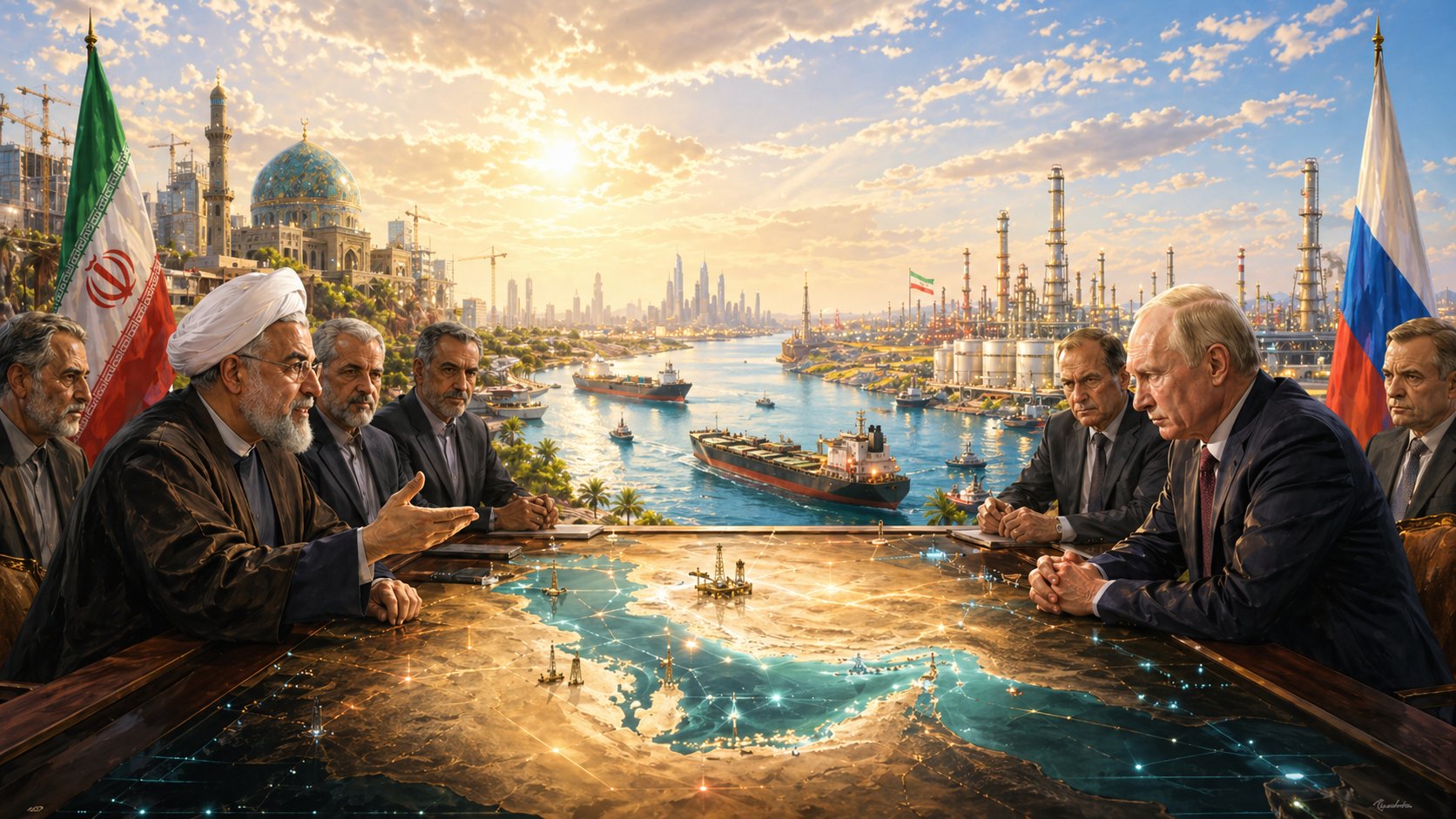
Russia has moved more openly into the diplomatic centre of the Iran crisis, after President Vladimir Putin met Iranian Foreign Minister Abbas Araqchi in St Petersburg amid stalled efforts to stabilise the Persian Gulf and reopen the Strait of Hormuz to normal commercial traffic.
The meeting has been seized upon by commentators as evidence of a major geopolitical shift: Iran, having survived the US-Israeli military campaign and retained leverage over one of the world’s most important energy corridors, is now seeking to convert battlefield resilience into diplomatic advantage. The central claim circulating on social media is that Tehran is no longer negotiating merely as a besieged state, but as a regional power setting terms with Russian backing.
Some of that framing remains political interpretation rather than confirmed fact. But the hard diplomatic signals are significant. Putin publicly praised Iran’s resistance to US and Israeli pressure and said Russia would do what it could to help Tehran. Araqchi, for his part, underlined the strategic nature of the Russia-Iran relationship, saying Moscow had consistently supported Iran. Putin also confirmed that he had received a message from Iran’s leadership shortly before the meeting. (RadioFreeEurope/RadioLiberty)
The talks came after Araqchi’s regional diplomacy through Pakistan and Oman, two states that have become important channels in efforts to manage the crisis. According to reports, the Iranian foreign minister blamed “excessive” US demands for the continuing deadlock, while also indicating that Tehran was reviewing new American proposals. That sequence suggests Iran is widening the negotiating table, ensuring that any settlement is no longer handled solely through Washington and its allies. (RadioFreeEurope/RadioLiberty)
At the heart of the standoff is the Strait of Hormuz. Before the war, between 125 and 140 ships normally moved in and out of the strait each day. That traffic has collapsed dramatically. Reuters reported that only seven vessels transited in a recent 24-hour period, with none carrying oil bound for the global market. The same report said the strait usually handles around 20% of the world’s daily oil and LNG supply, making its disruption a direct threat to global energy markets. (Reuters)
Iran has imposed restrictions on shipping through the strait, while the United States announced a blockade of Iran-related shipping on April 13. US forces have reportedly turned back dozens of vessels since then. This creates a dangerous dual-control situation: Iran can complicate maritime passage, while the United States can obstruct Iran-linked traffic. The result is not peace, but a tense, controlled paralysis in which both sides are using shipping as leverage. (Reuters)
The maritime problem is not simply political. It is also technical and commercial. Al Jazeera reported that Pentagon officials told US lawmakers it could take months to fully clear the Strait of Hormuz of mines, and maritime insurers warned that even a ceasefire may not be enough to restore normal traffic if the risk cannot be priced with confidence. In other words, even if diplomats announce an agreement, the strait may remain only partially usable until shipowners, underwriters and naval authorities believe the route is reliably safe. (Al Jazeera)
This gives Iran lasting leverage. A formal ceasefire may end open hostilities, but the practical reopening of Hormuz depends on guarantees, inspection, naval coordination and insurance confidence. For Tehran, that means the strait becomes not only a military pressure point, but a bargaining instrument in any wider settlement.
Russia’s role is therefore important. Moscow is not merely expressing sympathy. It is positioning itself as a necessary interlocutor. Putin has raised the possibility of Russia helping to mediate, including around the nuclear dispute, which remains a major obstacle in US-Iran talks. Analysts cited by RFE/RL suggest Russia may try to use its access to Tehran to secure nuclear concessions acceptable to Washington, while also preserving Iran as a strategic partner. (RadioFreeEurope/RadioLiberty)
At the same time, defence diplomacy is moving in parallel. Russian Defence Minister Andrei Belousov held talks in Kyrgyzstan with Iran’s Deputy Defence Minister Reza Talaei-Nik, according to Reuters. Belousov repeated Moscow’s position that the Iran conflict should be resolved through diplomacy and said he expected Moscow and Tehran to continue supporting one another. Talaei-Nik also travelled to Belarus for talks on the Middle East situation. (Reuters)
The Kyrgyzstan setting matters because it sits within the Shanghai Cooperation Organisation framework, where Russia, China, Iran, Pakistan and India are all present. China’s defence minister Dong Jun also attended the SCO defence meeting and called for deeper defence and security cooperation among member states. Reuters reported that Dong held sideline talks with officials from Iran, Russia, Pakistan and Belarus. (Reuters)
This points to the wider strategic picture. Iran is not only relying on missiles, ports or the Strait of Hormuz. It is embedding itself in Eurasian structures: the SCO, Russian-backed security channels, trade corridors through Pakistan and Central Asia, and the wider North-South and East-West transport logic linking Russia, Iran, India and China. The more these routes develop, the less decisive Western maritime pressure becomes.
The social-media claim that “Iran won the war” is a political judgement, not a settled historical fact. What can be said with more confidence is that Iran has not been isolated in the way Washington may have intended. Instead, the crisis has accelerated the visibility of a Russia-Iran alignment and brought Eurasian powers more directly into the Persian Gulf equation.
The emerging settlement, if one is reached, will therefore not be a simple US-Iran bargain. It will likely involve maritime guarantees, nuclear sequencing, sanctions questions, Russian mediation, Gulf security arrangements and the practical reopening of Hormuz. That is the real chessboard now taking shape: not a single battlefield victory, but a contested diplomatic order in which Iran is trying to convert survival into strategic influence, with Russia standing visibly beside it.