


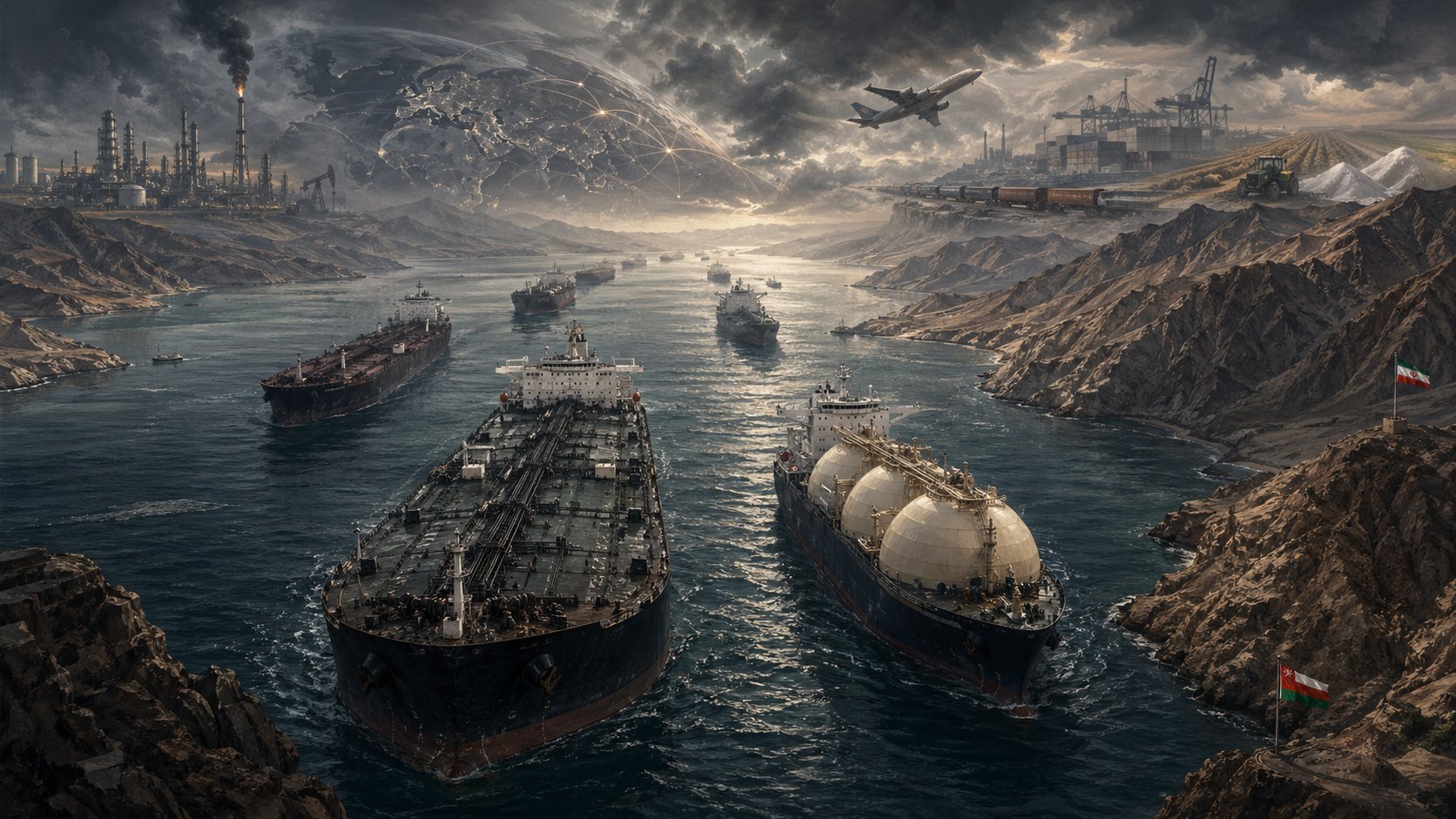
The Strait of Hormuz is once again reminding the world that geography is not background scenery. It is infrastructure. It is leverage. And in moments of conflict, it can become a weapon more powerful than any single missile, sanction or diplomatic statement.
The narrow waterway between the Persian Gulf and the Gulf of Oman is only around 21 miles, or 34 kilometres, wide at its narrowest point. Yet it carries a level of strategic weight almost impossible to exaggerate. The International Energy Agency describes it as a route through which around 20 million barrels of oil per day normally pass, equal to roughly a quarter of global seaborne oil trade, with around 80% of that crude destined for Asia. It also carries a major share of global liquefied natural gas, including most LNG exports from Qatar and the UAE. (IEA)
That makes Hormuz more than a regional maritime passage. It is a global economic organ. When it is obstructed, the effects do not remain in West Asia. They move into petrol prices in Europe, fertilizer costs in Africa, factory inputs in Asia, airline schedules, food prices, inflation figures and household budgets.
Recent reports suggest traffic through the strait remains severely reduced, with Reuters reporting that daily transits have fallen from a normal range of around 125–140 vessels to only a handful in recent days. Oil prices have responded accordingly, with Brent crude reported around $108.68 per barrel and WTI near $96.96 as markets absorb the continuing disruption. (Reuters)
The immediate story is energy. But the deeper story is dependency.
Hormuz is often described as an oil chokepoint, but that understates the issue. Oil is the most visible commodity, but it is not the only one. The strait is also central to LNG flows, petrochemicals, plastics, fertilizer inputs, sulfur, aluminum-related supply chains and other industrial materials. Many of these are not easily rerouted. Pipelines can shift some crude flows, but they cannot replace the maritime movement of ammonia, urea or other bulk inputs needed by agriculture and industry.
That matters because fertilizer is food before it becomes a commodity. Nitrogen fertilizers support a large share of modern agricultural output. If key inputs fail to arrive during planting or application windows, the consequences are delayed but severe: lower yields, higher prices and pressure on already vulnerable food-importing countries.
For import-dependent economies, especially in parts of Africa, South Asia and Latin America, the Hormuz crisis is therefore not just about the cost of fuel. It is about whether fertilizer arrives on time, whether food imports remain affordable and whether governments can absorb another external price shock. Brazil, India, Pakistan, Bangladesh and many African countries are especially exposed to fertilizer disruptions because their agricultural systems rely heavily on imported inputs.
Europe is also feeling the shock, particularly in aviation and industry. The head of the International Energy Agency warned in mid-April that Europe had “maybe six weeks” of jet fuel left if supplies remained blocked, with flight cancellations possible if the situation did not improve. (AP News) Lufthansa has already announced cuts to around 20,000 short-haul flights through October, citing soaring jet fuel costs and the need to save fuel. (Al Jazeera)
The aviation impact is only one visible symptom. Higher oil and gas prices feed through refineries, trucking, shipping, chemicals, plastics, construction materials and consumer goods. Energy inflation rarely stays in one sector. It spreads.
This is why the closure or near-closure of Hormuz has the character of a global stress test. It exposes how much of the world economy has been built on the assumption that a few narrow maritime corridors will remain open, insured and navigable. Once insurers withdraw war-risk cover, shipping becomes not merely dangerous but commercially impossible. No insurance means fewer vessels. Fewer vessels mean fewer cargoes. Fewer cargoes mean shortages, price spikes and production delays.
There are signs of limited movement. Reuters reported that an ADNOC-managed LNG tanker recently crossed the strait, appearing off India after weeks without transmitting a signal. But analysts cautioned that one successful crossing does not prove that the route is safe or commercially reliable. (Reuters) That distinction is crucial. A chokepoint does not need to be sealed with concrete to damage the world economy. It only has to become uncertain enough for shipping, insurance and finance to hesitate.
The crisis also underlines a strategic irony. The Gulf states themselves are deeply vulnerable to disruption in the same waterway through which they export energy. Several depend heavily on imported food, consumer goods and industrial supplies. If Hormuz becomes unreliable for outgoing oil and gas, it also becomes unreliable for incoming food and essential materials.
For Asia, the stakes are direct. China, India, Japan, South Korea and other major economies depend on Gulf energy flows. If tanker traffic remains restricted, they face higher import bills, tighter supply and stronger competition for alternative cargoes. For Europe, the shock arrives through fuel, inflation and industrial costs. For the United States, even with larger domestic production, oil is priced globally. A disruption in Hormuz still reaches American petrol pumps.
Goldman Sachs has reportedly lifted its oil price expectations, warning that Brent could move toward $120 per barrel if Gulf exports recover slowly. (marketwatch.com) That is the market’s way of saying what policymakers often avoid saying plainly: the world has no simple replacement for Hormuz.
The most dangerous assumption is that this is only a temporary regional drama. The strait has always been strategic, but the modern economy has made it systemic. A disruption there does not merely interrupt trade. It tests the architecture of globalization itself: just-in-time logistics, concentrated energy supply, specialized fertilizer production, global aviation, food security and inflation management.
The world is discovering that resilience is not the same as efficiency. For decades, economies optimized for low cost, speed and concentration. Hormuz shows the price of that model. A single corridor can connect refineries, farms, hospitals, airports, factories and households across continents. When it closes, the map of dependency becomes visible.
That is the real lesson of the Strait of Hormuz. It is not simply a strip of water between Iran and Oman. It is a global pressure point where energy security, food security, industrial production and geopolitics meet.
And right now, that pressure point is under strain.