


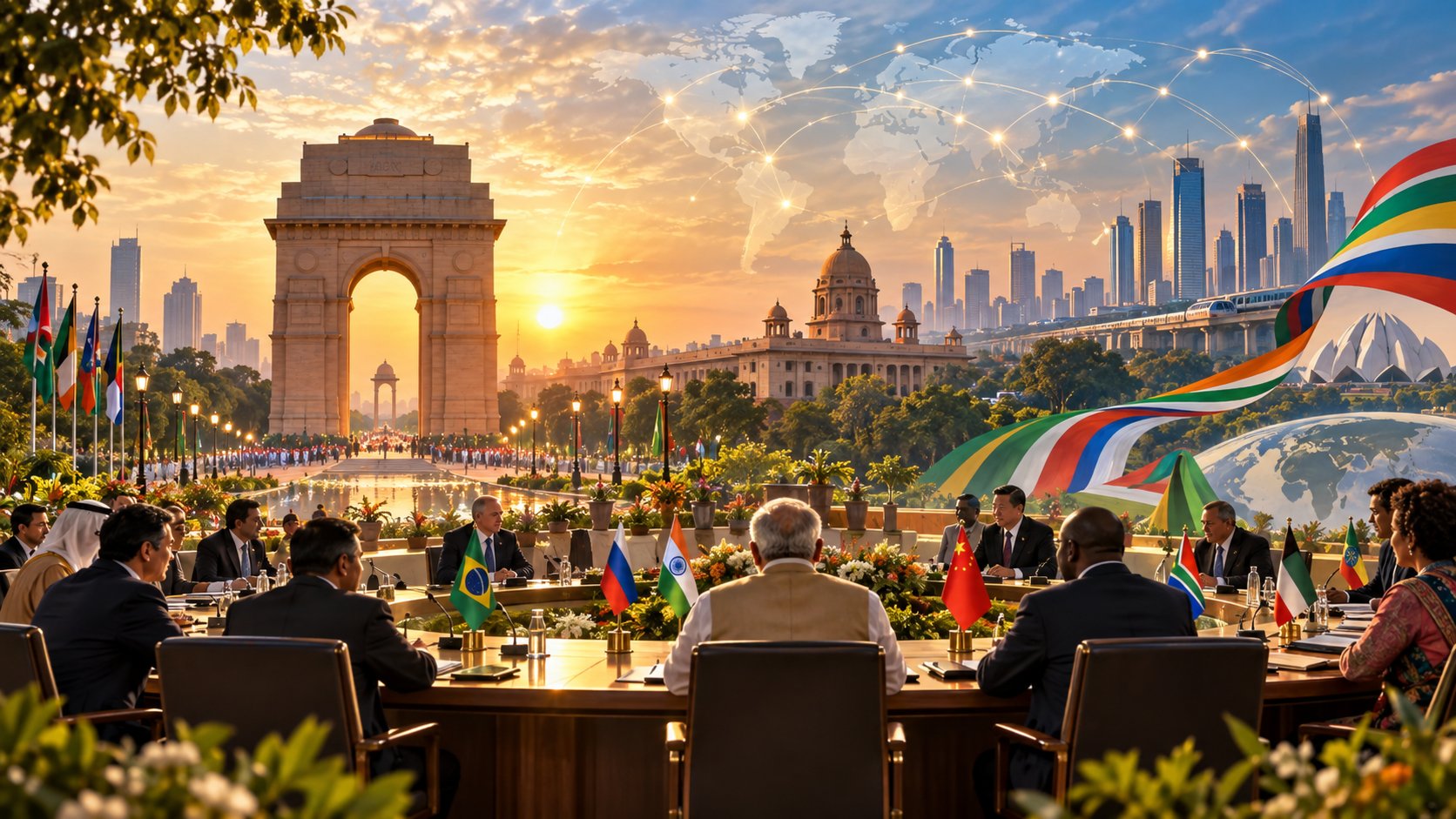
The New Delhi Declaration, adopted at the XVIII BRICS Summit in India on 12–13 September 2026, presents an increasingly ambitious BRICS agenda. Its central message is that the international political and economic system should be more representative of emerging and developing countries, while BRICS itself should become a stronger platform for economic cooperation, development finance, technology, trade, security and political coordination.
Although the Declaration contains 140 paragraphs covering almost every major area of international cooperation, several themes stand out as particularly important. (Link to complete document at the foot of the page.)
1. BRICS wants a larger role for the Global South in global governance
The strongest political theme running through the Declaration is the demand for reform of the institutions created largely after the Second World War.
BRICS argues that the present international system does not adequately reflect the economic and political weight of emerging markets and developing countries.
It therefore calls for greater representation of developing countries — particularly from Africa, Asia, Latin America and the Caribbean — within the United Nations, International Monetary Fund, World Bank and other international organisations.
Reform of the UN Security Council remains a central objective. China and Russia again support the aspirations of Brazil and India to play a greater role within the UN, including the Security Council, while BRICS also recognises African demands for increased representation.
The group similarly wants changes to IMF quotas and World Bank shareholding so that voting power more closely reflects the present-day world economy.
This is arguably the most important underlying message of the Declaration: BRICS is positioning itself as an organised political and economic voice for the Global South rather than simply as a grouping of large emerging economies.
2. BRICS is not rejecting multilateralism — it wants to reshape it
Despite frequent portrayals of BRICS as an alternative to the Western-led international system, the Declaration repeatedly supports the United Nations, WTO, IMF, World Bank, G20 and other multilateral institutions.
The difference is that BRICS wants those institutions reformed.
The Declaration repeatedly advocates a more multipolar international order, but simultaneously emphasises international law, the UN Charter and multilateral cooperation.
BRICS therefore appears to be pursuing reform from both directions:
strengthening its own institutions and cooperation mechanisms while simultaneously demanding greater influence within existing global institutions.
3. Trade protectionism, unilateral sanctions and tariffs are major concerns
BRICS strongly criticises the increasing use of tariffs, non-tariff barriers, economic sanctions and other unilateral measures.
The Declaration argues that such measures disrupt supply chains, increase uncertainty, damage developing economies and weaken the multilateral trading system.
It calls for a stronger World Trade Organization, including restoration of its fully functioning two-tier dispute settlement system.
BRICS also specifically opposes sanctions that have not been authorised by the UN Security Council where these are considered contrary to international law.
This position is likely to become increasingly important as trade tensions, industrial subsidies, sanctions and strategic competition reshape international commerce.
4. BRICS is slowly building its own financial architecture
One of the most significant practical developments concerns financial cooperation.
BRICS continues work on mechanisms that could make trade and investment between its members less dependent on existing international payment channels.
The Declaration highlights work by the BRICS Payment Task Force on cross-border payment systems and messaging networks. It also supports further discussion on settling trade and investment using BRICS members’ local currencies.
Importantly, the Declaration does not announce a BRICS common currency.
Instead, the emphasis is on practical interoperability between national payment systems, faster and cheaper cross-border transactions and greater use of local currencies.
Other initiatives include:
- strengthening the New Development Bank (NDB);
- expanding NDB local-currency financing;
- developing a New Investment Platform;
- strengthening the BRICS Contingent Reserve Arrangement;
- examining BRICS insurance and reinsurance capacity;
- developing multilateral guarantees to reduce the cost and risk of development projects;
- improving financing mechanisms for SMEs.
Taken together, these initiatives point towards the gradual construction of a more extensive BRICS financial ecosystem, rather than the sudden replacement of the existing global financial system.
5. The New Development Bank is becoming increasingly important
The Declaration gives considerable prominence to the New Development Bank.
BRICS wants the NDB to increase its ability to mobilise capital, finance infrastructure, provide more local-currency lending and support sustainable development across BRICS and the wider Global South.
Further enlargement of the Bank’s membership is encouraged.
The NDB therefore appears to be evolving into one of BRICS’ most important permanent institutions — particularly because it converts political cooperation into actual infrastructure and development financing.
6. Artificial intelligence and digital sovereignty have moved to the centre of the BRICS agenda
Technology is one of the most prominent areas of practical cooperation.
BRICS recognises artificial intelligence as a major economic and developmental opportunity, but calls for international governance that ensures AI is safe, inclusive, reliable and accessible, particularly to developing countries.
The members commit themselves to implementing the BRICS Leaders’ Statement on the Global Governance of Artificial Intelligence.
Other digital priorities include:
digital public infrastructure;
cybersecurity;
digital skills;
future telecommunications networks;
digital financial systems;
data security;
AI standards;
quantum technologies;
research collaboration;
and improved international digital connectivity.
BRICS is also considering the feasibility of improved submarine cable connectivity between member countries.
A recurring concept is the development of a more sovereign and self-reliant digital ecosystem. This suggests that technological independence and control over critical digital infrastructure are increasingly being treated as strategic issues rather than simply economic ones.
7. Energy policy remains deliberately pragmatic
The Declaration takes a noticeably pragmatic position on energy.
BRICS supports decarbonisation and the Paris Agreement but explicitly states that fossil fuels will continue to play an important role, particularly in emerging and developing economies.
Rather than prescribing one energy model, BRICS supports diversified national energy systems incorporating combinations of:
renewables, fossil fuels, nuclear energy, hydropower, hydrogen, bioenergy, energy storage and other low-carbon technologies.
The emphasis is on a “just, orderly, equitable and inclusive” energy transition that takes national circumstances into account.
Energy security receives considerable attention, particularly the resilience of infrastructure and international energy supply chains.
The Declaration also identifies critical minerals as strategically important and argues that resource-rich countries should receive greater value from their mineral resources through local value addition and economic diversification.
8. Climate action is supported — but climate protectionism is opposed
BRICS reaffirms its commitment to the Paris Agreement and acknowledges the increasing impact of climate change, especially on developing economies.
However, the Declaration insists that developed countries must provide substantially greater climate finance, technology transfer and capacity-building assistance.
Particular emphasis is placed on adaptation, climate-resilient infrastructure and community-based solutions.
The Declaration supports greater cooperation on carbon markets, ecosystem protection, forests, biodiversity, water, land restoration and disaster resilience.
At the same time, BRICS strongly objects to climate policies that it considers disguised trade protectionism.
It specifically criticises unilateral carbon border adjustment mechanisms and similar measures when they are regarded as discriminatory or inconsistent with international law.
The result is a distinct BRICS position: support for climate action, but opposition to climate rules that restrict developing-country trade or development.
9. Food security is becoming a strategic BRICS issue
Agricultural cooperation receives substantial attention.
One of the most significant proposals is continued development of a BRICS Grain Exchange, potentially later expanding into other agricultural products and commodities.
The intention is to improve food security, agricultural trade and resilience against supply disruptions and price volatility.
The Declaration also supports cooperation involving:
climate-resilient seeds;
food reserves;
regenerative agriculture;
agroecology;
digital agriculture;
fisheries;
fertilisers and agricultural inputs;
and protection of small-scale and family farmers.
Food security is therefore being treated increasingly as both an economic and strategic security issue.
10. BRICS takes strong positions on current international conflicts
The Declaration expresses considerable concern about rising geopolitical tension, military expenditure and nuclear risks, while repeatedly advocating diplomacy and negotiated settlements.
Gaza and Palestine
BRICS adopts a particularly strong position on Palestine.
It calls for maintenance of the Gaza ceasefire, unrestricted humanitarian access and an end to forced displacement.
The group supports a two-state solution, including an independent Palestinian state based on the internationally recognised 1967 borders, with East Jerusalem as its capital.
It supports full Palestinian membership of the United Nations.
The Declaration also references the International Court of Justice proceedings initiated by South Africa against Israel and the Court’s provisional measures concerning humanitarian assistance.
Lebanon
BRICS supports the ceasefire in Lebanon, calls for implementation of UN Security Council Resolution 1701 and demands respect for Lebanese sovereignty and territorial integrity.
Sudan
The group calls for an immediate permanent ceasefire and a negotiated solution, while warning of the rapidly worsening humanitarian situation.
Syria
BRICS supports Syrian sovereignty and territorial integrity, a Syrian-led political transition and eventual reconstruction, while also calling for action against terrorist organisations and foreign fighters.
Nuclear risks
The Declaration warns of increasing nuclear dangers and calls for renewed arms control, disarmament and non-proliferation efforts.
It also condemns attacks on civilian nuclear installations and facilities operating under International Atomic Energy Agency safeguards.
11. Security cooperation is expanding beyond conventional military issues
BRICS increasingly treats financial crime, cybercrime and digital fraud as international security issues.
The Declaration calls for deeper cooperation against:
terrorism;
money laundering;
terrorist financing;
illegal virtual-asset flows;
organised crime;
cross-border fraud;
human trafficking;
corruption;
drug trafficking;
cybercrime;
disinformation and malicious digital activity.
Particular attention is given to large cross-border digital scam networks and “scam compounds”, with stronger cooperation proposed between financial intelligence units, customs authorities, police, tax authorities, technology companies and financial regulators.
12. Industrial and technological cooperation is accelerating
BRICS wants developing countries to move into higher-value manufacturing and technology industries rather than remaining predominantly suppliers of raw materials.
Initiatives cover Industry 4.0, intelligent manufacturing, robotics, photovoltaic technology, AI, advanced manufacturing, chemicals, start-ups and SMEs.
A BRICS Incubator Network has been established and a possible BRICS Startup Innovation Fund is under consideration.
Research cooperation is also expanding through 14 science and technology working groups, joint research programmes, research infrastructure networks and cooperation in emerging technologies such as quantum science.
13. Infrastructure resilience is emerging as a major strategic theme
Infrastructure appears throughout the Declaration — energy systems, communications networks, cities, transport, water systems and digital infrastructure.
The common objective is resilience.
BRICS advocates stronger early-warning systems, climate-resilient infrastructure, disaster preparedness, public-private partnerships and improved infrastructure finance.
Transport cooperation includes railways, urban mobility, logistics, aviation and sustainable aviation fuels.
Cities receive particular attention, with cooperation proposed around housing, water, sanitation, waste management and sustainable urban transport.
14. Health cooperation has expanded substantially
BRICS is developing a broad health cooperation agenda spanning infectious diseases, pandemic preparedness, digital healthcare, medical regulation, vaccine research, mental health and traditional medicine.
Important initiatives include:
a BRICS Integrated Early Warning System for infectious diseases;
greater cooperation between medical-product regulators;
digital healthcare systems;
the BRICS Mission for Healthy Lifestyle;
mental-health Centres of Excellence;
cooperation on vaccine research;
and stronger public-health institutes.
The Declaration also identifies tuberculosis, antimicrobial resistance, obesity and non-communicable diseases as major priorities.
15. South Africa remains strategically important within the expanded BRICS
Several elements of the Declaration are particularly relevant to South Africa.
BRICS reiterates its commitment to increasing African representation in global institutions, including the UN Security Council.
It acknowledges South Africa and Brazil’s proposal for an international panel on inequality.
The Declaration also explicitly emphasises South Africa’s status as a founding and full member of the G20, arguing that changes to G20 membership should occur only through consensus.
South Africa’s International Court of Justice case concerning Gaza is also specifically referenced.
Africa therefore remains an important part of BRICS’ broader argument that the Global South requires greater influence over international governance.
The Big Picture
The New Delhi Declaration shows a BRICS that is becoming broader, more institutionalised and more ambitious.
It is no longer primarily an economic dialogue between several large emerging economies. It is gradually developing into a network covering finance, trade, payments, technology, AI, research, energy, agriculture, health, infrastructure, climate policy, security and international diplomacy.
However, the Declaration does not announce a revolutionary break with the existing international order.
There is no BRICS currency.
There is no BRICS military alliance.
There is no attempt to replace the United Nations, IMF, World Bank, WTO or G20.
Instead, the strategy appears evolutionary.
BRICS is simultaneously attempting to increase the influence of developing countries inside the existing global system while constructing additional BRICS institutions and mechanisms alongside it.
That distinction is important.
The strategic significance of the 2026 New Delhi Declaration is therefore less about any single dramatic announcement and more about the cumulative direction of travel: a larger and increasingly organised Global South seeking greater autonomy, greater economic resilience and a substantially larger voice in the governance of the international system.