


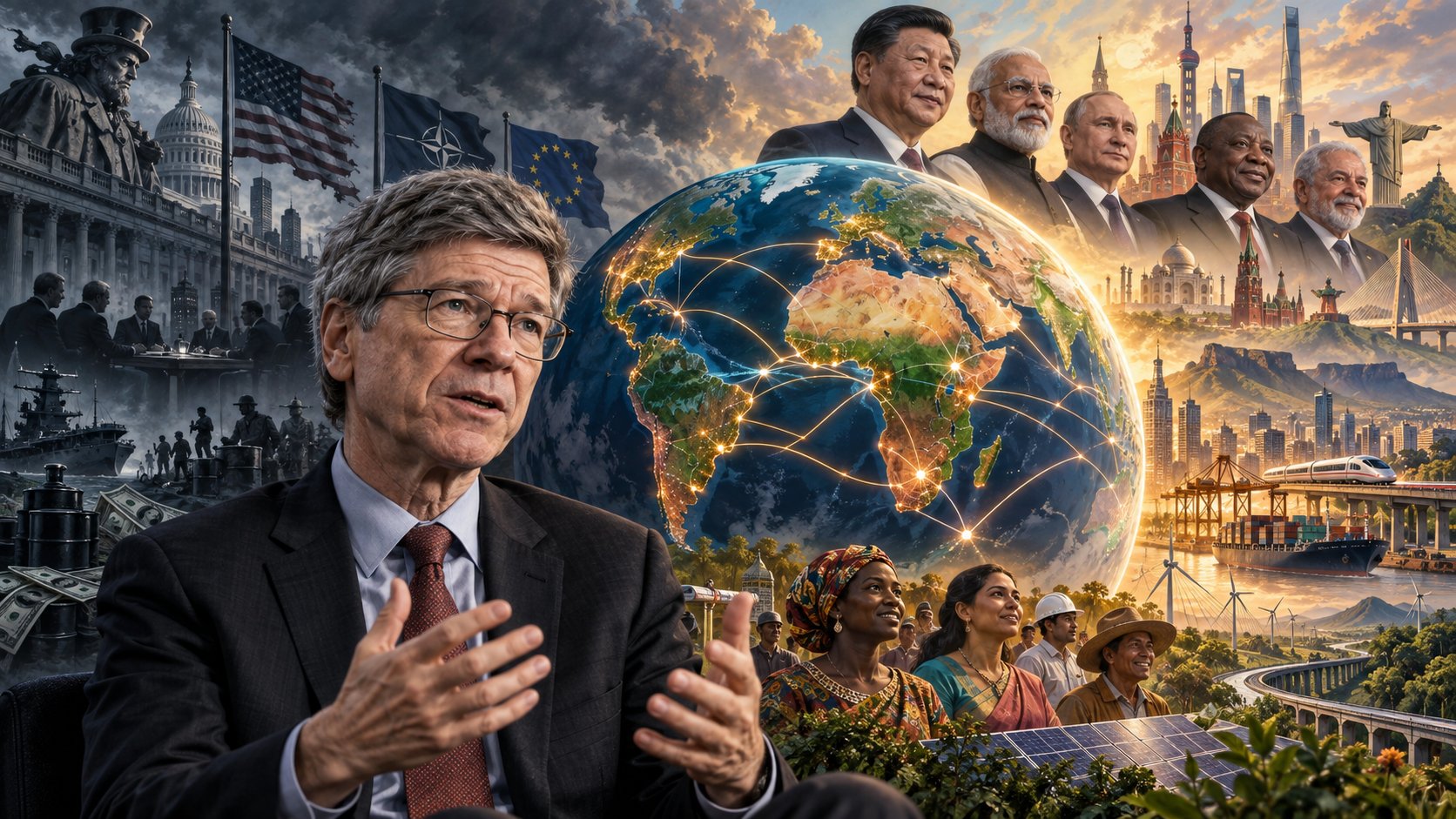
In his interview with Glenn Diesen, Jeffrey Sachs places the rise of BRICS within a much longer history: the ascendancy of European empires, the emergence of American power and the recovery of societies whose development was constrained by colonial rule. His argument is that economic change has already produced a multipolar world, while Western political thinking remains attached to dominance.
For Professor Jeffrey Sachs, the significance of BRICS begins with a change in how the world understands its history. Western predominance, he argues, was neither permanent nor the natural arrangement of international affairs. It emerged under particular historical conditions, lasted for a relatively short period and is now being overtaken by the economic recovery of countries that once occupied much larger positions in the world economy.
“We’re speaking for a world past empire. We’re speaking for a multipolar world,” he says, articulating his interpretation of the grouping’s message.
Speaking to Glenn Diesen in an interview dated 16 September 2026 in the supplied transcript, Sachs, director of Columbia University’s Center for Sustainable Development, presents BRICS as the political expression of this transformation. Countries once colonised, impoverished or subjected to Western pressure have acquired the economic and technological capacity to demand a greater say in international affairs.
His central concern is the distance between that changing distribution of power and the assumptions guiding American policy. In his account, the United States continues to act as though its post-Cold War supremacy can be maintained indefinitely, while Europe remains attached to the prospect of exercising influence alongside it. BRICS, meanwhile, is asserting a different basis for international cooperation: stronger representation, sovereign development and multilateral institutions operating beyond the control of a single dominant power.
The historical exception that became an expectation
Sachs begins his explanation centuries before the creation of BRICS. He identifies the period from roughly 1750 to 1950 as an extraordinary episode in which Europe, a relatively small part of humanity, acquired global ascendancy.
Europe had not, he argues, been uniquely dominant economically across the preceding millennia. China and India were major centres of population and manufacturing, and as late as the early eighteenth century Europe had no uncontested claim to world leadership. Understanding how that changed is essential to understanding why the present shift appears so unsettling to Western governments.
He highlights two developments. The first was European conquest in the Americas. Colonisation brought both organised violence and pathogens that devastated Indigenous populations, leaving European powers able to exploit the resources of two enormous continents. This accumulation of wealth and territory, he argues, helped propel their subsequent expansion elsewhere.
“It was kind of a slingshot for what would come in the following centuries, which was European dominance over Asia,” Sachs says.
The second development was the organisation of scientific inquiry around technological and economic advance. He gives particular importance to Francis Bacon’s early seventeenth-century vision of a society improved through experimentation and the systematic development of knowledge. Sachs describes Bacon as “one of the most consequential thinkers in all of human history”.
His point is not that scientific achievement belonged exclusively to Europe. He explicitly recognises science elsewhere. What he considers distinctive was the institutional organisation of research to develop technologies, increase productive capacity and improve economic life. The scientific revolution associated with Isaac Newton helped stimulate an acceleration in technological change.
In energy, industrial mechanisation and large-scale production, Europe gained an advantage, with Britain—and particularly England—at the forefront. By the end of the eighteenth century, a profound transformation was taking place in British economic life.
The Napoleonic Wars delayed the full international expression of that change, Sachs argues, but by their conclusion in 1815 Britain was increasingly urban, industrial and factory-based. Agricultural advances released or displaced workers into industry, while greater productive capacity supported the projection of imperial power.
During the nineteenth century, Britain developed an empire of exceptional geographical reach, with India central to its power. Sachs distinguishes its worldwide span from the contiguous territory of the Mongol Empire. By the century’s end, the relationship between Europe and Asia had been dramatically reversed.
“The world was turned upside down by historical standards with European imperial dominance,” he says.
America joins the imperial world
Sachs places the rise of the United States within this same history of expansion. Having completed its continental advance across North America, conventionally dated in his account to around 1890, Washington began pursuing an overseas empire.
He describes the American takeover of Hawaii in the 1890s as part of its movement into the Pacific and towards Asia. The war with Spain in 1898, which he calls “a concocted war”, enabled the United States to take advantage of a declining European empire, extending its power over Cuba, Puerto Rico and the Philippines.
In Sachs’s interpretation, Puerto Rico remains effectively a colony despite its particular legal status. He describes Cuba as having been treated as essentially colonial territory until Fidel Castro’s revolution, arguing that Washington has never accepted the loss of that relationship and continues to seek the overthrow of Cuba’s government. The acquisition of the Philippines established the United States as an imperial power in Asia alongside European states.
Meanwhile, European conquest had extended across almost all of Africa. Sachs links the timing of the late nineteenth-century expansion into the continent’s interior to the overcoming of disease barriers, especially malaria, through quinine derived from a traditional Peruvian fever treatment. His broader argument is that technological and medical advantages helped make conquest possible.
“By 1900, Europe and increasingly a rising huge United States claimed to run the world,” he says.
That claim, in his telling, had been centuries in the making. Its consequences extended beyond formal colonial administration: it established an expectation among Western powers that they were entitled to determine the organisation of international life.
The wars that exhausted Europe
Sachs locates the culmination of European imperial power immediately before the First World War. He characterises the two world wars as essentially European civil wars whose effects destroyed the foundations of Europe’s global predominance.
Between them came the Great Depression and the rise of Hitler. By 1945, the European imperial powers had suffered devastation, financial exhaustion and what Sachs describes as moral bankruptcy. Independence movements in Asia and Africa gained new opportunities, supported by the creation of the United Nations and the weakening of colonial governments.
The United States emerged from the wars in a radically different position. Its continental industrial capacity had expanded enormously, leaving it technologically, financially and economically dominant. The Soviet Union became the other great power despite the catastrophic losses it had sustained in defeating Nazi Germany.
Sachs stresses the Soviet death toll of 27 million and the scale of the destruction it faced. Nevertheless, it rebuilt, acquired the atomic bomb in 1949 and demonstrated its technological capabilities with the launch of Sputnik in 1957.
The resulting world comprised an American-led bloc, a Soviet-led bloc and a much poorer majority of countries seeking to recover from colonialism. NATO, founded in 1949, organised the Western alliance against the Soviet Union. Sachs describes Soviet control over countries occupied after the war in the context of unresolved post-war security arrangements and the failure to reach a diplomatic accommodation with Washington.
China occupied a distinctive position in this history. It had not been comprehensively ruled as a European colony, but Sachs describes it as having endured more than a century of imperial intrusion and coercion. He traces that period to Britain’s first Opium War in 1839, fought, in his account, to force open a market for opium and generate revenues to purchase Chinese tea.
He follows this history through the second Opium War, the devastating Taiping Rebellion, pressure from Western powers and Japanese aggression. Japan, Asia’s early industrialiser, fought China in 1894, seized Manchuria in 1931 and launched its wider invasion in 1937.
For Sachs, this history explains the impoverishment from which much of Asia began its modern development. Societies with long records of productive and political importance had been subordinated to an international economy in which their role was largely to supply others.
“Your responsibility as a colony is to produce raw materials for the metropole,” he says.
Independence changes the economic possibilities
The decisive importance of decolonisation, in Sachs’s argument, was that it enabled countries to pursue development under their own sovereignty. Formal independence did not immediately remove poverty or the enormous disparities in education, technology and industry, but it changed what governments could attempt.
India’s independence, the establishment of the People’s Republic of China and the emergence of independent Indonesia formed part of this transformation. Sachs also places non-alignment within that developmental ambition: countries wanted the space to improve their economies without being required to choose between rival geopolitical camps.
“We don’t want to choose sides between two rival camps. We want economic development,” he says, expressing the position he attributes to these countries.
Yet the institutions established around the end of the Second World War reflected the concentration of power in American hands. Sachs discusses the United Nations, the International Monetary Fund and the World Bank, together with the trading arrangements that developed into the General Agreement on Tariffs and Trade and later the World Trade Organization.
He argues that Washington placed itself at the centre of the institutional framework, retaining privileges that continue to matter. His principal example is the United States’ capacity to veto major decisions at the IMF, giving one country exceptional influence within an organisation of approximately 190 members.
Europe retained visible markers of great-power status. Britain and France held permanent seats on the UN Security Council, France still possessed an empire, and Britain acquired nuclear weapons. Nevertheless, Sachs sees the underlying transfer of Western leadership to the United States as unmistakable.
The apparent permanence of this arrangement was reinforced by the economic disparities of the time. Around 1950, Western countries held commanding advantages in industry, literacy, energy use, military capabilities and technology. Independence for others coexisted with a Western expectation that global leadership would remain in the same hands.
Sachs argues that this expectation confused a moment in history with an enduring condition. Once countries could direct their own development, the distribution of economic power could change.
The Cold War ends—and Washington claims the world
Sachs identifies December 1991, when the Soviet Union dissolved, as the beginning of the present political era. His account of that moment combines admiration for Mikhail Gorbachev with criticism of the American response.
He describes Gorbachev as a serious reformer who sought a democratic, restructured Soviet Union and an end to Europe’s Cold War division. “I, for one, believe Gorbachev was a very great man and a great statesman and a great peacemaker of the world,” he says.
The reforms destabilised the state they were intended to improve. Sachs invokes Alexis de Tocqueville’s warning about the dangers governments face when attempting reform, drawing a parallel between the Soviet experience and the changes preceding the French Revolution.
The Soviet Union broke into 15 successor states, with Russia becoming its principal successor and, as Sachs notes, its continuation state for treaty obligations and associated international responsibilities. Washington, he argues, interpreted this outcome as a victory authorising uncontested global leadership, rather than an opportunity to establish a more accommodating international system.
“This is almost a comic book view of the world, but I think it’s an accurate description of the way that American leaders and strategists viewed the world after December 1991,” he says.
He characterises that outlook as a belief that the United States could choose wars, overturn governments and organise international affairs according to its own preferences, treating American interests as synonymous with those of the world.
His criticism of Donald Trump is severe, but he does not present the current president’s approach as a departure from this tradition. Sachs argues that the belief Washington could attack Iran and then determine its leadership belongs to the broader foreign-policy mentality established after the Soviet collapse.
The fundamental analytical mistake, he says, was to assume that American predominance would remain fixed while other economies developed. Washington’s strategists “take snapshots of the world and believe that that’s the permanent story for the world, but the world doesn’t sit still”.
Asia returns to the centre
Against this expectation of permanent American leadership, Sachs places what he calls “the return of Asia to center stage”. He presents Asia’s growth as a recovery of historical economic weight, enabled by sovereignty and sustained development.
In his account, Asia represented roughly 60–70 per cent of both world population and economic output across much of the period before 1800. Its share of output fell to around 15–20 per cent by 1950. Subsequent development began reversing that decline.
China provides his most striking example. After further decades of upheaval and policy mistakes, it began an extraordinary economic advance in the late 1970s. Sachs describes approximately four decades of growth at around 10 per cent a year and an eventual fortyfold expansion of the economy.
“Massive investments, massive savings, incredible hard work,” he says of the sources of that transformation. He connects the account to his own experience of visiting China perhaps a hundred times or more since 1981 and observing its emergence from poverty.
Sachs places particular emphasis on how economies are measured. Using purchasing power parity, which compares output at international prices, he puts China’s economy at approximately 30 per cent larger than that of the United States. He estimates China’s share of world output at around 19–20 per cent, against roughly 14–15 per cent for the United States, with Asia again producing half or more of the world total.
These are the comparisons on which his argument rests. He also contends that China has overtaken the United States across much, though not all, of industry and has become a technological peer in advanced fields, including artificial intelligence.
India is central to his account of the next stage. He identifies it as the world’s third-largest economy on the same purchasing-power basis and expects it to become the second largest by the middle of the century. His most likely scenario places China first, India second and the United States third.
For Sachs, the Western expectation of continued dominance has therefore been overtaken by economic change. “That is what is passé. History has passed that by,” he says.
What BRICS represents
Sachs describes BRICS as “the grouping of countries that has found its footing again in the world that was once colonized or battered by the Western world”. China leads in economic and technological scale, but the grouping’s significance extends beyond any single member.
He lists the original five—Brazil, Russia, India, China and South Africa—and the subsequent participation of Ethiopia, Egypt, the United Arab Emirates, Iran and Indonesia. He describes Saudi Arabia as occupying an ambiguous position, attending the New Delhi meeting while still balancing its longstanding relationship with Washington against closer involvement in BRICS. He also refers to another ten associate members.
His numerical comparison is intended to show the distance between inherited assumptions and present economic weight. The ten core BRICS countries, he says, account for almost half the world’s population and approximately 41 per cent of its output. He puts the G7’s share of output at around 28–29 per cent.
Taking the wider Western grouping, including its allies in Asia and the Pacific, Sachs contrasts approximately one billion people with around four billion in BRICS. The larger political constituency BRICS claims to represent—the emerging and developing countries—amounts, in his account, to approximately 85 per cent of humanity.
“We want our voice. We want our say,” he says, summarising the demand he hears from that constituency.
This is a claim for influence corresponding to changed circumstances. Sachs argues that American control over institutional privileges, and its role as host of major international organisations, continue to support an assertion of leadership that no longer reflects the underlying distribution of economic power.
A multilateral order beyond hegemony
Sachs’s description of the emerging order centres on global cooperation. His reading of the New Delhi Declaration emphasises BRICS support for the United Nations, the multilateral system and the renewal of international trade rules.
He argues that Washington has acted to undermine the World Trade Organization, while BRICS members are calling for a functioning framework of global rules. In this account, the institutions of international cooperation remain necessary, but their operation must accommodate countries whose voices were marginal when the existing arrangements took shape.
He draws attention to the declaration’s discussion of the next UN secretary-general. Sachs interprets its references to the absence of a woman in the role and to Latin American representation as signalling support for a Latin American woman. He presents this as one example of the wider demand for representation.
He also refers to a Rockefeller Foundation-commissioned international survey which, in his account, shows falling support for American leadership and a preference for cooperation through the United Nations and the rule of law. The importance he attaches to it is consistent with his central argument: countries want international coordination without accepting the authority of a hegemon.
“We are now truly in a multipolar world, and we need to live peacefully within it,” he says, again articulating the message he takes from BRICS.
Sachs expects China’s forthcoming BRICS presidency to give further impetus to this agenda. “China absolutely means business of creating this new post-hegemonic world,” he says, predicting that the work of the New Delhi meeting will be amplified in the following year.
The danger of refusing the transition
Sachs sees the most immediate danger in American resistance to the redistribution of power. He connects the wars in Ukraine and Iran to the effort to preserve hegemony, arguing that NATO expansion grew from the post-1991 belief that Washington could extend its security arrangements without accommodating other powers’ concerns.
He describes the Ukraine war as “a war of U.S. expansion” and places American support for Israel within an attempt to retain dominance in the Middle East. These are Sachs’s interpretations of the conflicts and their underlying causes. In his account, the resulting violence is eroding rather than strengthening American international standing.
“It’s all violence, it’s all war, it’s all loss of global support,” he says.
Reflecting on his career advising and studying economies in Latin America, Eastern Europe, the former Soviet Union and China, Sachs argues that the broad economic transition was foreseeable. He recalls that his 1997 book, Emerging Asia, anticipated a rise of approximately 20 percentage points in Asia’s share of the world economy between 1995 and 2025, a projection he says proved almost exactly correct.
He explains the process through economic convergence: countries can narrow gaps in income and technology over time, provided development is not obstructed by forces such as imperialism and war. For him, China’s emergence was neither an inexplicable surprise nor inherently a threat.
“China’s rise is not only not bad and dangerous, it’s natural,” he says.
The opportunity in the 1990s, he argues, was to use American power to establish peaceful arrangements suited to the more equal distribution of economic and technological capabilities that would follow. Instead, successive administrations attempted to preserve the exceptional position the United States briefly occupied.
“We didn’t do any building of what a comfortable, peaceful, multilateral order would be. We doubled down on U.S. hegemony.”
Sachs regards the consequences as extending beyond government. He criticises the assumptions he encounters across universities, think tanks and the national-security establishment, and treats articles in Foreign Affairs as a revealing expression of that wider mentality. He argues that claims of enduring Western supremacy frequently rely on inappropriate economic measures, including appeals to stock-market performance, while dismissing China’s strength, BRICS cooperation and Russia’s capacity to endure.
His warning concerns the combination of that outlook with military power. A political establishment convinced that it can still control events may respond dangerously to evidence that it cannot. “That’s how we hit disaster if we do,” he says.
For Sachs, BRICS expresses a transformation that is already under way. The unresolved question is whether the United States and its allies will adjust their institutions and expectations to it. His preferred outcome is a world in which major powers accept one another’s presence, emerging and developing countries gain an effective voice, and cooperation rests on shared rules. The danger he identifies is that the attempt to preserve the old hierarchy will obstruct that accommodation through further conflict.
Source: