


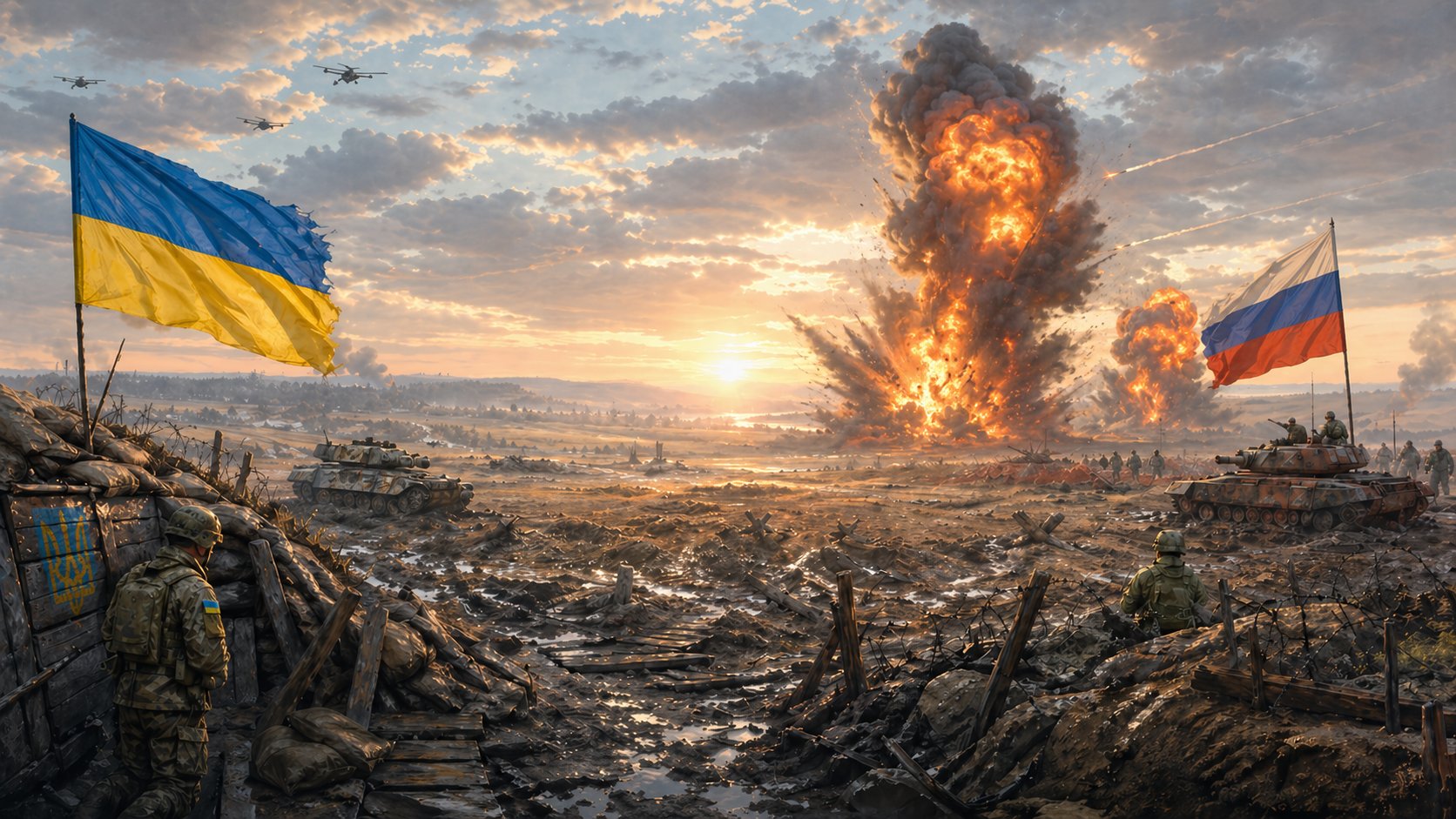
While the world’s attention has shifted sharply toward West Asia, the war in Ukraine has not slowed into irrelevance. It has become less visible, not less important. As of 28 April 2026, the Russia-Ukraine war remains one of the central strategic contests shaping Europe, NATO, global energy politics and the future credibility of Western power. The difference is that it has entered a quieter, harder phase: less dramatic than the opening invasion, less mobile than the counteroffensives, but possibly closer to a political endgame.
The war is now best understood as a contest of exhaustion. Russia is still attacking. Ukraine is still defending, adapting and striking deeper into Russian territory. Neither side has achieved its declared political objectives. Russia has not conquered Ukraine or broken its state. Ukraine has not expelled Russia from all occupied territory. The result is not peace, but a brutal equilibrium.
On the battlefield, Russia continues to hold the larger army, greater manpower depth, a bigger industrial base and the ability to absorb losses at a scale Ukraine cannot match. Its method remains attritional. CSIS describes Russia’s approach as one that accepts very high casualties in the hope of wearing down Ukraine’s army and society, using infantry assaults, drones, artillery, glide bombs and stand-off weapons to grind forward. (CSIS)
But Russia’s superiority has not translated into decisive victory. Its advances remain slow, costly and tactically limited. Ukraine’s defensive system — trenches, mines, drones, artillery, mobile reserves and increasingly sophisticated battlefield surveillance — has made every Russian gain expensive. The war now favours the defender, especially in heavily fortified eastern areas where movement near the front is dangerous for vehicles and troops alike. (CSIS)
This creates the central paradox of the war: Russia may be advancing in places, but it is not clearly “winning” in the strategic sense. It has captured territory, but at enormous cost. It has damaged Ukraine, but not destroyed it. It has survived sanctions, but remains locked into a long war economy. It has shown endurance, but not dominance.
Ukraine, meanwhile, is not winning in the classic sense either. It remains dependent on Western military, financial and intelligence support. It faces manpower constraints, air-defence shortages and the constant pressure of Russian missile and drone attacks on cities and infrastructure. Reuters reported recent Russian drone strikes on Odesa and missile and drone attacks on Dnipro, showing that Ukraine’s rear areas remain vulnerable. (Reuters)
Yet Ukraine has also changed the war. Its drone campaign has widened the battlefield into Russia itself. Recent Ukrainian attacks have targeted Russian oil, refinery and industrial infrastructure, including Tuapse and other sites. Moscow calls these attacks strikes on civilian infrastructure; Kyiv sees them as pressure on Russia’s war economy. (Reuters)
This is one reason the war has become harder to categorise. Ukraine cannot easily defeat Russia in a conventional land campaign. Russia cannot easily force Ukraine to capitulate. Both sides are therefore seeking leverage beyond the trench line: energy, diplomacy, sanctions, air defence, long-range strikes, prisoner exchanges, European funding and American political pressure.
The diplomatic picture is equally frozen. Moscow says President Vladimir Putin would meet President Volodymyr Zelenskiy only to finalise an already prepared agreement, not to negotiate from scratch. Kremlin spokesman Dmitry Peskov said such a meeting would require “political will” from Kyiv and careful preparation. Ukraine, for its part, has asked Turkey to help host a leader-level meeting. (Reuters)
The United States remains involved, but not decisively enough to force an outcome. President Donald Trump said on 26 April that he continues to have “good conversations” with both Putin and Zelenskiy and hopes to settle the war, but Reuters noted that more than a year into his second term the conflict continues. (Reuters)
This matters because the war’s ending is likely to be determined less by a sudden battlefield collapse than by political arithmetic. The question is not simply who controls which village this month. It is whether Moscow, Kyiv, Washington and Europe can accept a settlement that each side can survive politically.
For Russia, the minimum objective is to secure recognition, formal or informal, of its control over occupied territory and prevent Ukraine from becoming a fully integrated Western military platform. Moscow will want neutrality guarantees, sanctions relief, limits on Ukrainian rearmament and acceptance that Crimea and parts of eastern and southern Ukraine are no longer under Kyiv’s control.
For Ukraine, those terms are extremely difficult. Any agreement that openly concedes territory risks looking like surrender. Kyiv needs security guarantees strong enough to prevent Russia from using a ceasefire as a pause before another war. It also needs a path toward Europe, reconstruction funding and continued access to weapons.
For Europe, the problem is strategic credibility. If Russia is seen to gain territory through war and keep it, the lesson for the continent is dangerous. But if Europe insists on total Ukrainian territorial restoration without the means to achieve it, the war may drag on indefinitely. That is why recent European language has begun to sound more pragmatic. Reuters reported that German Chancellor Friedrich Merz suggested Ukraine may have to accept that some territory could remain outside Kyiv’s control in a future peace deal, linking this to Ukraine’s European prospects. (Reuters)
The most likely ending is therefore not a clean peace treaty. It is a ceasefire or armistice: a frozen or semi-frozen conflict with a militarised line of contact, continued non-recognition of Russian annexations by Ukraine and many Western states, gradual reconstruction in Ukrainian-held areas, and a long struggle over sanctions and security guarantees.
This would resemble neither victory nor defeat in simple terms. Russia would claim it had secured territory and blocked NATO expansion. Ukraine would claim it had preserved its state, army, capital, sovereignty and European future. The West would claim Russia failed to conquer Ukraine. Everyone would claim victory because none could admit the full cost of compromise.
Could Ukraine still regain the initiative? Possibly, but only if several factors align: stronger European arms production, sustained American support, improved air defence, successful deep strikes against Russian logistics, and continued Russian overextension. Some analysts argue Ukraine has built momentum through drone warfare and defensive adaptation, but this has not yet produced a decisive strategic reversal. (mickryan.substack.com)
Could Russia still break Ukraine? Also possible, but less likely than Moscow once hoped. Russia can keep grinding, but grinding is not the same as winning. The deeper danger for Ukraine is not a single dramatic breakthrough, but cumulative exhaustion: fewer soldiers, weaker air defence, political fatigue in the West and economic strain at home.
The war has fallen under the media radar because West Asia has produced faster, more spectacular headlines. But in strategic terms, Ukraine remains the hinge of the European order. Its ending will not be a cinematic moment. It will probably be a negotiated exhaustion, dressed up as principle, necessity and victory.
For now, the balance of power is this: Russia has the advantage in mass, endurance and escalation tolerance. Ukraine has the advantage in legitimacy, defensive innovation, Western alignment and national survival. Neither has a decisive path to total victory. That is why the war may be approaching an ending — not because peace has arrived, but because the battlefield is slowly forcing politics to catch up.