


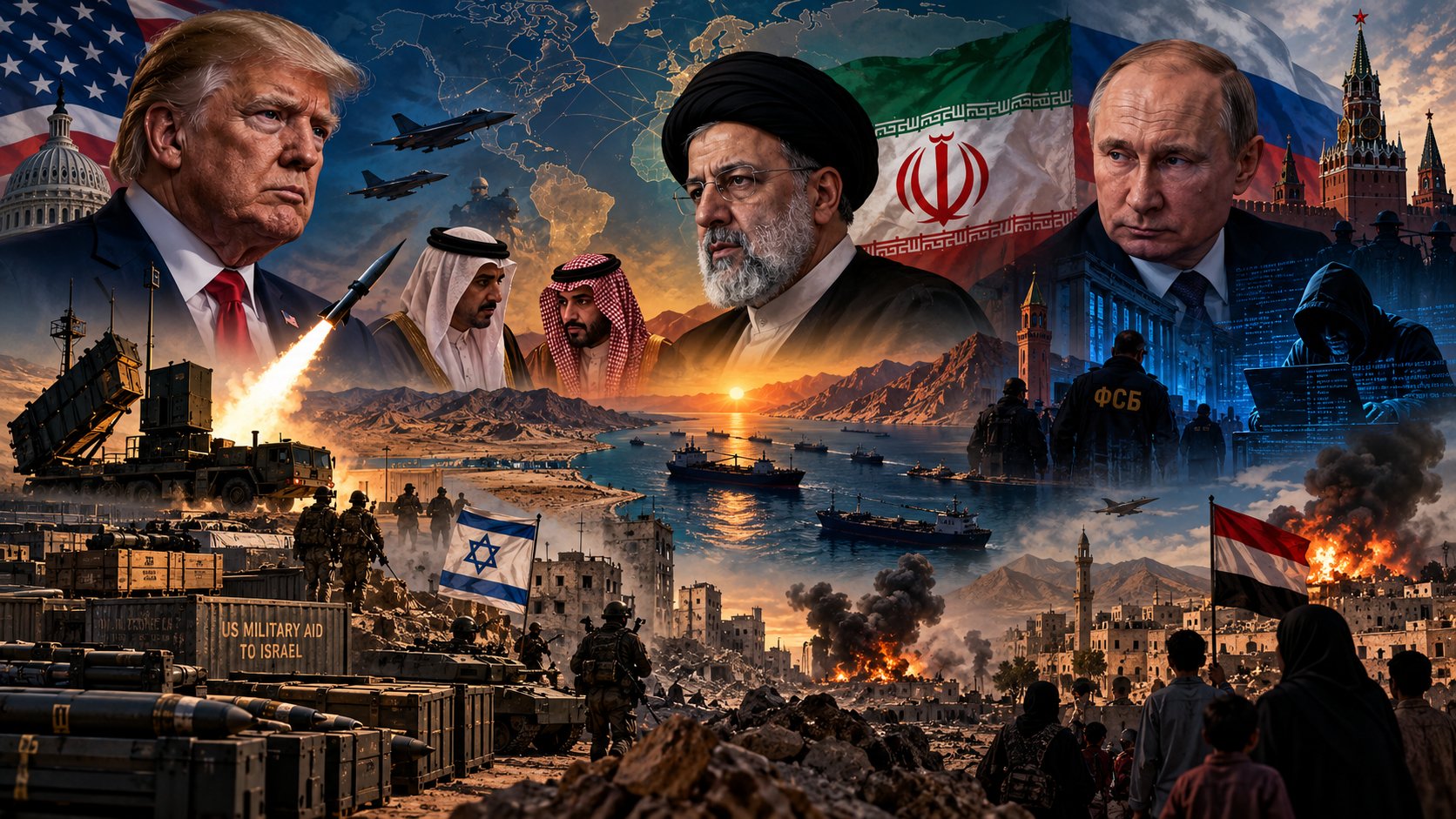
A World Under Pressure: Iran Diplomacy, American Power, Russia’s Internal Contradictions and the Expanding Geography of Conflict
The international news of 29 October 2026 presents a picture of a world struggling to manage the consequences of prolonged military confrontation, increasingly assertive state power and the erosion of established political institutions. From diplomatic manoeuvring around Iran and the deteriorating security environment across West Asia to cyberattacks on Western infrastructure and the tightening of political controls inside Russia, the day’s developments reveal a geopolitical order under sustained pressure.
The most consequential developments centre on the continuing United States–Iran confrontation. Washington is preparing additional military capabilities for Israel even as Gulf Arab governments attempt to revive diplomacy. Meanwhile, the Pentagon’s own estimates reveal that the financial cost of the Iran war has exceeded $47 billion, excluding substantial additional losses.
Elsewhere, Israeli operations continue across southern Syria, Hezbollah rejects demands for disarmament in Lebanon, and renewed Saudi airstrikes have reportedly killed civilians in Yemen. In Russia, economic intervention, technological censorship, contested property seizures and sophisticated cyber operations illustrate the growing reach of state authority.
The day’s reporting also examines democratic accountability in the United States, press freedom in Egypt, and the practical challenges facing Russians living abroad. Taken together, these stories demonstrate that contemporary international conflict is increasingly fought through economics, digital infrastructure, political institutions and control over information, as much as through conventional military force. 29 October 2026
Iran: Diplomacy Under the Shadow of Another War
Iranian Foreign Minister Abbas Araghchi declared that Tehran remains prepared to defend itself militarily while continuing to pursue diplomatic solutions to its confrontation with Washington.
His remarks came amid renewed efforts by Gulf Arab governments to prevent another American-Israeli attack on Iran. Qatar has reportedly presented proposals intended to reopen negotiations over the Strait of Hormuz, sanctions relief and Iran’s nuclear programme.
The central disagreement concerns the order in which concessions must occur. Iran wants the United States to fulfil previously discussed commitments concerning its ports, frozen financial assets and sanctions before further nuclear negotiations. Washington and regional intermediaries are reportedly seeking additional Iranian commitments as part of any renewed arrangement.
Araghchi’s statement is consequently significant because it combines a warning against military escalation with an explicit indication that Tehran has not closed the diplomatic door.
The Gulf states have compelling reasons to pursue de-escalation. A broader regional war would threaten energy exports, shipping routes, investments and the economic diversification programmes on which many Gulf governments depend.
Nevertheless, diplomatic efforts are taking place alongside unmistakable military preparations. The Wall Street Journal reportedly disclosed that Washington is deploying an additional Patriot air-defence system to Israel in anticipation of possible further operations against Iran.
This would reinforce Israeli missile defences but also place additional pressure on American military inventories. Reports suggest that approximately 1,700 Patriot interceptors have already been expended, demonstrating the extraordinary material demands of contemporary missile warfare.
The resulting contradiction is clear: governments are simultaneously preparing for renewed confrontation and exploring mechanisms to prevent it.
The greater danger is that military deployments intended as deterrence could be interpreted by an adversary as preparations for an imminent attack, increasing the risk of miscalculation. News From Antiwar.com29 October 2026
The Mounting Economic and Strategic Cost of American Military Power
New Pentagon estimates put the direct American expenditure on the Iran war above $47 billion, an increase of approximately 25 percent over the department’s July assessment.
The figures, obtained by Reuters and reported by Antiwar, include an estimated $29 billion for replacing expended munitions and approximately $6 billion for military equipment and platform losses.
However, the figures exclude damage to American bases and other longer-term costs. Independent analyst Stephen Semler previously estimated that the first 120 days of the conflict may have cost approximately $103 billion in direct expenditure alone.
The gap between these assessments highlights the difficulty of calculating the true economic burden of war. Military budgets may account for weapons, equipment and immediate operational requirements while excluding infrastructure repairs, future medical care, interest payments and broader economic disruption.
According to Pentagon figures cited in the report, American military casualties since the conflict began on 28 February included 22 deaths and 905 injuries.
For Washington, these growing costs create political and strategic challenges. Resources committed to the Middle East cannot simultaneously be directed towards other defence priorities, while depleted missile inventories increase pressure on the American defence-industrial base. News From Antiwar.com
These developments form the background to The Intercept’s analysis, The Incredible Shrinking Superpower, which argues that the Iran war has exposed the limitations of American military influence.
The article interprets the conflict as evidence that overwhelming military superiority does not necessarily translate into strategic success or sustained regional control.
That conclusion is an analytical judgement rather than an established fact. Nevertheless, it raises an important question: can the United States continue exercising global leadership through military dominance when its interventions increasingly generate financial exhaustion, political opposition and uncertain outcomes?
The answer will have implications extending well beyond West Asia, including for African governments navigating relations with Washington, Beijing, Moscow and emerging regional powers. 29 October 2026
Israel’s Regional Conflicts and the Fragility of Lebanon and Syria
Israel’s own political environment remains closely connected to the wider regional confrontation.
President Donald Trump publicly credited his endorsement of Benjamin Netanyahu with improving the Israeli prime minister’s electoral standing. However, the election results described in the digest indicated that Netanyahu’s coalition remained short of the parliamentary majority required to establish a government.
Trump’s intervention underscores the unusually close personal and political relationship between the two leaders. It also demonstrates the degree to which American foreign policy can become entangled with another country’s domestic electoral competition.
In Lebanon, Hezbollah leader Naim Qassem reiterated that the movement would not surrender its weapons while Israeli forces continued occupying Lebanese territory.
Qassem expressed support for elements of the existing diplomatic framework, including United Nations Security Council Resolution 1701, while rejecting arrangements negotiated between Washington, Israel and the Lebanese government that Hezbollah regards as incompatible with its security interests.
The dispute centres on competing definitions of sovereignty and security. Israel and its supporters present Hezbollah’s military capabilities as a continuing threat. Hezbollah maintains that its weapons are necessary to resist occupation and deter future attacks.
Without an agreement on Israeli withdrawal, Lebanese state authority and acceptable security guarantees, disarmament remains a deeply contested political question.
Meanwhile, Israeli forces reportedly entered villages in Syria’s Quneitra Governorate, searching homes and detaining a civilian in Saida al-Golan. Additional operations were reported around al-Samandiyah.
These incursions reinforce concerns that Israel’s military presence in southwestern Syria could become prolonged, further undermining the sovereignty of an already weakened Syrian state.
The wider regional picture is therefore one of interconnected instability. Developments in Iran affect Israeli military planning, which in turn influences Lebanon, Syria and the wider strategic calculations of neighbouring governments. 29 October 2026
Yemen: Civilian Casualties Continue as Regional Fighting Persists
Yemen remains among the countries most severely affected by the region’s continuing conflicts.
Saudi airstrikes reportedly struck a market and petrol station in al-Jawf Governorate, killing at least 14 civilians, according to the Health Ministry associated with the Ansar Allah-led authorities.
The reported attacks underline the continuing vulnerability of civilian infrastructure in Yemen, where years of warfare have weakened public services, destroyed economic assets and displaced large numbers of people.
Markets and fuel facilities are particularly significant targets because their destruction affects not only immediate casualties but also food distribution, transport and the functioning of local economies.
The renewed violence also complicates diplomatic efforts around Iran. Regional negotiations that address missile threats, shipping security or sanctions without confronting the fighting in Yemen risk producing agreements that leave important drivers of instability unresolved.
For African economies connected to Red Sea shipping, instability around Yemen additionally threatens maritime trade, insurance costs and supply-chain reliability. 29 October 2026
Russia’s Economy: Aviation, State Control and the Costs of Isolation
A series of reports from Russia illustrates how years of conflict and international isolation are reshaping the country’s economy and political institutions.
Russian authorities have proposed an additional surcharge of up to 1,000 rubles on airline tickets to finance domestic aircraft manufacturing.
The proposal reflects the challenges confronting Russian civil aviation, particularly the need to sustain aircraft production and maintenance amid restrictions on access to Western technology, components and services.
While the measure could provide financial support for domestic manufacturers, it would also transfer part of the cost of industrial development directly to passengers.
The proposed surcharge forms part of a broader policy of state-led industrial support and import substitution. Yet the success of such programmes depends not only on financing but also on technological capability, reliable component supplies and sustained engineering expertise.
Another aviation-related development concerns Dmitry Kamenshchik, the former owner of Moscow’s Domodedovo Airport, who has reportedly relocated to Israel and acquired Israeli citizenship after Russian authorities seized the airport over allegations involving foreign influence.
The case illustrates growing uncertainty around private ownership in strategically important sectors. It also raises questions about the extent to which political considerations influence the treatment of major Russian business assets.
Russia’s relationship with Afghanistan presents another institutional contradiction. Despite suspending its ban on the Taliban, Russian government records reportedly continue identifying the movement as a terrorist organisation.
Meduza found that documents prepared by the Federal Security Service and updated financial-monitoring records still include the Taliban.
The discrepancy illustrates how diplomatic recognition, security legislation and bureaucratic systems can develop at different speeds. A government may pursue practical engagement with a foreign movement while older legal classifications remain embedded in official institutions.
Such contradictions become particularly significant when they affect banking transactions, cross-border cooperation and the legal status of organisations operating internationally. Meduza+1
Digital Conflict: Cyber Sabotage and the Battle Over Information
One of the day’s most concerning reports involves Russian-linked hacking groups allegedly attacking poorly protected industrial systems in Western countries.
According to a Bloomberg investigation summarised by Meduza, targets have included water facilities, factories and food-production businesses.
Unlike conventional cyberattacks that steal information or disable websites, these operations reportedly interfere with physical processes, sometimes causing broken pipes, spoiled food and industrial fires.
The implications are profound. Industrial control systems were traditionally designed to prioritise operational reliability, sometimes with limited protection against modern cyber threats.
When inadequately secured equipment is connected to wider networks, cyber intrusions can create consequences extending directly into the physical world.
For African infrastructure operators, the lesson is especially relevant. Water treatment plants, electricity distribution networks, manufacturing facilities and transport systems increasingly depend on interconnected operational technologies.
Cybersecurity can therefore no longer be treated exclusively as an information-technology concern. It is becoming an essential component of infrastructure reliability and national security.
Two other Russian technology stories illustrate the continuing struggle over digital control.
A former employee of Roskomnadzor, Russia’s internet censorship agency, reportedly became a leading developer of AIVPN, a service designed to bypass government website restrictions.
The reversal is striking: someone previously involved in maintaining online censorship is now reportedly helping users circumvent those same controls.
Separately, Russian authorities reportedly blocked the AI-generated song You’re My Scumbag from streaming platforms.
Although comparatively minor beside the day’s military developments, the incident highlights how state censorship is extending into AI-generated cultural expression.
Together, these developments demonstrate that technological control is increasingly contested on several fronts: governments seek to regulate information, citizens seek tools for circumvention, and cyber operators exploit vulnerable digital systems to influence events in the physical world. 29 October 2026
Democratic Accountability and Press Freedom
The day’s reporting also raises concerns about political rights and institutional independence.
In the United States, President Trump announced plans to send election monitors to Maine following allegations of voter fraud involving Somali American communities.
The Intercept reported that the allegations were unsubstantiated and that state authorities had been preparing local law-enforcement personnel to respond to potentially unlawful interference at polling stations.
Election monitoring can serve legitimate transparency purposes when conducted within established legal frameworks. However, the deployment of federal personnel in an atmosphere of politically charged allegations raises concerns about intimidation and public confidence in electoral administration.
The controversy also demonstrates how immigrant communities can become central to domestic political narratives, particularly when national security, identity and election integrity are conflated.
In Egypt, the Middle East Research and Information Project condemned the conviction of Lina Attalah, editor-in-chief of the independent publication Mada Masr, and expressed solidarity with the outlet following its reported shutdown.
MERIP’s statement forms part of wider criticism of restrictions on independent journalism in Egypt.
The issue extends beyond the fate of one newsroom. Independent media organisations play an essential role in documenting abuses, challenging official narratives and providing citizens with information outside government-controlled channels.
When journalists face prosecution or media organisations are closed, the capacity for meaningful public scrutiny diminishes.
These developments in two very different political systems illustrate a shared concern: democratic accountability depends not simply on formal institutions but on whether citizens, journalists and independent organisations can operate without intimidation. 29 October 2026
Migration, Public Health and the Everyday Consequences of Political Change
Not all the day’s stories concern military confrontation.
Meduza published a detailed guide explaining the tax obligations of Russians living abroad, including the importance of the 183-day residency threshold.
The report distinguishes between tax residency, which helps determine income-tax obligations, and currency-control residency, which may impose additional reporting requirements concerning foreign bank accounts.
For emigrants, these rules can create complicated situations involving income earned in different countries, properties retained in Russia and bank accounts opened overseas.
The broader significance is that emigration does not necessarily terminate a person’s legal and financial relationship with their country of origin.
Such complexities have become increasingly relevant as conflict and political uncertainty encourage people to relocate while maintaining economic ties across borders. Meduza
Another Meduza feature compared seasonal influenza vaccination practices across Russia, Germany, Britain and eight other countries.
The report emphasised the importance of vaccination timing, noting that immune protection generally takes approximately two weeks to develop.
Although this subject appears distant from geopolitics, it serves as a reminder that public-health preparedness, access to reliable medical information and effective institutional coordination remain central responsibilities of government.
A final incident in Belgrade illustrated another consequence of international tensions reaching beyond conflict zones.
A teenager reportedly attacked a security officer near the Israeli Embassy while carrying knives and was subsequently shot dead.
Authorities had not established a complete public account of the circumstances in the digest’s reporting. The incident nevertheless highlights the heightened security risks surrounding diplomatic missions during periods of major international confrontation. 29 October 2026
What These Developments Mean for Africa
Although much of the day’s reporting concerns Russia, the United States and West Asia, the implications for Africa are substantial.
The Iran confrontation directly affects energy markets and maritime shipping. Disruption around the Strait of Hormuz can increase fuel costs, raise inflation and complicate economic planning across African countries dependent on petroleum imports.
Instability around Yemen and the Red Sea threatens commercial shipping routes that connect African ports with international markets.
Cyberattacks against industrial systems provide a warning for African utilities and infrastructure operators, particularly where ageing equipment, limited investment and rapidly expanding digital connectivity create operational vulnerabilities.
Meanwhile, the increasing use of sanctions, state-directed industrial investment and restrictions on technology transfers raises important questions for African governments seeking greater industrial independence.
The Russian aviation surcharge, for example, demonstrates both the strategic appeal and potential financial burden of domestic manufacturing policies.
There is also a diplomatic dimension. As competition intensifies among global powers, African countries face growing pressure to align with competing security and economic blocs.
Maintaining strategic flexibility while strengthening regional institutions, critical infrastructure and economic resilience may become increasingly important.
Conclusion: Military Power Without Political Resolution
The news of 29 October 2026 reveals an international system in which governments continue investing enormous resources in military capabilities while political solutions remain uncertain.
Iran is offering conditional diplomatic engagement even as American forces strengthen Israel’s defences. Hezbollah rejects disarmament in the absence of an acceptable security settlement. Israeli operations continue in Syrian territory, while renewed airstrikes reportedly kill civilians in Yemen.
At the same time, the United States faces mounting financial costs from its military operations, Russia is restructuring elements of its economy under geopolitical pressure, and the digital domain is becoming an increasingly consequential arena of confrontation.
The day’s less dramatic reports are equally revealing. Tax rules shape the lives of emigrants, censorship determines which cultural products remain accessible, and restrictions on journalism affect the ability of citizens to hold governments accountable.
The central lesson is that modern geopolitical conflict is no longer confined to the battlefield. It extends into energy markets, industrial production, infrastructure systems, digital communications, electoral institutions and everyday civilian life.
For Africa, the challenge is not merely to observe these developments but to understand how they shape the continent’s economic security, political autonomy and long-term development opportunities.
The defining question is whether governments will continue treating military and technological superiority as substitutes for political settlement, or whether the growing costs of confrontation will eventually create the conditions for meaningful diplomacy.
The reports of 29 October suggest that, for now, the world remains dangerously committed to the former.
Editorial source note: This synthesis covers all 19 items in the Freenet Africa Digest, including reporting attributed to Antiwar, Meduza, The Intercept, Bloomberg, Reuters, The Bell and MERIP. Some original reports were inaccessible through the digest’s tracked links; the summary distinguishes attributed reporting from editorial interpretation and does not constitute independent verification of every claim.