


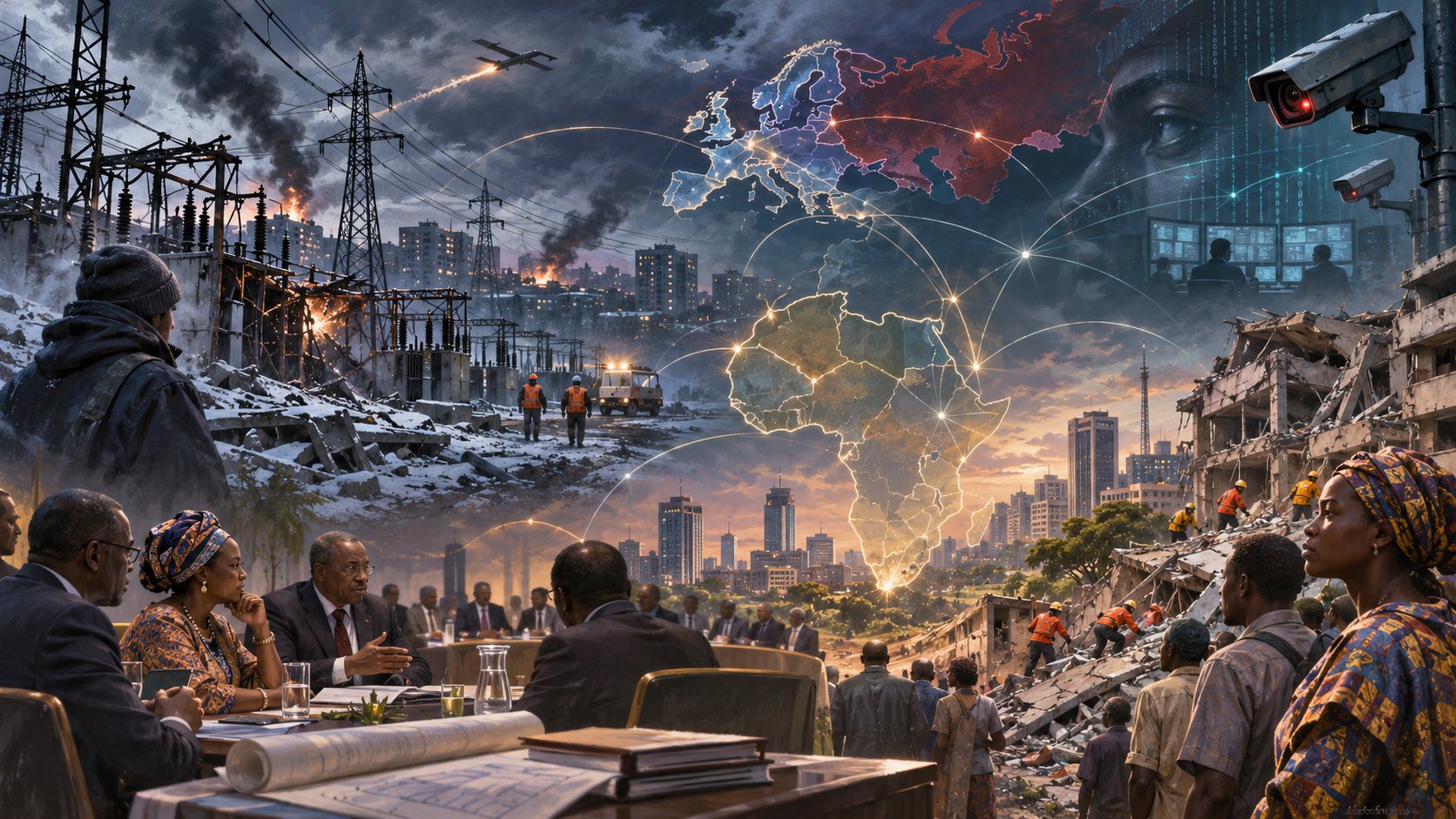
Energy conflict in Eastern Europe, shifting security norms, and debates on governance and accountability mark a day of contested international and domestic orders.
Energy Conflict and Infrastructure as a Strategic Battleground
The most striking development is Russia’s large-scale attack on Ukraine’s energy system, reportedly resulting in emergency power outages and water supply disruptions in Kyiv and several other regions. According to Ukrainian authorities cited in the digest, this marks one of the largest such attacks to date. The deliberate targeting of infrastructure further entrenches the weaponisation of essential civilian services in the ongoing war, escalating both the humanitarian impact and the strategic stakes. With repair efforts underway amidst ongoing hostilities, the episode illustrates how energy systems—critical for winter survival—remain focal points of vulnerability and leverage within Europe’s evolving security landscape. This attack also signals a persistent volatility in the international environment where infrastructure, not only military assets, are at the centre of conflict calculation.
Security, Surveillance, and the Contestation of Norms
Security threats, both state-driven and ambiguous, permeate today’s news. Poland’s Prime Minister Donald Tusk’s declaration of a prevented “provocation” at the border with Russia’s Kaliningrad exclave reveals sustained anxieties along NATO’s eastern frontier. Such statements, made without further corroborating detail in the reporting, primarily reflect an enlarged state of vigilance rather than concrete acts of aggression. Nonetheless, they feed into a cycle of suspicion and potential escalation within the region’s fragile equilibrium.
Meanwhile, Russia continues to expand the reach of its security apparatus. New measures granting the FSB round-the-clock access to cryptocurrency exchange customer data from March 2027 represent a significant intrusion into digital privacy and financial autonomy. This institutionalisation of surveillance is mirrored in Moscow’s schools, where investigative reporting has uncovered audio-recording capabilities on interactive panels, with data reportedly transmitted to the mayor’s office. These episodes underscore the increasing normalisation of state monitoring under the pretext of security, raising concerns about transparency, civil liberties, and the future of trust in public institutions.
International Order: Sport, Culture, and Legal Contestation
The transposition of international conflicts into arenas of sport and culture is observable in several instances. The boycott by Sweden, Finland, and other national hockey federations of matches involving Russia, following the Court of Arbitration for Sport’s reinstatement of the Russian team, invokes a collective effort to maintain pressure on Russia post-sanctions. Although the source does not detail wider diplomatic consequences, the refusal to normalise athletic relations points towards a broader recalibration of international participation rights, enforcement of global norms, and the limits of sport as a diplomatic bridge.
Culture, too, serves as a battleground for narrative and identity. The New Yorker’s profile of Cannes Grand Prix-winning Russian filmmaker Andrey Zvyagintsev, now in exile, reflects how individual figures and creative works become sites of broader struggle over freedom, belonging, and the reach of political control. The eviction ruling against Russian journalist Alexander Nevzorov’s family further illustrates targeted, bureaucratic forms of pressure exerted by the state on dissenters, reinforcing the risks faced by those challenging authority from abroad.
Governance, Accountability, and Vulnerability in Africa
African stories today expose the intersecting challenges of governance, safety, and opportunities for reform. In Nairobi, the recovery of a second body from the rubble of a collapsed building renews scrutiny of building standards in Kenya’s fast-growing capital. While the report is limited to the immediate aftermath, it reopens a perennial regional debate on regulatory enforcement and urban vulnerability. Similarly, an inquiry into procurement at The Gambia’s Kanifing Municipal Council reveals both gaps in record-keeping and the complex incentives shaping official behaviour—some facing sanction, others exonerated for resistance to improper conduct. Such situations highlight both endemic failings and the ongoing, often uneven, processes of accountability within African governance structures.
Elsewhere in East Africa, Prime Minister Justin Nsengiyumva’s call for renewed energy to unlock intra-EAC trade underscores leaders’ recognition of the limits to regional integration when smaller businesses are unable to take full advantage. There is an evident hope that removing barriers might yet drive tangible improvements in economic participation and growth, although the reporting offers no assessment of concrete policy shifts or outcomes to date.
In Somaliland, the police force’s anniversary becomes an occasion for presidential pledges of reform and professionalisation. Although framed as an aspirational moment, the digest does not outline the specific challenges or benchmarks against which future progress might be measured. These stories collectively suggest that, despite rhetoric surrounding reform and regional opportunity, real challenges persist in implementation and in ensuring that structural advances benefit the broader citizenry.
Diplomatic Engagements and Soft Power Initiatives
The upcoming UN Water Conference, co-hosted by the UAE and Senegal, highlights ongoing efforts by Global South states to shape agendas in crucial international forums. The digest records Abu Dhabi’s diplomatic briefing to 180 diplomats, including an invitation to Saudi Arabia’s crown prince, as part of its preparation. While such moves reflect ambition to steer global discourse on water—a resource of strategic and humanitarian import—the reporting does not indicate breakthroughs in coalition-building or clear shifts in soft power as yet. Likewise, Saudi football’s continuing intensity and the emergence of Russian sporting talent in Turkish leagues register as minor signals of global cultural circulation, but not of substantive diplomatic shift or BRI/BRICS expansion.
Multipolarity and BRICS: Discernible Undercurrents but Limited Evidence of Structural Shift
Today’s digest contains several items with indirect BRICS or multipolarity significance, though none strongly indicate systemic realignment. The most relevant are the infrastructural and diplomatic initiatives by BRICS-identified states (notably the UAE and South Africa, with mentions also for Egypt) and the showcasing of low-budget South African cinema under state patronage. Nonetheless, the evidence does not suggest coordinated, bloc-level advance or material change in the global order emanating from BRICS membership itself. The continued contestation between Western and Russian (or wider Eurasian) interests in sport, security, and law remains anchored to bilateral and multilateral disputes, not to cohesive coalitional strategies. Equally, intra-BRICS differences—unaddressed by today’s reporting—mean that the bloc remains heterogeneous, its agency contextually and sectorally specific rather than universally assertive.
Implications for Africa
Africa remains an arena of intense governance experimentation and state-building, but also of persistent challenges in oversight, institutional capacity, and the management of public resources. Stories of disaster response, procurement investigations, and calls for deeper regional integration signal both limitations and continual aspiration for improvement. The participation of African states in global diplomatic processes—most notably the impending water conference—demonstrates enduring efforts to assert agency on the international stage, albeit without substantive transformation of global diplomatic power structures visible in this digest. The continent’s engagement remains framed by the tension between domestic priorities and opportunities for influence through multilateral forums, rather than by a definitive pivot to an alternative world order or institutions associated with BRICS or other emerging coalitions.
Conclusion: Anxieties, Engagement, and the Absence of Decisive Realignment
Across continents, today’s developments reflect heightened anxieties over security and governance, with states intensifying their control over infrastructure, information, and dissent. International legal processes, cultural expressions, and transnational sport reproduce and reinforce the fault lines of contested order. While multipolar currents are detectable—through BRICS states’ initiatives and the uneven assertion of sovereignty—the day’s evidence chiefly points to continued fragmentation, experimentation, and negotiation, rather than to consolidated shifts in global hierarchy or influence. Africa, caught within these broader dynamics, advances incrementally, its agency manifest in engagement rather than structural redesign.
Editorial source note: This analysis is based on the aggregated summaries in Freenet Africa Daily News Digest — 4 November 2026. The underlying reports have not been independently verified for this analysis.