


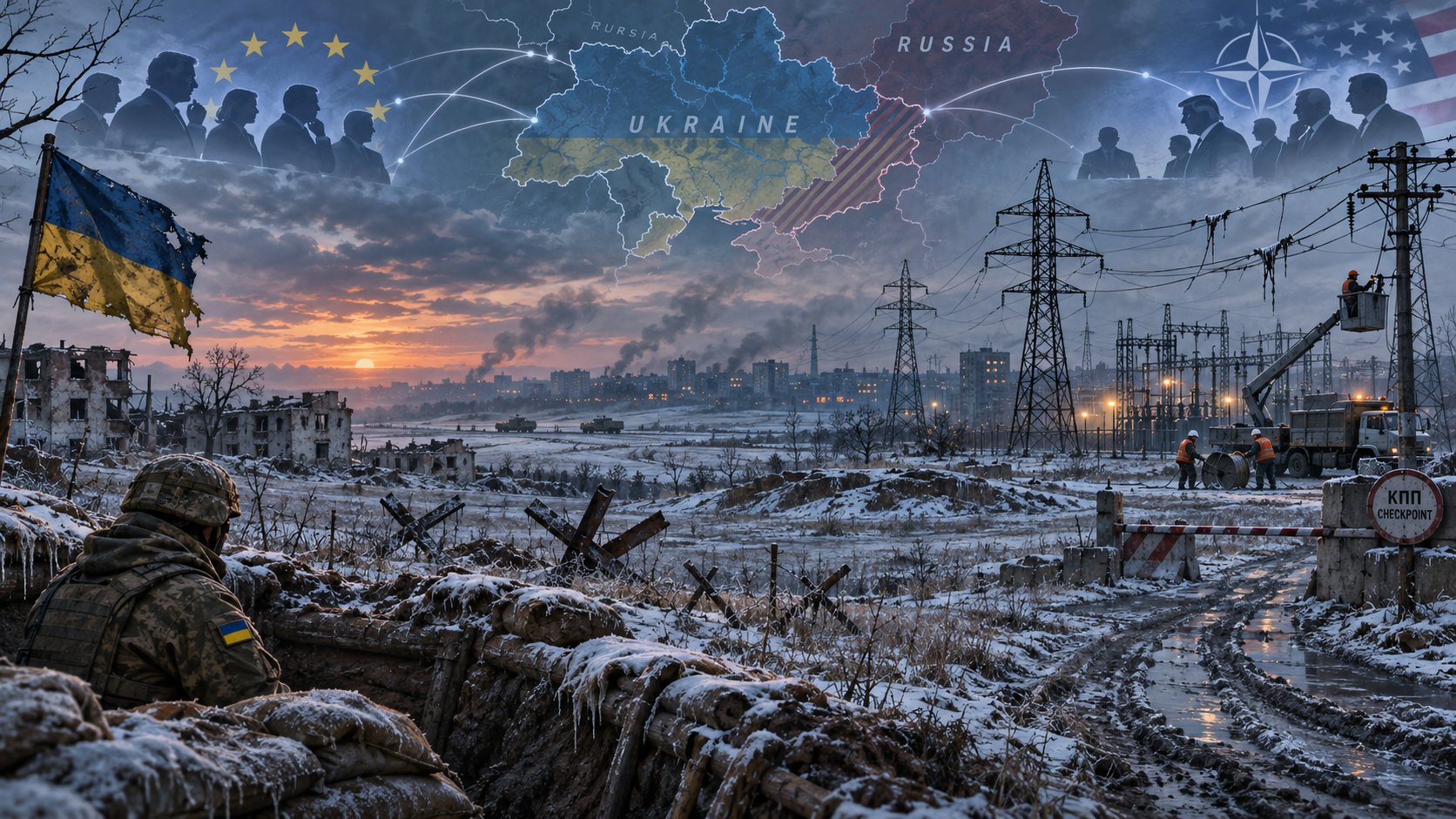
How a Stalled Offensive, an Energy Siege and a Divided West Are Redefining the Endgame
Nearly five years into Russia’s full-scale invasion, the war in Ukraine has settled into a condition that defies the simple categories of victory and defeat. It is neither a frozen conflict nor a decisive offensive, but a war of structural exhaustion—a grinding contest in which both sides pay enormous costs for marginal gains, while the political conditions for a settlement remain fundamentally unreconciled. The latest reports from the battlefield, the diplomatic track, and the corridors of allied capitals indicate that an end to the fighting is not yet in sight, but the reasons for that are shifting. The war is becoming less a question of who will win and more a question of who will tire first, and on what terms.
The Battlefield: Russia’s Momentum Has Broken
The most significant development of 2026 is that the Russian offensive has lost its forward momentum. According to the Institute for the Study of War (ISW), Russian forces lost ground on the battlefield in October 2026 for the second consecutive month, while suffering their highest monthly casualties of the entire war. This is not a temporary setback. Earlier in the year, Russian advances had already slowed to an average of just 2.9 square kilometers per day in the first four months of 2026, and in April, Russian forces suffered a net loss of territory—Ukraine liberated more ground than Russia seized.
The Kremlin’s spring-summer offensive, which was intended to deliver a breakthrough in the Donbas, has failed in its core objectives. Ukrainian counterattacks in late 2025 and early 2026 disrupted the initial Russian push, and a months-long Ukrainian counteroffensive in the northern Donbas has thwarted Russian efforts to encircle the remaining Ukrainian-held cities in the region. Ukraine’s Operation Vivaldi, launched in the Lyman direction, has had “cascading effects” on Russian offensives against the so-called Fortress Belt, the string of fortified cities that form Ukraine’s defensive backbone in Donetsk Oblast. Russian forces have still not completed the seizure of Kostyantynivka, more than a year after first infiltrating the town.
This does not mean Russia is collapsing. Russian forces continue to make limited, local advances in the Dobropillya direction, in western Zaporizhia Oblast, and along the northern border in Sumy and Kharkiv, where they are trying to expand a claimed “buffer zone”. But these are tactical gains purchased at enormous cost, not operational breakthroughs. The Russian military command appears to be committing substantial resources to directions that cannot yield sweeping advances, and it has not modified its plans even for forces that have been defeated by Ukrainian operations. The picture is one of a military machine that can still inflict damage but can no longer dictate the terms of the fight.
The Energy War: Russia’s Most Potent Remaining Weapon
If Russia’s ground offensive has stalled, its campaign against Ukraine’s energy infrastructure has intensified. In early November 2026, Russia unleashed one of its largest waves of ballistic missiles targeting critical infrastructure, as Ukraine braced for another winter of potential blackouts and heating failures. This follows the hardest wartime winter of 2025–2026, which saw millions of people without heating and power in subzero temperatures.
The strategic logic is clear. Ukraine’s three operating nuclear power plants are the backbone of its electricity system, and Russia has been targeting the electrical switchyards that connect them to the grid, intending to force them to shut down. Between December and February, Ukraine endured 15 large-scale attacks on its energy facilities—more than three times the average number of attacks over the previous three winters of the war. The economic cost is staggering: one Ukrainian official estimated that the destruction to the energy sector in 2026 alone would approach $6–7 billion.
This is a campaign designed not to win territory but to make the country unlivable, to break the will of the population, and to impose a cost that Ukraine’s allies may eventually decide they are unwilling to subsidize. It is a weapon of exhaustion, and it is arguably Russia’s most effective remaining lever for shaping the outcome of the war.
The Diplomatic Track: Talks Without a Framework
The diplomatic picture is one of motion without movement. In late October and early November 2026, Ukraine and Russia signaled a willingness to resume U.S.-brokered peace talks, and they agreed to a local ceasefire to allow humanitarian aid into a stranded town in the Kherson region. A new round of trilateral negotiations involving Russia, Ukraine, and the United States was planned for Abu Dhabi in mid-November, following earlier rounds in Abu Dhabi and Geneva.
But the substance of the negotiations reveals how far apart the sides remain. The core obstacles are unchanged: territory and security guarantees. Russia continues to demand Ukrainian territory it does not fully control, while Kyiv insists that any agreement must include ironclad guarantees against another invasion. President Zelensky has said he is ready to meet Putin directly in Turkey and has signaled openness to discussing a freeze of the current front line, suggesting Ukraine might accept retaining 75% or more of its territory in exchange for peace. But he has ruled out handing over the Donbas or recognizing Crimea as Russian territory, saying such concessions would violate the Ukrainian Constitution. Putin, for his part, has rejected abandoning occupied territories, framing them as historically Russian land.
The Kremlin has made clear that the resumption of talks does not mean an end to the fighting. A Kremlin spokesman said that trilateral negotiations do not signify that military operations will cease. And within hours of Putin saying he agreed “in principle” to restart talks, Russia launched a deadly barrage of ballistic missiles and drones on Kyiv. The talks, in other words, are a parallel track to the war, not a substitute for it. They serve to manage escalation, to test positions, and to satisfy the diplomatic demands of the Trump administration, but they have not yet produced a framework that either side is prepared to sign.
The Allies: NATO Steps Up, but the United States Steps Back
The external balance of support has become more complicated. NATO has substantially increased its commitments to Ukraine. At the July 2026 summit in Ankara, allies announced plans to provide $80 billion in defense support for Ukraine in 2026—$32 billion through an EU loan and $48 billion bilaterally—with an intention to provide at least the same level in 2027. Norway committed more than $300 million for Patriot missiles, Germany signed an agreement to jointly produce Bars drone missiles for Ukraine, and NATO leaders discussed total support packages reaching $140 billion for 2026 and 2027. European NATO members and Canada have pledged €70 billion in military aid for 2026 alone.
But this European and alliance support is offset by the ambivalence of the United States under the Trump administration. The Trump administration halted new aid packages for Ukraine at the beginning of 2025 and has provided only a fraction of the assistance the Biden administration gave. Trump has publicly mused that Ukraine has given the United States nothing in return for its support, and his administration has prioritized energy agreements with Russia over Ukrainian battlefield needs. Congressional Democrats have accused Trump of abandoning Ukraine in favor of Putin, but European officials reportedly do not expect even a Democratic victory in U.S. midterm elections to reverse the broader shift in American priorities.
This creates a strategic asymmetry. Ukraine’s European partners are trying to fill the gap, but the United States remains the indispensable power in NATO, and its ambivalence introduces a deep uncertainty into Kyiv’s long-term planning. Ukraine can continue to fight with European support, but the question of whether that support will be sustained over multiple years—and whether it can compensate for the loss of American leadership—remains unanswered.
Is an End in Sight?
The honest answer is that an end to the fighting is not yet in sight, but the conditions for a settlement are improving—for reasons that are deeply pessimistic. Mark Galeotti, a respected Russia analyst, has argued that the preconditions for ending the war are better than ever before, but he is brutally candid about why: “We have the best chance for peace for the worst possible reasons”. Ukrainian society is increasingly open to negotiations; polling cited by Galeotti indicates that a majority of Ukrainians support talks and many would be willing to accept territorial concessions to achieve peace. In Russia, public discussion of the war’s costs and the impossibility of infinite fighting has begun to appear, which Galeotti interprets as a sign that the Kremlin is preparing the ground for a settlement. In Europe, patience with the financial burden of the war is wearing thin, and mainstream politicians are quietly asking how support for Ukraine can be reduced.
This is not a picture of imminent peace. It is a picture of cumulative exhaustion. The war has become a contest in which neither side can achieve its maximal objectives, and the costs of continuing are rising for everyone involved. The most likely trajectory is not a decisive military victory or a comprehensive political settlement, but a protracted, unstable, and violent stalemate—a war that grinds on at a lower intensity while negotiations inch forward, punctuated by offensives, energy campaigns, and diplomatic crises.
The end, when it comes, will likely be ugly. It will not satisfy the demands of justice that Ukraine’s supporters articulated at the start of the war. It will likely freeze the front line, leave occupied territories in Russian hands, and defer the questions of accountability and reconstruction to a future that no one can yet foresee. But the alternative—a war that continues indefinitely, consuming lives and resources while the global order fractures around it—is one that an increasing number of actors on all sides are no longer prepared to accept. The war is not over. But the war of exhaustion has entered its final, uncertain phase, and the endgame, whenever it arrives, will be defined not by victory but by the limits of endurance.