

A day of contested partnerships, developmental challenges, and evolving alliances across Africa and the international system
Contested Alliances: Ghana’s Deliberation over BRICS Engagement
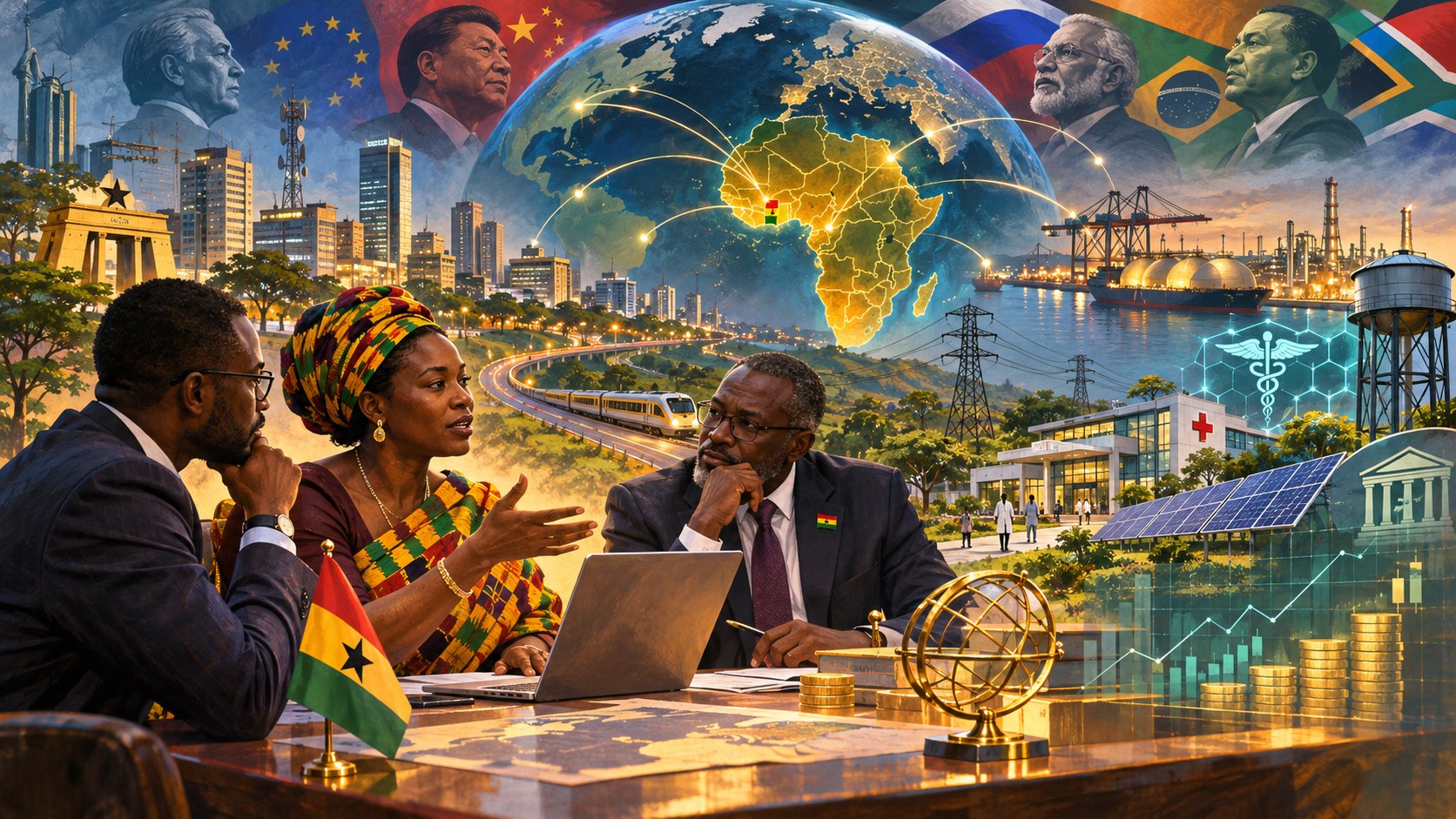
Ghana dominated much of the day’s cross-cutting analysis owing to a proliferating debate over the origins, substance, and direction of its engagement with the BRICS bloc. President John Mahama’s remarks, as reported by several sources, clarified that Ghana’s BRICS partnership proposal originated from a committee established under the previous Akufo-Addo administration—a detail intended to settle partisan speculation and demonstrate continuity across governments. Parallel commentary, such as that from 3News, framed Ghana’s overtures towards BRICS not as ephemeral sloganeering but as an exercise in strategic national self-interest. Both articles acknowledge Ghana’s ongoing assessment of BRICS as an alternative or supplement to traditional partnerships, reflecting a pragmatic approach to development and diplomacy rather than wholesale alignment. Nevertheless, neither report presents evidence of dramatic shifts in Ghana’s economic posture or irrefutable divergence from established international partners. These clarifications evidence a careful negotiation of agency rather than uncritical southward orientation.
Multipolarity, BRICS, and the Reach for Global Voice
The BRICS grouping surfaces in other contexts as well, most notably in the WHO Director-General’s applause for the New Delhi Declaration agreed at the BRICS 2026 Summit. The WHO endorsement, as synthesised from News On AIR, signals the bloc’s aspiration to influence global health governance and, by extension, a broader agenda of participating more forcefully in multilateral institutions. However, the evidence available does not yet confirm any immediate transformation in the mechanics of these institutions, but rather points to increased engagement and the symbolism of the bloc’s agenda-setting capacity. Independent variables—such as the persistent economic activity in Iran and structured investments in Egypt’s health system—underscore parallel strategies deployed by states subject to or outside of Western-dominated global governance structures, without clear proof of realignment of the international system as a whole.
Tensions and Agency: Israel, Cuba, and Guinea-Bissau in the Geopolitical Frame
While intra-BRICS and African relations receive significant attention, events elsewhere revealed enduring competition and contestation. The US decision to intensify sanctions on Cuba, per Antiwar, demonstrates an ongoing reliance on unilateral measures characteristic of the post-Cold War order, even as international criticism mounts regarding their impact on civilians. In the Middle East, Israeli military and construction activities in Syria’s Quneitra governorate signal both the persistence of regional interventions and the challenges of upholding international norms. The article on new senator Abdul El-Sayed in the US further reflects how domestic political shifts (here, driven by public sentiment on Palestine) can unsettle, but not necessarily overturn, longstanding alliance systems. Meanwhile, Guinea-Bissau’s decision to halt a US-funded vaccine trial amidst ethical controversy illustrates how African states—regardless of economic dependency—can exercise agency and contest external scientific agendas when sovereignty or population welfare is perceived at risk.
Resource Politics, Infrastructure, and Development: African Realities
The digest presents a mixture of developmental optimism and chronic shortfalls in African infrastructural, financial, and governance landscapes—often with complex ties to both established and emerging global actors. Zambia’s anticipation of a 2029 operational launch for the electricity interconnection to Tanzania exemplifies slow, regionally-driven infrastructure integration, responding both to internal needs and to the potential for cross-border energy trade within the continent. Mozambique, grappling with declining traditional gas reserves, accelerates the Matola LNG terminal in hopes of sustaining its export position. In both cases, international actors (whether private sector, donor countries, or multilateral bodies) remain indispensable, but the protagonists are African ministries and firms.
In South Africa, Eskom’s announcement of a 532-day streak without load shedding marks tangible if partial improvement in power stability—tempered by the reality that nearly 200,000 customers still experience forced load reduction. This development, coupled with Ghana’s initiatives to mobilise risk capital and connect digital skills programmes to genuine employment, suggests a continent intent on transcending its historic setbacks. Nevertheless, as underscored by the interview cited by All Africa, access to risk capital—not merely liquidity—is a major structural constraint limiting Africa’s entrepreneurial and technological ascent. The international system, including new ‘southern’ alignments, has yet to provide clear remedies for these persistent deficits.
The Diaspora and African Development: Calls for Pragmatism
Ghana’s call to ease barriers for diaspora return—and to provide robust support for integration and investment—articulates a long-standing but under-implemented agenda: channelling the capital and capacity of the global diaspora for national gain. This approach, while not unique to Ghana, demonstrates the country’s recognition that the international order’s hierarchies can be mitigated by leveraging non-state actors embedded in global networks. Here, too, the evidence points to an agency conditioned by practical constraints and the need for state-led facilitation.
Multipolarity and BRICS: Cautious Steps Rather Than Systemic Upheaval
The documentary evidence for today does not support claims of a decisive new multipolar world order. Ghana’s engagement with BRICS is incremental rather than transformative, and is marked by internal debate, cross-administration continuity, and pragmatic rhetoric. The New Delhi Declaration’s endorsement by the WHO indicates that BRICS members are seeking greater influence within existing multilateral frameworks, but the reported coverage does not document whether these interventions have resulted in significant structural reconfiguration beyond enhanced visibility.
Likewise, intra-African and south–south endeavours—whether in power infrastructure, health, skilled labour formation, or risk finance—evince ambition tempered by endemic obstacles. Notably, regional crises, such as Mozambique’s ongoing conflict in Cabo Delgado (mitigated in part by food donations from external sources such as Finland and Ukraine), underline the continuing dependency on global humanitarian networks. The day’s developments thus point to a world in which the rebalancing of power is slow, contested, and subject to the legacies of past alignments as much as to new initiatives.
Implications for Africa: Between Aspiration and Constraint
The dominant theme emerging across the news cycle is African assertion—whether in Ghana’s carefully navigated BRICS strategy, Guinea-Bissau’s pause on a controversial trial, or local efforts to address infrastructural and financial bottlenecks. However, such agency is often bounded by external structural constraints and historic dependencies. Ghana’s nuanced approach to BRICS, for example, reflects broader continental debates: how to cultivate leverage between major world blocs whilst sustaining productive relationships within the traditional Western sphere. The challenge of mobilising risk capital, not simply capital, encapsulates the practical shortfalls that frequently delimit transformative potential. Ethiopia’s new real estate credibility efforts, Zambia’s interconnection project, and South Africa’s partial power turnaround all stand as testaments to indigenous solutions with regionally and internationally entangled implications.
Conclusion: Gradual Change, Incremental Agency
The digest from 6 November 2026 reveals international alignments undergoing modest recalibration rather than abrupt reversal. African states continue to assert agency within international frameworks, exploring alternatives such as the BRICS collective and reformulating domestic agendas to compete in evolving global markets. At the same time, the enduring influence of Western economic, humanitarian, and scientific networks—be it through sanctions, financial support, or regulatory paradigms—remains a defining feature of the strategic landscape. Evidence from the present news cycle underscores the complexity and incrementalism characterising the global order’s evolution, and places African agency at the centre of both aspiration and constraint in the years ahead.
Editorial Note: This analysis draws exclusively on aggregated summaries from the 6 November 2026 Freenet Africa Digest and does not constitute independent reporting or source verification.
Editorial source note: This analysis is based on the aggregated summaries in Freenet Africa Daily News Digest — 6 November 2026. The underlying reports have not been independently verified for this analysis.