


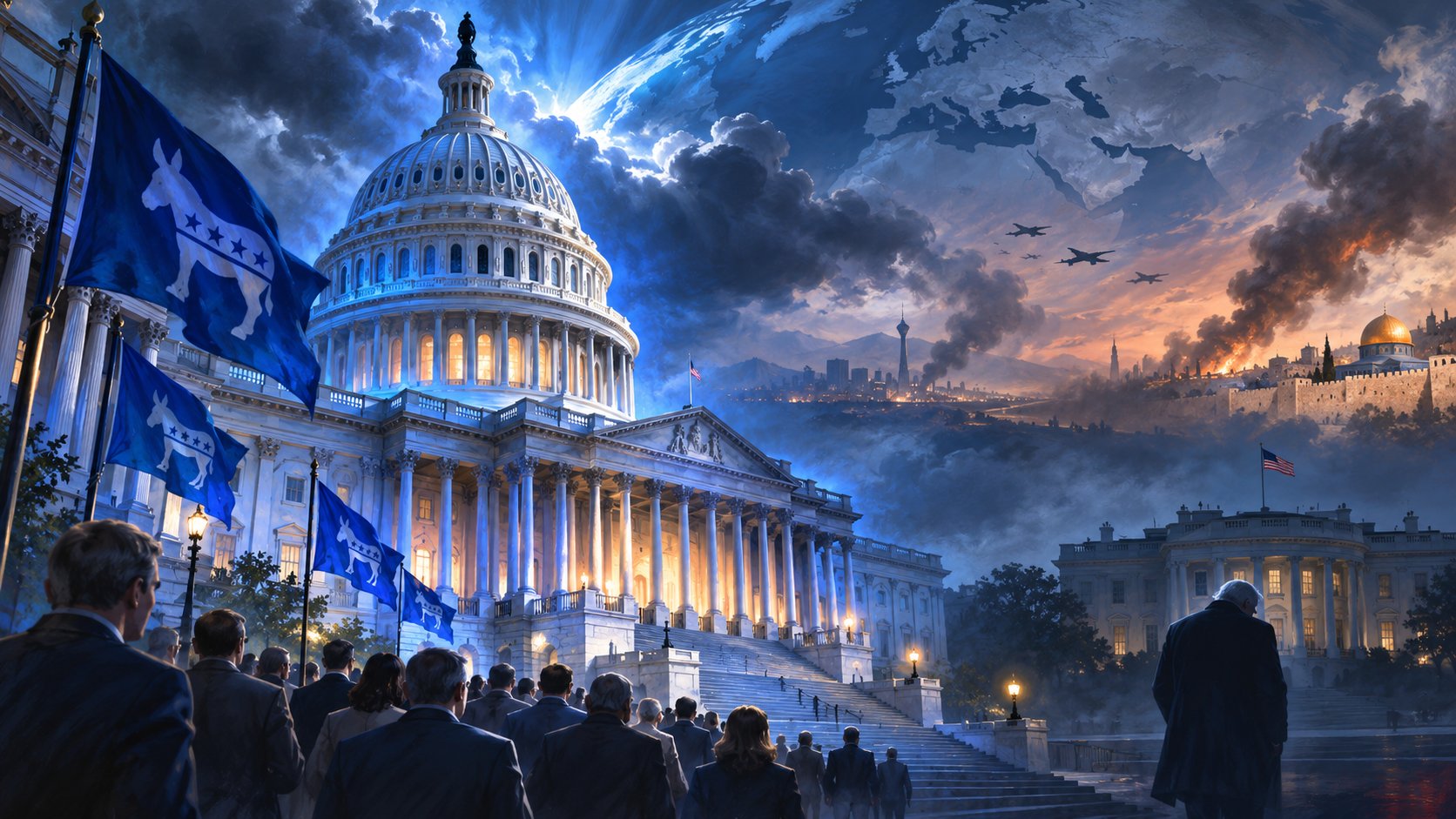
A historic Democratic takeover of both chambers of Congress constrains a wounded president and puts the Iran war and the Israeli–Palestinian conflict under new scrutiny. The effects will be felt far beyond Washington.
The 2026 U.S. midterm elections delivered one of the most decisive repudiations of a sitting president in modern American history. Democrats won control of both the House and the Senate, along with a string of governorships in traditionally Republican territory. The result ends two years of unified Republican government and places the war in Iran, the conflict in Gaza, and the wider Middle East at the centre of a newly contested American foreign policy.
For global audiences, the significance lies less in the domestic political drama than in the levers Congress now holds: control of military and security assistance, sanctions legislation, war-powers authority, and the confirmation of senior officials. Those levers will shape how Washington conducts itself in West Asia over the next two years.
A constrained presidency
With both chambers lost, President Donald Trump becomes a lame duck in practical terms. His legislative agenda is effectively finished, and the veto becomes his principal tool of governance. A Democratic Senate can block Supreme Court appointments and oppose Cabinet nominees; a Democratic House can subpoena officials, investigate the administration, and attach conditions to spending.
The president retains command of the armed forces and the authority to conduct diplomacy. But funding, confirmation, and political legitimacy are now contested. Analysts expect a period of partisan confrontation over budgets, executive power, and the conduct of the Iran war—and some warn that a president seeking to compensate for diminished domestic authority may act more aggressively abroad rather than less.
Iran: a war under new scrutiny
The unpopular war with Iran was a central issue in the campaign, tied directly in voters’ minds to rising fuel prices and the cost of living. The new Congress is expected to press the administration on the war’s origins, legality, and costs.
Practically, this means likely war-powers votes to force congressional authorisation for continued hostilities, appropriations measures restricting offensive operations, and hearings on the conduct of the campaign. Confirmation of hardline nominees for Iran-related posts will face sharper scrutiny. The political cost of escalation has risen considerably.
Two risks stand out. The first is a transition-period scramble: a president may seek to establish facts on the ground before the new Congress is seated in January. The second is that Tehran may read congressional constraints as diminished American resolve. The net effect is a narrower path to escalation and stronger pressure for a negotiated exit—but not a guarantee of either.
Palestine and Israel: conditionality, not rupture
Congress is deeply implicated in the Israeli–Palestinian file through military assistance, missile-defence funding, and oversight. A Democratic majority is expected to attach conditions to certain categories of arms transfers, expand human-rights vetting, and hold hearings on settlement expansion and civilian harm in Gaza. Humanitarian access and renewed funding for Palestinian humanitarian and civil-society programmes are likely to receive fresh attention.
A Democratic Senate can confirm ambassadors sceptical of settlement policy and take up symbolic resolutions on a two-state horizon. Yet bipartisan support for Israel’s security remains substantial, and without final seat margins it is difficult to gauge how far conditions will go. The realistic outcome is greater friction and conditionality rather than a rupture in the relationship—unless the new majorities are large and the president’s party fractures on the question.
Wider regional and global effects
America’s Gulf partners, Israel, and other regional actors are likely to hedge—courting the new congressional leadership while preserving channels to the executive branch. Turkey, Qatar, and Oman will remain important mediators. Russia and China will test whether congressional constraints translate into operational hesitation, particularly during the transition period.
Globally, a Congress that blocks presidential initiatives can reassure partners anxious about unilateral action. It can equally read as paralysis. Much depends on whether the new majorities pursue oversight as a governing strategy or as partisan warfare.
What to watch
Three indicators will reveal the direction of travel: the final seat margins in both chambers; the choice of committee chairs overseeing foreign affairs, armed services, and appropriations; and whether Democrats hold together on Israel-related votes. Together, these will determine whether the midterms produce incremental conditionality and oversight, or a genuine reorientation of American policy in West Asia.
What is already clear is that no president, however powerful, is invincible—and that Washington’s allies and adversaries alike are recalculating accordingly.
This analysis draws on CNN’s November 4, 2026 election analysis. Final vote margins were not available at the time of writing.