


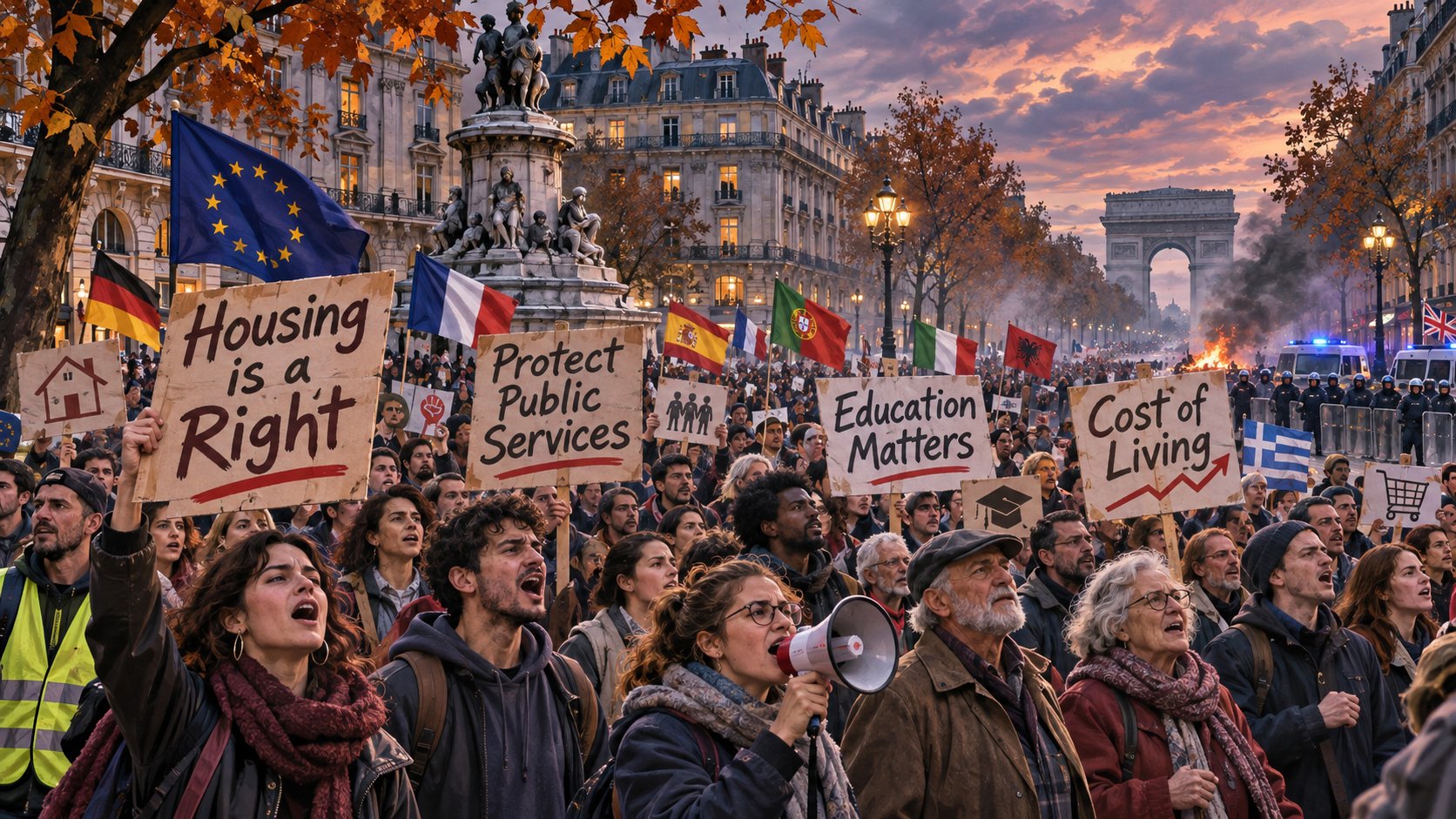
Across Europe, demonstrations over housing, wages, education, pensions and political accountability are becoming larger, younger and, in some cities, more confrontational. France is experiencing the most sustained mobilisation, but the unrest of recent weeks stretches from Italy and Portugal to Germany, Spain, Albania, Greece and Britain.
Europe is not in revolution. Governments are not collapsing across the continent and the overwhelming majority of people taking to the streets are demonstrating peacefully.
But something unusual is happening.
During the final days of October and the first week of November 2026, hundreds of thousands of Europeans have marched, gone on strike, occupied public squares, erected protest camps, blocked roads or confronted police. In several cities, peaceful demonstrations have been followed by rioting, burning barricades, smashed shopfronts and mass arrests.
The grievances differ from country to country. In France they encompass education, wages, public services and the cost of living. In Portugal, housing has become the focal point. Italians have protested against low wages, military spending and the cost of living. Spanish pensioners have marched over retirement security while young protesters in Barcelona have clashed violently with police. German youth have demanded better schools and affordable living. Albanian students have turned an education campaign into a challenge to the government itself.
Britain, meanwhile, has seen a different kind of confrontation: large-scale civil disobedience over restrictions on protest, accompanied by hundreds of arrests.
What links these movements is less a common ideology than a common sentiment: that the economic and political system is asking ordinary people—particularly younger generations—to accept steadily worsening conditions while offering little convincing prospect that those conditions will improve.
Reuters reported in late October that 40% of Europeans aged 16–30 identify the cost of living as a major concern, while more than a quarter of EU residents aged 18–24 were at risk of poverty or social exclusion in 2025. Housing, education, insecure employment and declining confidence in political institutions increasingly overlap.
France: the centre of the storm
Nowhere is that mixture more visible than France.
What began in September as demonstrations by school students complaining about understaffed schools, deteriorating buildings and education funding has expanded into a much broader movement. Workers, trade unions, university students, pensioners and some former Yellow Vest activists have joined demonstrations embracing wages, public services, inequality and the wider cost-of-living crisis.
France has now experienced repeated national mobilisations.
On 24 October, the Interior Ministry estimated that approximately 410,000 people demonstrated across the country, including around 110,000 in Paris. Organisers claimed substantially higher figures. The marches were generally calmer than the severe disturbances of 17 October, although clashes occurred in Nantes, Rennes and Marseille.
A week later, on 31 October, some 320,000 people again demonstrated according to government figures, including roughly 70,000 in Paris. Most authorised marches proceeded peacefully, but disturbances occurred during dispersal in Paris, Lyon, Marseille and other cities. Authorities maintained unusually heavy security, including restrictions around sensitive districts of the capital.
Then came 5 November.
A public-sector strike combined the student movement with organised labour on a much larger scale. The Interior Ministry estimated 575,000 demonstrators nationwide, while the CGT union claimed approximately 1.6 million. Around 70,000 police and gendarmes were deployed for more than 200 demonstrations.
The strike affected schools and energy production and closed the Eiffel Tower. According to Reuters, just over 15% of teachers participated. The demands now extend well beyond the original school protests: higher wages, protection of public services, employment security, education funding and relief from living costs.
Again, most demonstrations were peaceful. But clashes occurred in Paris and Lyon, police used tear gas, 448 arrests were reported and 53 police officers were injured. There were also incidents involving vandalism and fires at schools in Toulouse and the Paris region.
That distinction matters. France is witnessing a very large protest movement, but describing all of those demonstrators as rioters would be seriously misleading. The violence is generally associated with smaller groups operating within or around substantially larger peaceful marches.
Nevertheless, the disorder has changed the political atmosphere.
The serious violence and looting of 17 October prompted authorities to impose curfews, prohibit demonstrations in some cities and deploy unprecedented numbers of officers. Businesses have boarded windows. Authorities have restricted access to prominent public areas, while civil-liberties organisations have questioned whether some restrictions go too far.
President Emmanuel Macron is approaching the end of his presidency, unable to contest another consecutive term, and the unrest is unfolding as France enters an increasingly competitive 2027 presidential campaign.
The government has already indicated willingness to consider measures including an increase in the minimum wage and has promised thousands of additional teachers, smaller classes and billions of euros in loans for school renovation. Unions want significantly more.
France therefore faces an uncomfortable political equation: the government must demonstrate that it has heard the protesters while simultaneously keeping public spending and the national deficit under control. Reuters reports that the unrest is already affecting business and consumer confidence and has added to financial-market concern about France’s fiscal position.
This is no longer simply a student rebellion. It has become a national argument about the French social contract.
Italy: strikes, wages, war and public spending
Italy has experienced a parallel, although less concentrated, wave of protest.
On 24 October, thousands demonstrated in Rome, Milan, Turin, Bologna, Naples and Florence. Their grievances ranged from living costs and the policies of Prime Minister Giorgia Meloni’s government to opposition to war and increased military expenditure.
Most demonstrations were peaceful, but confrontations occurred in Turin, Rome and Bologna. Nine people were arrested and hundreds were temporarily detained for identification. Heavy police deployments followed more serious disturbances the previous weekend.
Six days later the pressure intensified.
A 24-hour general strike called by the grassroots USB union produced demonstrations in more than 40 cities on 30 October. Tens of thousands of students and workers demanded higher wages, stronger public services and relief from rising living costs while opposing increased military expenditure and the use of Italian ports for arms shipments.
The demonstrations again illustrated the divide between mass protest and violent fringes.
In Turin, police used water cannon against protesters near the prefecture. In Rome, rubbish bins were set alight and police dispersed a group attempting to approach parliament, with eight people detained. In Milan, demonstrators entered the ring road and fires were started. In Genoa, approximately 15,000 protesters, including students and port workers, entered the port area.
Italian protesters are therefore combining two political arguments that governments across Europe increasingly find difficult to separate: the domestic affordability crisis and the question of how much money Europe should devote to defence and international conflicts at a time when citizens perceive schools, healthcare, transport and household budgets to be under pressure.
That connection may become increasingly important.
European governments face demands for substantially greater defence expenditure at the same moment that ageing populations, expensive energy, weak economic growth and housing shortages are placing additional strain on public finances.
For protesters, the question is simple: if governments can find additional billions for defence, why can they not find comparable resources for housing, schools, wages and hospitals?
Governments, naturally, argue that national security cannot be postponed until every domestic social problem has been solved.
The political conflict between those two positions is likely to intensify.
Portugal: housing becomes a political flashpoint
Portugal’s protests are perhaps the clearest example of a single economic issue developing into something broader.
The issue is housing.
Portugal is experiencing one of Europe’s most severe affordability crises. Reuters reports that house prices have more than doubled since 2017, while rents on new leases have almost doubled. The Bank of Portugal estimates a national shortfall of around 300,000 homes.
For young Portuguese in particular, the arithmetic is becoming brutal.
Associated Press reported that a typical one-bedroom Lisbon apartment can cost around €1,500 per month while the national minimum wage is €920 before tax. Housing prices rose 147% between 2015 and 2025, with foreign investment, tourism, short-term rentals and insufficient supply contributing to the pressure.
Thousands marched through Lisbon on 24 October carrying keys and banners declaring that housing is a right rather than a luxury.
After the demonstration, more than 100 tents were erected in Rossio Square. In the early hours of 25 October police moved in, some accompanied by dogs, and baton-charged protesters while dismantling the camp. Twenty-five people were arrested. A separate camp in Porto was also cleared and six people arrested.
Police reported seven minor injuries during the two operations. The activist organisation Casa para Viver claimed approximately 60 people had been injured.
Instead of ending the movement, the intervention expanded it.
Thousands gathered outside parliament on 27 October protesting both the housing crisis and police tactics. Portugal’s internal affairs watchdog opened an inquiry into the police operations and prosecutors launched a separate investigation into officers’ conduct.
Then, on 31 October, thousands returned to Lisbon’s streets and protesters again established a camp in Rossio Square, this time with more than 50 tents. Police once again dismantled it during the early hours of the following morning, using shields and some baton charges to disperse hundreds of people surrounding the camp. A smaller Porto occupation was also removed.
At the heart of the dispute is proposed legislation that would make evictions easier and end rent caps on new leases. Prime Minister Luís Montenegro has rejected demands to withdraw the bill, although he has indicated that amendments may be possible before its final vote.
Portugal therefore demonstrates how quickly an economic protest can acquire a second grievance.
The original question was affordable housing.
Now the right to protest and the proportionality of police intervention are part of the argument as well.
Spain: two very different protests
Spain has offered an extraordinary contrast.
In Madrid on 24 October, approximately 25,000 people marched peacefully demanding protection of the public pension system.
Protesters called for pensions to remain linked to inflation, a minimum pension comparable with the minimum wage, protection against privatisation and measures to reduce the gender pension gap. The demonstration proceeded peacefully through central Madrid.
That same evening, Barcelona presented a completely different picture.
A relatively small youth protest around Plaça de Catalunya deteriorated into serious disorder. Groups smashed windows, erected barricades, set rubbish bins on fire and threw stones and other objects at police. Shops were looted.
Authorities reported 128 arrests, roughly a quarter involving minors, and 15 police officers injured. Train services through Plaça Catalunya were temporarily interrupted and businesses closed.
The gathering had been promoted on social media under the name Instituts Indignats and consciously borrowed imagery from the French student movement.
The comparison is important because it exposes one of the dangers in talking about a single European protest wave.
Twenty-five thousand pensioners walking peacefully through Madrid and several hundred youths involved in clashes in Barcelona are not the same political phenomenon simply because they occurred on the same day.
Yet both emerge from anxiety about economic security and the future.
Germany: Generation Z takes to the streets
Germany entered the picture dramatically on 31 October.
The youth initiative Gen Z regelt—roughly, “Gen Z takes charge”—organised demonstrations across 34 German cities, including Berlin, Frankfurt and Munich.
Its demands included increased investment in education and healthcare, lower living costs, climate protection and opposition to compulsory military service.
Police figures from Frankfurt, Munich and Berlin indicated around 18,000 protesters combined, although organisers reported higher numbers. Most demonstrations were peaceful.
Frankfurt, however, experienced serious disturbances later in the day.
Stores were damaged and at least two were looted. Police reported Molotov cocktails being thrown at emergency services. Barricades were set alight in Hamburg, while authorities across several cities had already warned that extremist groups might attempt to exploit the demonstrations.
The organisers explicitly distanced themselves from violence.
The German movement nevertheless points to a broader generational anxiety emerging across Europe. Young people complain that they are inheriting deteriorating infrastructure, expensive housing, weak employment prospects and growing fiscal burdens while being asked to finance pensions for an ageing population, higher defence expenditure and the transition to a low-carbon economy.
Those concerns are not necessarily ideologically left or right.
They are increasingly generational.
Albania: protest becomes a challenge to government
In Albania, the protests have become explicitly political.
On 24 October, student-led demonstrations in Tirana escalated into serious confrontations with riot police.
Protesters threw rocks at officers and a fire was started at the entrance to the agriculture ministry. Police responded with tear gas, water cannon and rubber bullets.
The movement began around complaints about poor education standards, tuition costs, lack of employment opportunities and alleged corruption. It then expanded into a wider anti-government campaign demanding the resignation of Prime Minister Edi Rama, who has governed Albania since 2013 and secured a fourth term last year.
Government buildings and banks have been targeted during disturbances, shop windows smashed and paving stones torn from streets for use as projectiles.
Thousands participated on 24 October and approximately 2,500 police officers were reportedly deployed in Tirana. The demonstrations have attracted support from university professors, artists and opposition groups.
Of all the protests presently occurring in Western and Southern Europe, Albania’s therefore most closely resembles a conventional anti-government uprising rather than an industrial dispute or issue-based campaign.
Greece: the peaceful side of the protest wave
Greece illustrates the other side of the story.
On 5 November, students and teachers demonstrated in Athens and Thessaloniki demanding greater public funding for education, improved school and university buildings, additional teachers and better working conditions.
Teachers staged a four-hour work stoppage to participate.
The demonstrations were peaceful. Traffic restrictions were temporarily imposed in central Athens and the University metro station was briefly closed.
The demands nevertheless resemble those heard in France and Germany: better-funded education, improved infrastructure and relief from the cost of living.
Greece therefore reinforces the argument that Europe’s current protest wave cannot simply be described as “rioting”.
In many countries the mobilisation is large but entirely conventional democratic protest.
Britain: civil disobedience and mass arrest
Britain’s most notable protest confrontation during the period has taken a different form again.
On 31 October, protesters gathered outside the US embassy in London as part of a campaign opposing the government’s proscription of Palestine Action under terrorism legislation.
The Metropolitan Police subsequently reported 325 arrests, including 320 people accused of expressing support for the banned organisation. Many participants deliberately carried placards expressing support for Palestine Action as an act of civil disobedience.
The protest itself was not comparable to rioting in France, Barcelona or Tirana. The confrontation concerned the boundary between protest, free expression and national-security legislation.
The arrests occurred immediately before a Supreme Court challenge concerning the legality and proportionality of the ban. According to organisers, thousands of people have been arrested since the proscription came into force.
Britain therefore belongs in the wider picture not because it is experiencing widespread street violence, but because questions surrounding the right to demonstrate and the state’s response to protest have become unusually prominent.
A European revolt—or several crises happening at once?
It is tempting to bundle everything together and declare that Europe is experiencing a continent-wide revolt.
That would be dramatic.
It would also be inaccurate.
There is no single organisation coordinating these demonstrations, no common political manifesto and no unified demand. A French school student, Portuguese housing campaigner, Spanish pensioner, Italian dockworker, German anti-conscription activist and British civil-liberties protester may have little else politically in common.
But beneath those differences, several themes continually reappear.
Housing costs have risen faster than incomes. Public services are under pressure. Young people increasingly doubt that education will deliver the economic security enjoyed by previous generations. Governments face enormous demands on limited budgets. Energy remains expensive. Economic growth is weak in several major European economies. Populations are ageing. Defence expenditure is rising.
And perhaps most importantly, many protesters believe conventional political mechanisms are failing to respond quickly enough.
That explains why student demonstrations about leaking school roofs in France can evolve into national protests about wages and public services; why Portuguese housing activists move from marches to occupations; and why a German campaign about schools quickly embraces healthcare, military service, climate policy and living costs.
Specific grievances are becoming containers for something larger.
They express declining confidence in the promise that tomorrow will necessarily be better than today.
The danger for European governments
The principal risk for European governments is not that every demonstration becomes violent.
Most will not.
The more serious political danger is that different dissatisfied groups begin to recognise themselves in one another.
Students complain about education. Workers complain about wages. Families complain about housing. Pensioners fear losing retirement security. Taxpayers question military expenditure. Farmers, healthcare workers, public servants and small businesses have their own grievances.
If these constituencies remain separate, governments can negotiate with them separately.
If they begin to perceive their problems as different manifestations of the same failure of economic policy and political representation, protest can acquire a very different character.
France is the clearest warning.
A movement that began with young people complaining about schools has become a nationwide argument about wages, public services, inequality, taxation and political leadership.
Similar cross-pollination is already visible elsewhere.
The streets of Europe are not yet witnessing a single rebellion.
They are showing something potentially more consequential: a growing number of societies asking, at roughly the same moment, whether the economic and political bargains on which post-war European stability was built are still working.
For the rest of the world—and particularly for Africa, where Europe frequently presents its political institutions and social model as examples of stability—the current unrest deserves careful observation rather than simplistic conclusions.
Europe remains wealthy, democratic and institutionally strong.
But those strengths do not make it immune to the pressures familiar elsewhere: inequality, unaffordable housing, frustrated youth, declining trust and anger at governments perceived to be listening too slowly.
The demonstrations from Paris to Lisbon, Rome to Frankfurt and Tirana to London are different.
The dissatisfaction beneath them increasingly is not.