


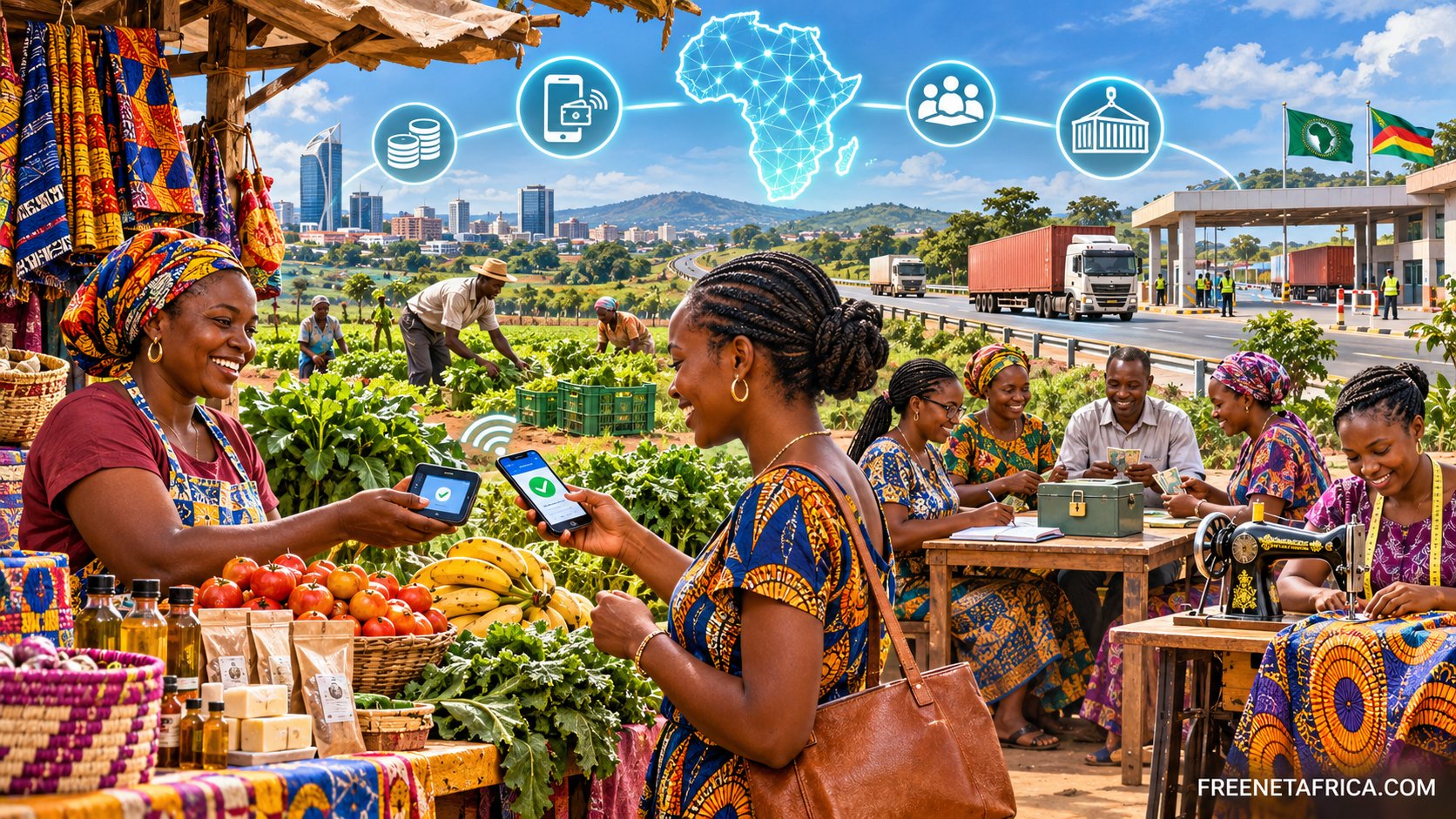
Why There Is No Single Silver Bullet for Poverty Reduction in Africa
Every few years, a new idea is presented as the answer to poverty in Africa’s poorest nations. In the 1980s it was structural adjustment; in the 2000s, microcredit was hailed as a revolution; more recently, mobile money and continental free trade have taken turns in the spotlight. Each of these tools has genuine value. None of them, on its own, has lifted whole economies out of poverty. The honest story is more complicated — and more useful — than the headlines suggest.
This article looks at three levers that dominate current policy debate: microfinance, mobile money, and trade reform. It examines what the evidence actually shows, where the hype outruns the data, and how the three can work together. The central argument is simple: finance without connectivity is slow, connectivity without market access is limited, and market access without functioning institutions is fragile. Progress comes from combination, sequencing, and context — not from silver bullets.
The Scale of the Challenge: Unbanked Adults and Informal Economies
Sub-Saharan Africa is home to hundreds of millions of adults who remain outside the formal financial system, according to Global Findex estimates (figures should be checked against the latest edition). Most of these adults work in the informal economy — trading, farming, running small stalls, providing services — where income is irregular, records are scarce, and collateral is rare. This matters because almost every financial product designed in rich countries assumes exactly what the poorest Africans lack: documented income, formal identity, and a bank branch nearby.
Informality also shapes trade. A large share of cross-border commerce in Africa moves through unofficial channels, often in small consignments carried by individual traders. Any reform that ignores this reality — whether a credit product or a tariff schedule — will miss most of the people it aims to help.
Three Levers: Finance, Connectivity, and Market Access
The three levers address different constraints:
- Microfinance tackles the credit and savings constraint — the lack of capital to invest, smooth consumption, or absorb shocks.
- Mobile money tackles the transaction-cost and distance constraint — the difficulty and expense of moving money safely.
- Trade reform tackles the market-access constraint — the barriers that keep small producers from selling beyond their village or border.
Each lever relaxes a different bottleneck. A farmer with credit but no buyer gains little; a trader with mobile payments but no credit cannot scale; a producer with market access but no working capital cannot fulfil orders. That is why the most promising programs bundle them.
Why Institutional Quality and Governance Are Binding Constraints
It is tempting to treat technology and finance as forces that bypass weak states. They do not. Mobile money depends on regulators who permit innovation while guarding stability. Microfinance depends on contract enforcement and consumer protection. Trade agreements depend on customs officials who implement them honestly and courts that resolve disputes. Where governance is weak, elite capture is common: subsidized credit flows to the connected, import licenses become rents, and well-designed programs are hollowed out in implementation.
Infrastructure is the other hard limit. Roads, electricity, and internet coverage determine whether a digital payment or a trade corridor actually reaches a rural district. No amount of fintech innovation compensates for a bridge that does not exist.
Setting Realistic Expectations for Poverty Reduction Strategies for Africa
Realism is not pessimism. It means expecting modest, uneven, and gradual gains rather than transformations within a few years. It means measuring outcomes over a decade, not a project cycle. And it means accepting that the binding constraints — governance, infrastructure, and political stability — are precisely the ones that outside actors can influence least directly.
Microfinance in Africa: Promise, Evidence, and Limits
Microfinance remains the most studied anti-poverty intervention in development economics, and the most misunderstood. Its early champions promised that small loans would unleash entrepreneurial energy and end poverty at scale. The evidence has since become more nuanced — not because microfinance fails, but because it does several modest things rather than one dramatic thing.
How Group Lending Works and Why It Spread
The classic model, pioneered by Grameen Bank in Bangladesh, lends to groups rather than individuals. Members guarantee one another’s loans, substituting social pressure for physical collateral. The approach spread rapidly across Africa in the 1990s and 2000s because it solved a real problem: poor borrowers had no assets to pledge, but they did have reputations within tight-knit communities.
Group lending lowered the cost of screening and monitoring for lenders and gave borrowers access to sums that mattered for petty trade, livestock, and farming inputs. It also created social infrastructure — regular meetings, savings habits, and peer support — that proved valuable beyond credit itself.
Graduation Programs: Bundling Credit with Training and Safety Nets
Practitioners noticed that the very poorest often could not use a loan well: they were too focused on daily survival to take on debt. Graduation programs, pioneered by BRAC and now tested in many countries, respond by bundling several elements — a productive asset (such as livestock), training, a small stipend or consumption support, savings encouragement, and health access — over roughly two years. The design is deliberately sequenced: stabilize first, then build assets, then connect to finance.
Evidence on graduation programs is generally more encouraging than on credit alone, particularly for consumption and asset accumulation. The lesson is that credit works best when the other constraints on a household’s ability to use it are addressed at the same time.
What RCTs Actually Show About Microfinance and Poverty
A wave of randomized controlled trials — including influential studies by Banerjee, Duflo, Karlan and others — examined what happens when microcredit becomes available in new markets. The findings were consistent and sobering for enthusiasts:
- Take-up was often modest; many eligible households chose not to borrow.
- Business investment and profits rose modestly among some borrowers.
- Average effects on poverty, consumption, education, and women’s empowerment were small and highly heterogeneous.
- Some households benefited substantially; others saw little change or were worse off.
These results do not show that microfinance is useless. They show that it is a financial service with real but bounded effects, and that “average” impacts hide wide variation. Claims that microcredit reliably lifts whole communities out of poverty are not supported by the best evidence.
Over-Indebtedness, Mission Drift, and Consumer Protection Risks
The risks are equally well documented. Multiple borrowing from several lenders, aggressive collection practices, and high effective interest rates can push households into distress. In several markets, competitive pressure has led to over-lending in saturated areas. “Mission drift” is another concern: institutions that began as poverty-focused NGOs may shift toward wealthier clients and profitable products to achieve financial sustainability.
Consumer protection is the missing piece in many markets — transparent pricing, grievance mechanisms, credit bureaus, and limits on predatory collection. Without these, microfinance can transfer risk onto the poorest borrowers rather than reduce it.
How Microfinance Helps Reduce Poverty in Africa: What the Evidence Supports
A fair summary of the evidence is that microfinance helps most reliably when it:
- Provides safe savings and insurance alongside credit, not credit alone.
- Targets borrowers with genuine investment opportunities.
- Bundles training, market linkages, or safety nets for the very poorest.
- Operates under effective consumer protection and supervisory oversight.
Used this way, it is a useful tool for smoothing consumption, building small assets, and supporting microenterprise. It is not, on its own, an engine of structural poverty reduction.
Mobile Money and Financial Inclusion: Lessons from M-Pesa
If microfinance’s story is one of modest and contested gains, mobile money’s story is one of genuine, rapid transformation — at least in the places where conditions aligned. M-Pesa, launched in Kenya in 2007, is the flagship case, and it is worth understanding both why it worked and why copying it has proven harder than it looks.
How M-Pesa Succeeded: Agent Networks, Regulation, and Trust
M-Pesa succeeded through a combination of factors that are difficult to assemble deliberately:
- A dominant telecom with existing distribution reach and brand recognition.
- A dense agent network — small shops and kiosks where cash could be deposited and withdrawn — that brought banking to where people already were.
- Light-touch, enabling regulation that allowed the service to launch and scale before formal banking rules could strangle it.
- Trust, built through visible reliability and word of mouth in a market where formal banks had served only a small minority.
The service filled a real gap: sending money home safely and cheaply. Once people trusted the system for remittances, they began using it for savings, bill payments, and small business transactions.
Evidence on Savings, Remittances, and Women’s Empowerment
Research on mobile money has found meaningful effects: increased household savings, more efficient and frequent remittances, better risk-sharing against shocks, and — in several studies — measurable gains in women’s economic agency, as women gained greater control over money received and sent. Mobile money accounts across sub-Saharan Africa have grown sharply, according to GSMA State of the Industry reports (check the latest edition for current figures).
These effects are real but should not be overstated. Mobile money is primarily a payments and storage tool; it does not by itself create income or credit access. Its poverty impact comes indirectly, through lower transaction costs and better resilience.
Barriers to Mobile Money Adoption: ID, Literacy, Fees, and Connectivity
The people still excluded are excluded for concrete reasons:
- Identity documents — SIM registration and KYC rules exclude those without official ID, disproportionately women and rural residents.
- Literacy and digital skills — menu-driven USSD interfaces still assume basic literacy and numeracy.
- Fees — small balances make even modest transaction charges significant.
- Agent networks — rural and remote areas often lack reliable cash-in/cash-out points.
- Connectivity and electricity — network coverage and phone charging remain constraints in the poorest districts.
Each barrier is a policy choice as much as a technical one. Digital ID programs, tiered KYC rules, and agent-network incentives can all widen access.
Can the M-Pesa Model Be Replicated Across Africa?
Partially. Elements — agent networks, enabling regulation, simple interfaces — can be adapted. But replication has often disappointed because the underlying conditions differ: fragmented telecom markets, stricter regulators, lower population density, or weaker trust. Some countries have seen strong growth through bank-led or fintech-led models rather than telecom-led ones. The lesson is not to copy M-Pesa but to identify which constraint — distribution, regulation, or trust — is binding locally, and to design accordingly.
Mobile Money Adoption and Financial Inclusion in Africa: Beyond the Hype
Account ownership is not the same as active use, and active use is not the same as financial health. Many accounts sit dormant; many users still rely on cash for most transactions. The genuine achievement is that hundreds of millions of people now have a safe, cheap way to move money — a foundation on which credit, insurance, and savings products can be built. That is substantial, but it is infrastructure, not a finished anti-poverty strategy.
Trade Reform and Market Access for Africa’s Poorest Nations
Finance and payments help households manage what they have. Trade reform is about expanding what they can earn. The potential is large — African economies trade far less with each other than comparable regions do — but so are the obstacles.
AfCFTA: Ambitions, Implementation, and Limits for the Poorest Countries
The African Continental Free Trade Area entered into force in 2019, with trading beginning in 2021, and has more than fifty signatories. Its ambition is to create a single market across the continent, reducing tariffs and eventually harmonizing rules. For small economies, the promise is access to a much larger market and the chance to join regional value chains.
The limits are equally real. Tariff reductions mean little if goods cannot move — poor roads, slow customs, and non-tariff barriers can cost more than the tariffs themselves. Implementation is uneven, and the poorest, landlocked, and conflict-affected states have the least capacity to take advantage. AfCFTA is a framework, not an outcome.
Tariff and Non-Tariff Barriers That Still Bind
Non-tariff barriers often matter more than tariffs: rules of origin, standards and certification, sanitary requirements, customs delays, and informal payments at borders. For a small producer, the cost of complying with a certificate of origin or a quality standard can exceed the value of the tariff saving. Simplifying and digitizing these processes — single windows, electronic documentation, mutual recognition of standards — is unglamorous but decisive.
Informal Cross-Border Trade and Women Traders
A large share of intra-African trade is informal, carried out by small-scale traders, many of them women, who cross borders with goods worth modest sums. These traders are often invisible in official statistics and disproportionately burdened by harassment, arbitrary fees, and complex documentation. Reforms that formalize and simplify small-scale trade — simplified certificates, dedicated border lanes, clear fee schedules — can deliver quick, tangible gains to exactly the people poverty strategies aim to reach.
Aid-for-Trade and Value Chain Upgrading
Aid-for-trade support helps poorer countries build the capacity to trade: customs systems, standards laboratories, trade facilitation, and export promotion. Value chain upgrading — moving from raw commodities to processing, branding, and higher-value products — offers the largest income gains but requires investment, skills, and reliable infrastructure. Both are long-term investments that rarely produce quick headlines.
Why Landlocked and Conflict-Affected States Lag Behind
Landlocked countries depend on their neighbours’ roads, ports, and customs, making trade costs structurally higher. Conflict-affected states face destroyed infrastructure, absent institutions, and risk premiums that deter investment. For these countries, trade reform is necessary but far from sufficient; peace, basic infrastructure, and functioning customs matter more than tariff schedules. Realistic strategies must sequence these foundations first.
Combining Microfinance, Mobile Money, and Trade Reform for Greater Impact
The strongest argument in this field is not for any single lever but for their combination. Each addresses a different constraint, and the constraints bind together.
Why Bundled Interventions Outperform Single Levers
A producer who gains market access through a trade corridor still needs working capital to fulfil orders and a safe way to receive payment. A microfinance client with a good business idea still needs buyers and reliable payments. A mobile money user can save and transact but cannot invest without credit. Bundling addresses these gaps simultaneously, and evaluations of multi-component programs generally show larger and more durable effects than single interventions.
Sequencing and Context: What to Do First
Sequencing matters. In fragile or low-capacity settings, basic stability, identity systems, and connectivity come first; credit can do harm before households can use it well. In more stable settings with existing agent networks, linking savings groups to digital payments and then to market information may be the highest-return next step. There is no universal order — but ignoring context is the most common failure.
Combining Microfinance and Mobile Money for Poverty Alleviation
Digitizing microfinance — disbursing loans and collecting repayments via mobile money — lowers costs, reduces fraud, and builds credit histories for borrowers who had none. Savings groups can hold funds digitally, reducing theft risk. These combinations are already spreading and represent one of the most practical routes to broader inclusion.
Digital Payments as a Bridge to Formal Trade and Credit
Digital transaction records create something the poor have historically lacked: a verifiable financial history. That history can support credit scoring, insurance underwriting, and participation in formal supply chains. A trader who is paid digitally can demonstrate turnover to a lender or a buyer. In this sense, mobile money is not just a convenience — it is infrastructure for formalization and market access.
Who Does What: Governments, Donors, and the Private Sector
Division of labor matters as much as the tools themselves. Each actor has comparative advantages — and characteristic failure modes.
The State’s Role: Regulation, Infrastructure, and Industrial Policy
Governments set the rules of the game: proportionate regulation that permits innovation while protecting consumers, investment in roads, power, and connectivity, and predictable policy that allows firms to plan. Industrial policy — targeted support for particular sectors — can accelerate value chain development, but it is vulnerable to capture and requires strong administrative capacity to avoid becoming a subsidy for the connected.
Donor Roles: Evidence, Risk Capital, and Avoidable Distortions
Donors are most useful when they fund evidence, take risks the market will not, and build local capacity. They are least useful when they flood markets with subsidized credit that crowds out sustainable providers, or when they fund projects designed to satisfy reporting requirements rather than local needs. Humility and patience are undervalued donor virtues.
Private Sector and Fintech Innovation
The private sector drives innovation and delivery — agent networks, payment platforms, and product design. But private incentives do not automatically serve the poorest; commercial logic pushes toward denser, wealthier markets. Public policy therefore has a role in shaping incentives: interoperability requirements, universal service obligations, and targeted subsidies can push commercial innovation toward underserved areas and populations. The goal is not to replace private dynamism but to steer it toward the people who need it most.
Political Economy Risks: Elite Capture and Weak Regulatory Capacity
Every tool in this article can be captured. Subsidized credit programs can become patronage networks; trade licenses and import quotas can become rents for the well-connected; mobile money regulation can be shaped by incumbent telecoms to exclude competitors. Weak regulatory capacity compounds the problem: supervisors lack the skills and independence to police complex financial products, and customs officials lack the incentives to enforce rules fairly. Recognizing these political realities is not cynicism — it is a precondition for designing programs that are harder to capture, with transparent rules, independent oversight, and mechanisms that give excluded groups a voice.
Source: FREENET AFRICA