

How Freenet Africa Works: Inside Our AI-Driven News and Analysis Network
The Freenet Africa Network (FNA) is an AI-driven news aggregation, analysis and publishing platform designed to transform global news reporting into a structured, continuously developing body of information, analysis and historical perspective.
Rather than simply reproducing news stories as they appear, Freenet Africa operates a multi-stage editorial production system that gathers information from selected international news sources, organises the day’s developments, identifies significant emerging patterns and produces analytical publications covering increasingly longer periods.
The objective is to build an independent information resource that allows readers to follow not only what is happening around the world, but also how events relate to one another, how circumstances evolve over time and what broader geopolitical, economic and social developments may mean for Africa and the international community.
The system is designed to function with a high degree of automation, using artificial intelligence throughout the editorial production process, from news selection and information processing to analysis, summarisation and the preparation of publications.
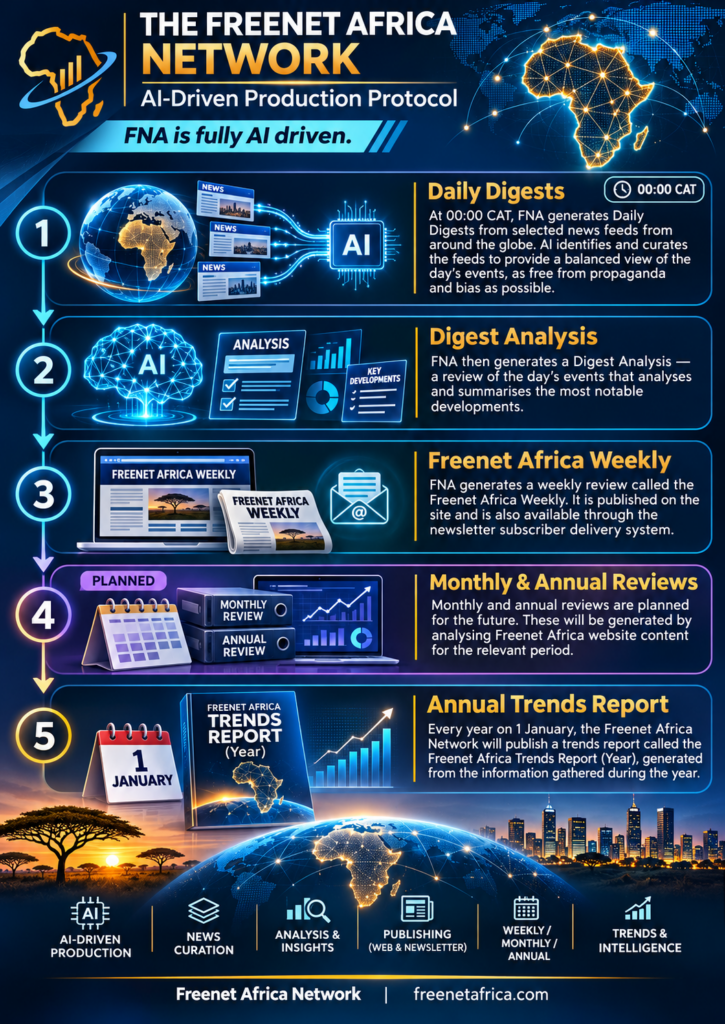
At the centre of the network is a five-stage production protocol. Each stage builds upon information generated by the preceding stages, progressively transforming daily news into a cumulative record of global developments.
The first three stages are operational. Two additional stages, involving longer-term historical analysis and annual trend identification, are planned extensions of the network.
1. Daily Digests: Building the Global News Record
Production schedule: Daily, beginning at 00:00 CAT (Central Africa Time)
The first stage of the Freenet Africa production protocol is the creation of the FNA Daily Digest.
This is the foundation upon which the entire publishing system operates.
Every day, Freenet Africa processes information drawn from a selection of international news feeds, representing different geographical regions, political environments, economic interests and editorial perspectives.
AI-Assisted News Source Selection
One of the fundamental challenges facing contemporary news consumers is the fragmentation of the global information environment.
Different news organisations frequently present the same international development through substantially different political, cultural or ideological perspectives.
An event reported by a Western media organisation may be interpreted quite differently by an African, Asian, Middle Eastern or Latin American publication. Even the selection of which stories deserve attention can vary considerably between regions.
Freenet Africa seeks to address this imbalance by drawing information from a geographically and editorially diverse collection of sources.
Artificial intelligence assists in identifying and curating these sources, with the objective of creating a broader and more representative picture of international developments.
The intention is not to assume that any particular news organisation is completely objective. Rather, it is to reduce dependence on a single narrative by incorporating information originating from multiple perspectives.
This approach recognises that genuinely balanced international reporting requires exposure to competing interpretations, particularly when dealing with geopolitical disputes, military conflicts, international economic relationships and major political developments.
Daily Information Collection and Processing
At 00:00 CAT, the scheduled Daily Digest production process begins.
The system draws upon the selected news feeds and prepares a consolidated account of the material available for the reporting period.
Artificial intelligence processes the incoming information, identifying newsworthy developments across the principal areas of international affairs.
These may include:
- African politics, governance and regional affairs.
- International relations, diplomacy and geopolitical developments.
- Global economic activity, trade, investment and financial affairs.
- International security, military conflicts and peace initiatives.
- Energy, infrastructure, technology and industrial development.
- Climate change, environmental policy and sustainability.
- Science, healthcare, education and social developments.
- International organisations and multilateral cooperation.
- Cultural developments and significant events affecting societies worldwide.
Particular attention is given to events affecting Africa and the evolving relationships between African nations and the wider international community.
However, Freenet Africa is not exclusively an African domestic news service. Its editorial scope is international, reflecting the reality that developments in other parts of the world frequently have direct consequences for African economies, societies and political institutions.
Producing the Daily Digest
The AI production system organises the collected material into a coherent daily publication.
Related developments are grouped together, significant information is summarised and the material is structured to make the day’s international news easier to understand.
The Daily Digest is intended to provide readers with an accessible overview of important developments without requiring them to consult numerous individual news organisations.
Where source references are available, they provide a means of identifying the reporting upon which the digest is based.
The resulting publication is then made available on the Freenet Africa website as part of its permanent news archive.
Importantly, the Daily Digest is primarily a structured record of reported events, rather than an extensive interpretation of their significance.
Its central purpose is to establish the factual and contextual foundation required for the next stage of the production process.
The distinction matters: the network first records what has been reported before undertaking a broader analysis of what those developments may signify.
2. Digest Analysis: Understanding the Meaning Behind the News
Production cycle: Daily, following the preparation of the Daily Digest
The second stage transforms the collected daily news material into a more interpretative publication known as the FNA Digest Analysis.
While the Daily Digest answers the question, “What happened?”, the Digest Analysis attempts to answer a more demanding series of questions:
Why did it happen? What does it mean? How does it connect with other developments? And what might happen next?
From Information to Interpretation
News events rarely occur in isolation.
A change in international trade policy may be connected to diplomatic tensions, competition for natural resources, industrial policy or wider changes in economic power.
A regional security crisis may reflect historical grievances, economic instability, competing external interests or developments occurring thousands of kilometres away.
Similarly, new infrastructure investments, diplomatic agreements or changes in international financial institutions may be important not simply as individual events but as indicators of wider structural change.
The FNA Digest Analysis examines the day’s material with these relationships in mind.
Using the Daily Digest as its principal source, artificial intelligence identifies important developments and evaluates their possible connections, consequences and wider significance.
The resulting publication moves beyond summarisation to provide an integrated interpretation of the day’s events.
Identifying the Most Significant Developments
Not every news story carries equal international significance.
Some developments may attract considerable immediate media attention but have little enduring importance. Others may initially receive relatively modest coverage while representing significant changes in international relationships.
The analysis process therefore seeks to distinguish between short-lived events and developments that may have more substantial implications.
Particular attention is given to emerging geopolitical trends, economic realignments, international institutional change and the evolving relationships between established and emerging centres of influence.
These assessments also consider implications for Africa, including trade relationships, investment flows, development opportunities, economic sovereignty and diplomatic independence.
Understanding an Emerging Multipolar World
A central element of Freenet Africa’s analytical perspective is the evolution of the international system towards a more multipolar distribution of political and economic influence.
For much of the modern era, international reporting has been dominated by perspectives originating in established Western political and economic centres.
Although these perspectives remain important, they do not necessarily represent the complete range of international interests or experiences.
The growing international influence of China, India, Brazil, Russia, the Gulf states and other emerging economies, alongside the expanding role of African nations, has created a more complex international environment.
Institutions and groupings such as BRICS+, the African Union and regional economic organisations form part of this changing landscape.
Freenet Africa examines these developments as components of a wider transformation in international relations.
However, the purpose is not to impose a predetermined geopolitical interpretation upon every event.
Some developments are best understood through local political circumstances, economic conditions, environmental factors or domestic social considerations.
The analytical system is therefore intended to assess each subject within its relevant context, while remaining attentive to larger international patterns where they are supported by the available information.
Distinguishing Reporting from Analysis
An essential principle of the Freenet Africa editorial model is the distinction between reported information and analytical interpretation.
The Digest Analysis may examine competing explanations, assess possible motivations or explore the potential consequences of political and economic decisions.
Such interpretations are not automatically established facts.
Artificial intelligence is capable of recognising relationships and generating plausible explanations, but it can also reproduce inaccuracies, overlook missing information or place excessive weight on an incomplete set of sources.
For this reason, FNA’s commitment to reducing bias is best understood as an editorial objective and a continuing process, rather than a guarantee that every conclusion will be free of error or subjectivity.
The aim is to produce reasoned, transparent analysis that readers can evaluate critically.
The Daily Analytical Record
The resulting FNA Digest Analysis is published as a separate website article.
Over time, these daily analyses establish a chronological record of how international developments were interpreted as they unfolded.
This creates a second information layer alongside the Daily Digest archive: one recording the news and another examining its meaning.
Together, these two daily publications form the core information resource upon which the network’s longer-term reviews are based.
3. Freenet Africa Weekly: Connecting the Events of an Entire Week
Production cycle: Weekly
The third stage extends the analytical timeframe from individual days to an entire reporting week.
The publication is called Freenet Africa Weekly.
Where daily reporting captures developments as they occur, the weekly review provides an opportunity to consider events across a longer period and identify relationships that might not be immediately apparent in daily coverage.
Consolidating Seven Days of Information
During each reporting week, Freenet Africa generates a succession of Daily Digests and associated analyses.
These publications collectively represent a substantial volume of information.
The weekly production process examines the relevant material from the reporting period and prepares a consolidated account of the week’s most important developments.
The objective is not simply to reproduce seven Daily Digests in a shorter format.
Instead, the system seeks to identify the developments that characterised the week as a whole.
For example, a diplomatic announcement on Monday may be followed by economic measures on Wednesday and an international response on Friday.
Considered individually, these developments may appear to be separate news stories. Examined together, they may reveal the progression of a single geopolitical or economic issue.
This is one of the principal advantages of analysing information across a longer timeframe.
Recognising Developing Patterns
The weekly analysis identifies significant themes that emerge or evolve during the reporting period.
These may include shifts in international diplomatic relationships, the progression of ongoing conflicts, changes in economic policy, new multilateral initiatives or developments affecting African countries and regional institutions.
The process also provides an opportunity to distinguish between issues that remained consistently important throughout the week and those that attracted only temporary attention.
By grouping related developments, Freenet Africa Weekly offers readers a more coherent interpretation of international affairs than a simple chronological collection of headlines.
A Publication for Readers Who Cannot Follow the News Every Day
Not everyone has the opportunity or inclination to monitor international developments on a daily basis.
Freenet Africa Weekly is designed for readers who want a comprehensive but manageable account of the most important developments from the preceding week.
It is particularly relevant to readers interested in international relations, African affairs, geopolitics, business and economics, but who prefer to receive a consolidated overview rather than individual daily updates.
The weekly publication therefore provides a bridge between the immediacy of daily news reporting and the broader perspective offered by periodic analysis.
Website Publication and Newsletter Distribution
Freenet Africa Weekly serves two complementary functions.
Website publication: The weekly review is published on freenetafrica.com, where it becomes part of the permanent archive of FNA reporting and analysis.
Newsletter distribution: The network also operates a newsletter subscription system, allowing subscribers to receive the weekly review through email.
This means readers can access Freenet Africa’s weekly reporting without having to visit the website every day.
The newsletter arrangement deliberately concentrates email distribution around a weekly publication, avoiding the unnecessary volume that would result from distributing every Daily Digest and daily analysis directly to subscribers.
Daily publications remain available through the website, while the weekly newsletter provides a convenient summary of the reporting period.
The result is a two-channel publishing model combining an extensive online news archive with a more selective email publication.
4. Monthly and Annual Reviews: Developing a Longer-Term Perspective
Status: Planned future development
The fourth stage of the FNA production protocol will introduce monthly and annual analytical reviews.
These publications are intended to extend the network’s existing reporting methodology beyond daily and weekly intervals, allowing artificial intelligence to examine developments over substantially longer periods.
The planned reviews represent an important progression from immediate news reporting towards historical and strategic analysis.
Why Longer Reporting Periods Matter
Many of the most consequential developments in international affairs become visible only when examined over time.
Economic restructuring, changes in diplomatic alliances, shifts in international trade, infrastructure investment, technological transformation and the evolution of regional political relationships are rarely explained by individual news events.
They develop progressively, sometimes through numerous seemingly unrelated decisions and announcements.
A longer analytical timeframe offers the opportunity to distinguish meaningful developments from temporary fluctuations.
For example, a single trade agreement might be of limited significance when considered in isolation.
However, a succession of agreements involving the same regions, industries or trading partners may reveal a broader transformation in international economic relationships.
Similarly, developments affecting energy security, investment patterns, monetary arrangements or diplomatic cooperation may become more intelligible when examined across several months.
The Planned Monthly Review
The proposed monthly review will draw upon the information published by Freenet Africa during the relevant calendar month.
This will include the daily news record, associated analyses and the weekly reviews available for that period.
Artificial intelligence will examine the accumulated content to identify the principal developments, recurring themes and notable changes that characterised the month.
The intention is to develop a publication that provides more than a monthly summary.
The review will seek to explain how major issues progressed over the month, identify newly emerging developments and evaluate the relationships between events across different regions and sectors.
Monthly reviews could also provide useful comparisons between consecutive reporting periods.
For example, a subject that was emerging during one month may have become a central international issue by the following month.
This type of analysis can help readers understand both the direction and the pace of change.
The Planned Annual Review
The annual review will operate at a broader level.
Drawing upon the accumulated Freenet Africa reporting archive for the year, it is intended to provide a comprehensive examination of the most significant geopolitical, economic and social developments across the reporting period.
The annual publication will seek to identify the events and processes that defined the year, including important developments that may have received relatively little attention at the time.
It will also examine how major issues evolved from their initial appearance through subsequent developments.
The review may consider questions such as:
- Which international developments had the greatest lasting significance?
- How did political and economic relationships change over the year?
- Which emerging trends strengthened, weakened or reversed?
- What were the principal developments affecting African economies and societies?
- How did major international conflicts, diplomatic initiatives or economic policies evolve?
- Which developments appear likely to remain important in the following year?
These longer-term reviews will be particularly valuable because their principal source material will be the body of reporting already published by Freenet Africa.
Rather than relying solely upon a retrospective interpretation assembled at the end of a reporting period, the system will be able to examine the sequence of information and analysis recorded throughout that period.
Building a Structured Historical Archive
The introduction of monthly and annual reviews will also strengthen the long-term value of the FNA archive.
Each reporting period will add another layer of interpretation to the original news record.
Daily Digests will preserve the immediate reporting of events.
Daily analyses will provide contemporaneous interpretation.
Weekly reviews will identify short-term developments and connections.
Monthly and annual reviews will then place those developments within progressively longer historical contexts.
The result will be a cumulative information resource capable of supporting a more sophisticated understanding of international developments.
The detailed methodology, publication formats and operational arrangements for these planned reviews will be developed as the network expands.
5. Freenet Africa Trends Report: Identifying the Direction of Global Change
Planned publication date: 1 January each year
The fifth and most ambitious stage of the Freenet Africa production protocol is the proposed Freenet Africa Trends Report (Year).
This annual publication is intended to represent the culmination of the network’s information collection and analytical activities.
While the annual review will examine what occurred during the preceding year, the Trends Report will focus on a related but distinct question:
What do the accumulated developments suggest about the direction in which the world is moving?
From Historical Analysis to Trend Identification
A trend is not simply an isolated event or a prediction about the future.
It is a developing pattern that becomes apparent through the examination of related information over time.
For example, changes in international investment, industrial production, trade relationships, infrastructure development and diplomatic agreements might collectively indicate a gradual redistribution of economic influence.
Similarly, developments in energy technology, transport infrastructure, digital systems or international financial arrangements may reveal emerging structural changes.
The Trends Report will be designed to identify such patterns by examining the information accumulated through the Freenet Africa production system during the year.
Using the Accumulated FNA Knowledge Base
The proposed Trends Report will draw upon the network’s published archive, including daily reporting, analytical publications and longer-term reviews where available.
Artificial intelligence will analyse this material to identify recurring themes, changes in the frequency or significance of particular developments, and relationships between events occurring across different geographical and economic environments.
The objective will be to identify developments that appear to represent meaningful changes rather than temporary fluctuations.
Examples of possible analytical themes include:
Global economic realignment: Changes in trade patterns, investment flows, industrial development and the distribution of international economic influence.
International political relationships: The evolution of diplomatic alignments, multilateral organisations, regional institutions and geopolitical relationships.
Africa’s international position: Developments affecting African economic integration, industrialisation, infrastructure, resource management and international partnerships.
Energy and technological transformation: Emerging patterns in electricity generation, energy security, digital infrastructure, artificial intelligence, manufacturing and other strategically important technologies.
International institutions and governance: Changes affecting global and regional organisations, international cooperation and the institutions through which political and economic relationships are managed.
The precise scope of each report will be determined by the developments documented during the relevant year.
Trend Analysis Is Not Prophecy
An important distinction must be made between identifying an emerging trend and predicting a definite future outcome.
Historical patterns can provide useful indications of possible future developments, but they do not eliminate uncertainty.
Political decisions, economic shocks, military conflicts, technological breakthroughs and unexpected events can alter the trajectory of even well-established trends.
The Freenet Africa Trends Report will therefore aim to identify observable patterns, explain the evidence supporting them and examine their possible implications.
Where the report considers future developments, these should be presented as reasoned assessments or scenarios rather than certainties.
A credible trends publication must also recognise contradictory evidence, competing interpretations and the possibility that an apparent pattern may not continue.
Publication on 1 January
The planned publication date for each Freenet Africa Trends Report is 1 January.
Each report will examine developments from the preceding calendar year.
For example, the Freenet Africa Trends Report 2027, scheduled for publication on 1 January 2028, would analyse the reporting and information collected during 2027.
The objective is to establish a recognisable annual publication that gives readers an organised account of major emerging developments at the beginning of each new year.
Over time, successive editions could also provide an opportunity to compare identified trends with subsequent events, helping to assess how international developments actually unfolded.
This would add a valuable element of continuity and accountability to the analytical process.
The Trends Report remains a planned extension of the production system, and its final methodology will be defined as the necessary analytical capabilities are developed.
How the Five Stages Work Together
The defining characteristic of the Freenet Africa production protocol is that its publications are intended to operate as parts of a connected information system, rather than as unrelated editorial products.
Each successive stage broadens the analytical timeframe and builds upon information generated at earlier stages.
| Production stage | Primary function | Reporting period | Status |
|---|---|---|---|
| 1. Daily Digest | Collect, curate and summarise news | Daily, starting 00:00 CAT | Operational |
| 2. Digest Analysis | Analyse significant daily developments | Daily | Operational |
| 3. Freenet Africa Weekly | Consolidate and interpret the week’s news | Weekly | Operational |
| 4. Monthly and Annual Reviews | Examine developments over extended periods | Monthly and annually | Planned |
| 5. Freenet Africa Trends Report | Identify emerging structural trends | Annual, published 1 January | Planned |
This progression can be understood as a movement from information collection to interpretation, from interpretation to historical context, and from historical context to the identification of longer-term trends.
For readers, it creates several different ways of engaging with international affairs.
Those who want regular news updates can consult the Daily Digests.
Those seeking a deeper understanding of the day’s developments can read the Digest Analyses.
Readers who prefer a broader perspective can follow Freenet Africa Weekly or subscribe to its email distribution.
As the longer-term publications are introduced, readers will also have access to monthly, annual and trends-based analysis built upon the network’s accumulated reporting.
The Role of Artificial Intelligence in the FNA Publishing System
Artificial intelligence is not simply an additional tool used to produce occasional articles. It is the central operating technology of the Freenet Africa production model.
The network has been designed around an AI-driven workflow in which information can be collected, processed, organised, analysed and prepared for publication through interconnected automated processes.
A Multi-Stage Publishing Architecture
The production architecture separates different editorial functions into distinct stages.
This is significant because information gathering, factual summarisation, analytical interpretation and long-term trend identification are different tasks.
Each requires a different approach to the available information.
By organising these functions into stages, Freenet Africa seeks to avoid treating every incoming news item as a complete analytical product.
Instead, the source material is first organised into a daily record, then examined for meaning and finally consolidated across longer periods.
This structured approach also makes it possible to develop and improve individual parts of the system without necessarily redesigning the entire publishing process.
Automation and Consistency
Scheduled production is an important feature of the network.
The Daily Digest begins at a defined time, subsequent analysis is generated from the published material, and the weekly production process draws upon the accumulated content for its reporting period.
This reduces reliance on the continuous manual preparation of individual publications.
Automation also makes it possible to maintain a regular reporting cycle and build a substantial archive over time.
However, scheduled AI production should not be confused with a guarantee of perfect technical reliability or factual accuracy.
Automated workflows may encounter unavailable sources, incomplete information, processing errors or publishing failures.
For this reason, the performance of the network depends upon the continuing maintenance of its software, information sources, editorial instructions and publication systems.
Why Source Diversity Matters
The quality of AI-generated analysis is fundamentally dependent upon the information available to it.
If all source material reflects substantially the same editorial perspective, the resulting analysis may reproduce that perspective even when the language appears neutral.
Freenet Africa therefore places considerable emphasis on diversity in the selection of international news sources.
This includes attention to reporting originating outside the traditional centres of Western international media.
The objective is to incorporate information and perspectives that may receive less attention in globally dominant news channels.
At the same time, source diversity alone does not establish factual accuracy.
Conflicting accounts must be considered critically, and unsupported claims do not become reliable simply because they offer an alternative perspective.
The network’s aspiration is to produce a more balanced view through wider information coverage, careful contextualisation and a willingness to examine competing interpretations.
Independence and Editorial Perspective
Freenet Africa’s approach is informed by the belief that readers benefit from access to a wide range of international perspectives.
The network pays particular attention to Africa, the Global South and the transition towards a more multipolar international environment.
This is an editorial orientation, not a claim that every action by an emerging power or non-Western institution should be viewed favourably.
Governments, international organisations and major economic actors should be examined according to their decisions, policies and measurable consequences.
A serious independent analytical publication must be prepared to identify shortcomings, contradictions and failures wherever they occur.
The goal is to contribute to a more informed public understanding of international affairs, rather than substitute one unquestioned political narrative for another.
Why Freenet Africa Is Building a Cumulative News Archive
A conventional news publication generally concentrates on reporting events as they occur.
Once a story has been published and the news cycle moves forward, much of the information becomes part of an archive that readers may seldom revisit.
Freenet Africa is designed to give that accumulated material an additional purpose.
By preserving daily reporting and using it as the foundation for successive layers of analysis, the network aims to make its historical content an active resource for future publications.
A report published today may contribute to tomorrow’s analysis, the current week’s review, a future monthly assessment and ultimately an annual examination of global trends.
This cumulative structure is one of the most important characteristics of the proposed FNA model.
As the archive grows, it will contain not only records of events but also a chronological account of how their significance was understood at different stages.
Such a record may help distinguish between initial expectations and subsequent outcomes.
It can also expose changes in international priorities, recurring patterns and developments that were not immediately recognised as important.
The long-term ambition is to develop an information system in which historical reporting is continually available to support broader analysis.
The Future of AI-Driven Independent News Analysis
The Freenet Africa Network represents an experiment in applying artificial intelligence to the full cycle of news collection, interpretation and publication.
Its immediate purpose is to make international news and analysis more accessible through a regular sequence of structured publications.
Its longer-term ambition is to develop a continuously expanding analytical resource capable of examining global developments across multiple timescales.
The increasing volume of information generated by international media makes this approach particularly relevant.
No individual reader can realistically follow every significant political, economic, scientific or social development occurring across the world.
Artificial intelligence offers the ability to process large amounts of material, recognise relationships and prepare structured summaries at a scale that would otherwise require substantial editorial resources.
Yet its value depends upon how those capabilities are directed.
AI cannot automatically eliminate propaganda, establish truth from conflicting information or ensure that every analytical conclusion is correct.
Effective use requires sound editorial objectives, appropriate source selection, clear distinctions between evidence and interpretation, and continued scrutiny of the resulting publications.
Freenet Africa’s production protocol has been designed with these challenges in mind.
The system seeks to combine the scale and efficiency of automated information processing with an editorial commitment to geographical diversity, independent interpretation and longer-term understanding.
As the planned monthly, annual and trends-reporting capabilities are developed, the network aims to move progressively beyond daily news aggregation towards a more comprehensive model of historical and strategic analysis.
Our Objective: From Daily News to Long-Term Understanding
The Freenet Africa Network is built upon a straightforward principle:
Understanding the world requires more than knowing what happened today. It requires examining how today’s events connect with yesterday’s developments and tomorrow’s possibilities.
The five-stage production protocol provides a framework for achieving that objective.
Daily Digests establish the information record. Digest Analyses examine its significance. Freenet Africa Weekly consolidates developing events. Planned monthly and annual reviews will provide historical perspective. The proposed annual Trends Report will seek to identify the broader direction of international change.
Together, these interconnected publications are intended to create a continuously developing record of world affairs, with particular attention to Africa’s role in a changing international order.
Freenet Africa is not presented as an infallible source of truth. It is an evolving AI-driven information and analysis platform, designed to broaden perspectives, encourage critical examination and make complex international developments more accessible.
From daily reporting to long-term global intelligence, the Freenet Africa Network aims to turn the continuous flow of world news into a deeper understanding of our changing world.
Freenet Africa Network — AI-Driven News, Analysis and Global Perspectives.
freenetafrica.com
This version is structured for publication directly below the infographic, with descriptive headings suitable for WordPress and search indexing. It also makes the important distinction between the three operational stages and the two planned stages, without presenting the future capabilities as already implemented.