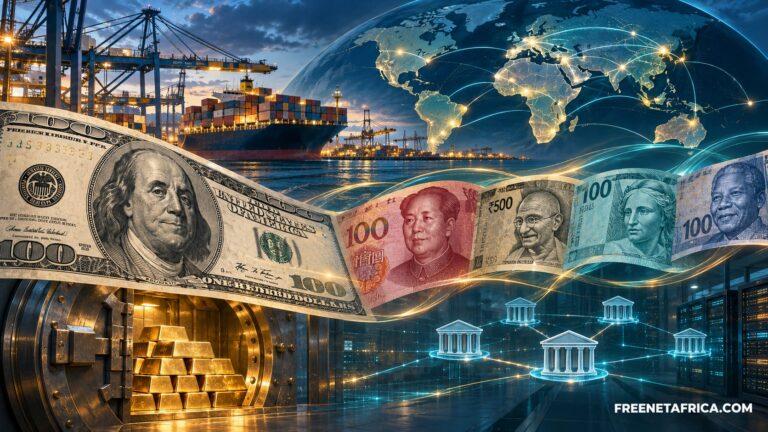



What Is Dedollarization? A Simple Definition
Dedollarization is the process by which countries reduce their reliance on the US dollar in international trade, central bank reserves, and financial settlements. In plain terms, it means paying for imports in yuan instead of dollars, holding gold instead of Treasury bonds, or building payment systems that route around dollar-clearing banks in New York.
It is worth saying clearly at the outset: dedollarization is not a single event or a coordinated campaign. It is a collection of national decisions, each driven by different motives, that happen to point in the same direction. Some countries are motivated by sanctions risk, others by the cost of dollar funding, and others simply by the desire to settle trade in their own money.
Dedollarization vs. De-dollarization: What’s the Difference?
The two spellings refer to the same phenomenon. “De-dollarization” follows the convention used in academic literature and in translations from other languages, while “dedollarization” is the more common form in English-language journalism and web search. You will also encounter “de-dollarisation” in British and Commonwealth publications. The choice of spelling carries no analytical meaning—it is purely stylistic.
The Three Pillars: Trade, Reserves, and Settlements
Discussions of dedollarization often blur together three distinct things. Keeping them separate is essential to understanding the topic:
- Trade invoicing: the currency in which exporters and importers price and pay for goods. Oil priced in dollars is the classic example.
- Reserves: the assets central banks hold for safety and liquidity. The dollar’s share here has been declining slowly for two decades.
- Settlements: the plumbing that moves money between banks—chiefly SWIFT messaging and dollar-clearing infrastructure. This is where alternatives like China’s CIPS are emerging.
A country can dedollarize its trade without touching its reserves, or diversify reserves while still invoicing in dollars. Most real-world dedollarization is partial and uneven across these three pillars.
Why ‘Erosion’ Is More Accurate Than ‘Displacement’
Headlines frequently imply that the dollar is about to be replaced. The data does not support that. What the data shows is a slow erosion of the dollar’s share in reserves, alongside persistent—even dominant—use of the dollar in payments and foreign exchange. The more precise framing is that the dollar’s unipolar role is giving way to a more multipolar system in which the dollar remains first among several currencies rather than the only one that matters.
Why Countries Are Moving Away From the US Dollar
The motivations behind dedollarization are a mix of geopolitics, economics, and national strategy. Understanding them explains why the trend is unlikely to reverse, even if it remains slow.
Sanctions and the Weaponization of the Dollar
Because most dollar payments ultimately clear through US banks, the United States can effectively cut a country off from global commerce by restricting its access to dollar infrastructure. The freezing of roughly $300 billion in Russian central bank reserves in 2022 was a watershed moment. It demonstrated that foreign exchange reserves held in dollars—or in euros—could be immobilized by political decision. For any government that considers itself potentially at odds with Washington, that lesson was impossible to ignore.
Currency Risk and High Dollar-Funding Costs
For emerging markets, the dollar is also a source of chronic financial stress. Borrowing in dollars while earning revenue in local currency creates a mismatch: when the local currency weakens, dollar debts become more expensive to service. This “original sin” of emerging-market finance has triggered repeated crises. Settling trade in local currencies reduces that exposure and lowers the demand for dollar liquidity that drives up funding costs during stress periods.
The Push for Strategic Autonomy and Multipolarity
Beyond sanctions and financing costs, many governments—particularly in the BRICS bloc—frame dedollarization as a matter of sovereignty. Relying on a currency controlled by a single foreign power is seen as a strategic vulnerability. This is as much a political project as an economic one: the goal is a multipolar monetary order in which no single country holds a veto over another’s participation in global trade.
How Local-Currency Trade Works in Practice
The mechanisms of dedollarization are less exotic than the rhetoric suggests. Most involve well-established central banking tools, adapted for political purposes.
Bilateral Currency Swaps Explained
A currency swap is an agreement between two central banks to exchange their currencies up to a set limit. If a Chinese importer wants to pay a Brazilian exporter in yuan, and the Brazilian exporter needs reais, a swap line lets the two central banks provide liquidity in each other’s currency without either side needing dollars. China has signed dozens of such agreements, and they form the backbone of most local-currency trade arrangements.
China’s CIPS and the Alternative to SWIFT
The Cross-Border Interbank Payment System (CIPS) is China’s answer to SWIFT, the Belgian messaging network that underpins most international payments. CIPS handles yuan-denominated cross-border payments and has grown steadily since its launch in 2015. It is important not to overstate its reach: CIPS processes a small fraction of SWIFT’s volume, and much of its traffic still ultimately depends on correspondent banking relationships that touch the dollar system.
INSTEX: A Case Study in What Doesn’t Work
INSTEX, launched by France, Germany, and the UK in 2019 to facilitate trade with Iran outside the dollar system, is the clearest cautionary tale. The mechanism was legally elegant but economically marginal: it struggled with low volumes, limited participation, and the reluctance of European firms to risk US secondary sanctions. It was effectively defunct by the early 2020s. The lesson is that payment channels without commercial scale and political will do not survive.
BRICS Local-Currency Settlement Talks and Gold Accumulation
The expanded BRICS bloc has discussed local-currency settlement and even a common trading currency, but no such currency exists and none is imminent. What has moved faster is gold: central banks—led by China, Russia, Turkey, and India—have bought record quantities of bullion in recent years. Gold is attractive precisely because it is nobody’s liability and cannot be frozen by sanctions.
Which Countries Are Leading Dedollarization?
The leaders are not a uniform bloc. Each has different reasons and different levels of commitment.
Russia and China: The Post-2022 Acceleration
Russia is the most aggressive dedollarizer by necessity. Cut off from much of the dollar system after 2022, it shifted most of its trade with China into rubles and yuan. Estimates vary, but the shift is substantial and largely structural. China’s role is more strategic and gradual: it promotes yuan invoicing and CIPS while carefully managing capital controls that limit the yuan’s international reach.
Iran, Brazil, India, and Saudi Arabia: Different Motives, Same Direction
Iran, under heavy sanctions, has long traded outside the dollar system through barter and regional channels. Brazil and India have pushed local-currency settlement for trade within their regions and with partners like China. Saudi Arabia has discussed pricing oil in currencies other than the dollar—a symbolic move with real implications, though the petrodollar arrangement remains largely intact.
Why Emerging Markets See Both Opportunity and Risk
For emerging markets, dedollarization cuts both ways. Reducing dollar dependence lowers vulnerability to US policy and dollar-funding shocks. But local currencies are often illiquid, volatile, and hard to convert, which raises transaction costs and can make trade more expensive. Losing access to deep, stable dollar markets is a real cost, and most central banks are diversifying gradually rather than exiting the dollar system.
The Reality Check: How Strong Is the Dollar Really?
Any honest assessment of dedollarization has to start with the numbers, and the numbers show a dollar that is eroding at the margins but still dominant.
USD Share of SWIFT Payments and Global Reserves
As of 2024, the dollar accounted for roughly 47% of SWIFT payment value—more than double the euro’s share. On the reserve side, the IMF’s COFER data puts the dollar at about 58% of allocated global reserves, down from roughly 70% in 2000. That is a meaningful decline over a quarter century, but no rival has filled the gap: the shift has gone to a basket of smaller currencies and to gold, not to a single successor.
The Dollar in FX Transactions and Trade Invoicing
The dollar’s role in foreign exchange is even more entrenched. According to the BIS 2022 survey, the dollar was on one side of about 88% of all FX transactions—a figure that reflects its role as the world’s vehicle currency. In trade invoicing, the dollar remains dominant well beyond America’s share of global trade, particularly in commodities.
Why Dedollarization Is Gradual, Partial, and Often Rhetorical
Much of what is labeled dedollarization is political signaling. Announcements of local-currency agreements often translate into modest volumes. Genuine change is happening, but it is incremental and concentrated in specific corridors—Russia-China, intra-BRICS trade, and sanctioned economies. The dollar’s dominance rests on deep capital markets, legal certainty, and network effects that no alternative currently replicates.
What Dedollarization Means for Inflation, Exchange Rates, and Your Investments
For ordinary savers and investors, dedollarization is a slow-moving background trend rather than an immediate threat or opportunity.
Implications for Inflation and Currency Volatility
Broader local-currency trade could raise transaction costs and increase currency volatility in some markets, since local currencies are less liquid than the dollar. It may also reduce structural demand for dollar funding, which could ease pressure on emerging-market borrowers over time. The net effect on global inflation is ambiguous and likely small in the near term.
The Investor Angle: Gold, Commodities, and Currency Diversification
The clearest investment implication is diversification. Central bank gold buying supports the metal’s long-term demand. Commodities priced outside the dollar could shift relative value over time. And for globally exposed investors, holding assets across multiple currencies is a reasonable hedge against a more fragmented monetary system.
Could the Dollar Collapse? Separating Risk From Headlines
A sudden dollar collapse is highly unlikely. The dollar still handles nearly half of SWIFT payments, roughly 88% of FX transactions, and about 58% of reserves. Dedollarization data shows gradual erosion, not imminent displacement. The realistic scenario is a slower, more multipolar system in which the dollar remains dominant but less unchallenged—not a cliff edge.
Frequently Asked Questions About Dedollarization
What is dedollarization, simply?
Dedollarization is the process of reducing reliance on the US dollar in international trade, central bank reserves, and financial settlements—shifting toward local currencies, gold, or other alternatives. It is gradual and partial, not an overnight switch.
Is the dollar losing its reserve status?
The dollar’s share of global reserves has slipped from roughly 70% in 2000 to about 58% (IMF COFER, 2024), but no other currency comes close. Most economists describe this as erosion of dominance, not loss of reserve status.
Which countries are leading dedollarization?
Russia (especially post-2022 sanctions), China, and Iran are the most active, joined by Brazil, India, and Saudi Arabia pursuing local-currency trade and diversification for strategic and economic reasons.
How does local-currency trade work in practice?
Countries sign bilateral currency swaps and settlement agreements so exporters and importers can pay in rubles, yuan, or rupees rather than dollars, often backed by alternative systems like China’s CIPS. Convertibility and liquidity limits still constrain scale.
What does dedollarization mean for inflation and my investments?
Broader local-currency trade could raise transaction costs and currency volatility in some markets while reducing dollar-funding demand elsewhere. For investors, it supports a case for gold, commodity exposure, and currency diversification—but not a dollar-collapse thesis.
Could the dollar collapse?
A sudden dollar collapse is highly unlikely. The dollar still handles roughly 47% of SWIFT payments (2024), about 88% of FX transactions (BIS 2022), and ~58% of reserves. Dedollarization data shows gradual erosion, not imminent displacement.
Conclusion
Dedollarization is real, but it is neither a revolution nor a collapse. It is a slow, uneven diversification driven by sanctions risk, funding costs, and the desire for strategic autonomy. The dollar remains the world’s dominant currency by every major measure, and no credible alternative exists today. What is changing is the assumption that the dollar’s dominance is permanent and unchallenged. For policymakers, investors, and businesses, the sensible response is to watch the data, distinguish rhetoric from substance, and prepare for a more multipolar monetary world—without betting on the dollar’s demise.
Source: FREENET AFRICA