

Widening Conflict Zones, BRICS Deliberations, and Africa’s Climate Finance Demands Mark a Shifting Geopolitical Landscape
Internationalising Conflict Zones: Libya, Poland and the Gulf
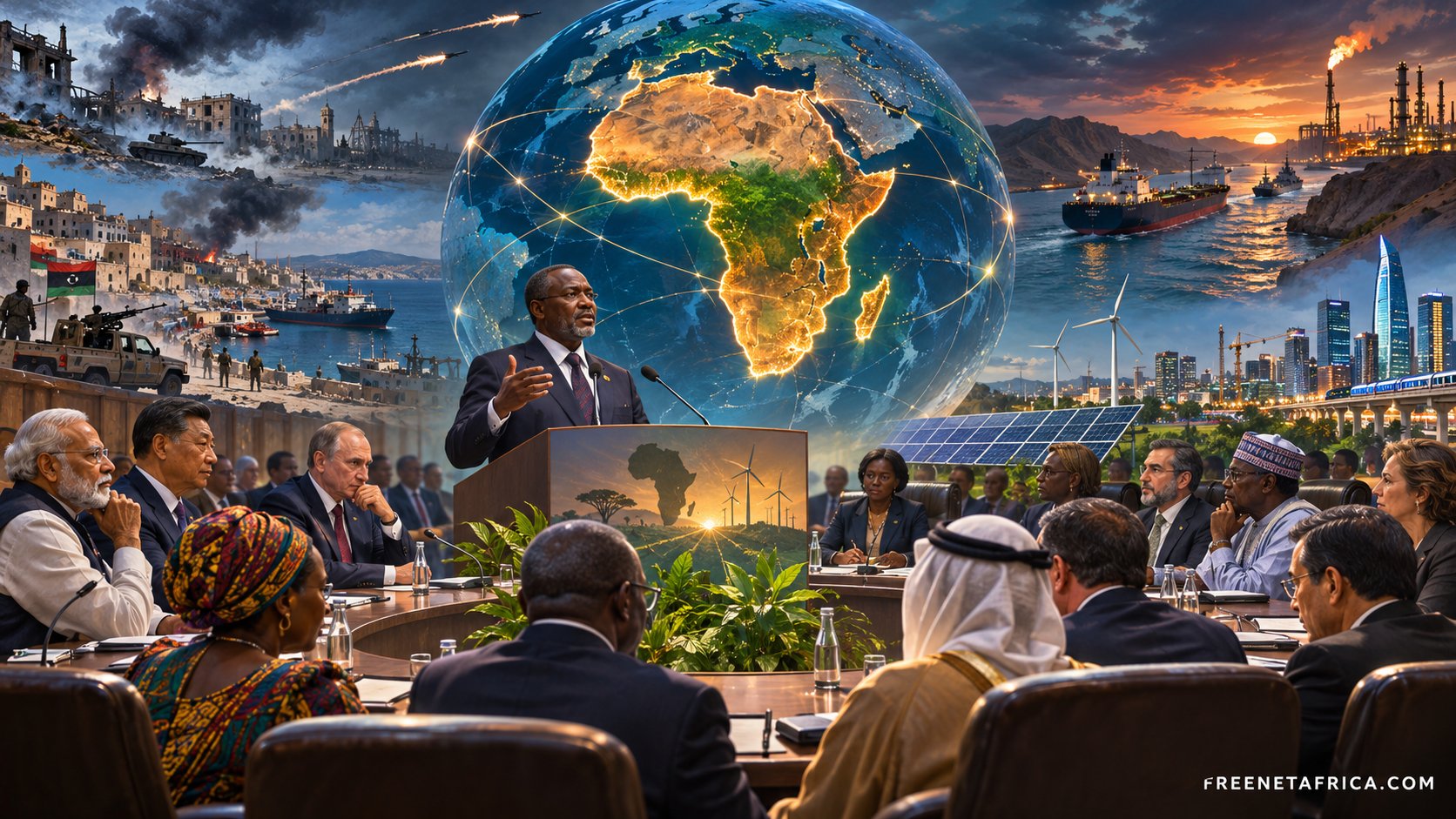
The 23 November digest brings into focus the further diffusion of traditionally localised conflicts into wider spaces. Reports of a Russian warship struck by an alleged Ukrainian drone boat in the Libyan port of Benghazi, if confirmed, would signal a notable geographic expansion of the Russia-Ukraine confrontation. Libya, long a subject of proxy involvement, now appears as a direct extension of this wider conflict, raising the stakes for Mediterranean security dynamics and Russia’s naval strategies. Attribution and full facts remain unconfirmed, but such actions exemplify the growing permeability of regional conflict boundaries.
In parallel, Polish prosecutors’ confirmation that three Russian Kh-101 cruise missiles entered Polish airspace and crashed inside the country (with Russia not yet commenting) illustrates another dimension of war spillover. This episode elevates tensions between NATO and Russia, renewing concerns of unintended escalation and further underlining the inability of geographical peripheries to contain great-power rivalry. These incidents, emerging from the Russia-Ukraine war’s epicentre, suggest a world order increasingly less able to firewall conflicts within their points of origin.
The potential for escalation remains acute also in the Gulf, where US President Trump is reported to have threatened to sink ships attempting to break a US naval blockade of Iran. Such rhetoric, framed around oil flows through the Hormuz Strait—a critical artery of global energy—signals both the enduring strategic importance of the region and a precarious reliance on military posturing to resolve disputes. Fears of direct confrontation signal the risk of unpredictable consequences should these dynamics spiral beyond diplomatic containment.
Contested Peace and Security Regimes: Lebanon and Gaza
Peace and security arrangements are the subject of negotiation and discord elsewhere. As the UN peacekeeping mandate in Lebanon nears renewal, the digest highlights a splitting of major powers over succeeding arrangements: the US and Israel promote use of private contractors against Hezbollah, while France advances an EU-centric model of peacekeepers. Both approaches reflect different philosophies about international involvement and underline persistent cleavages regarding future governance in this sensitive region.
Within Gaza, the Health Ministry’s casualty reports—at least 13 killed in recent Israeli attacks, amid claims of ceasefire violations—punctuate the fragility of diplomacy and the ongoing reality of violence despite external frameworks for truce. As with other present flashpoints, these developments remind us that negotiated frameworks, whether rooted in Western or multilateral design, are critically challenged by military facts on the ground.
Energy, Economic Adaptation, and National Strategies
Economic responses to ongoing volatility are visible in today’s digest, with countries recalibrating subsidy regimes, energy supply strategies, and regulatory frameworks. Brazil’s expiry of the imported diesel subsidy, while maintaining other fuel support measures, and Iran’s calls for gas conservation amid looming winter restrictions, exemplify the complex trade-offs governments must navigate as they balance fiscal constraints, energy needs, and vulnerable populations. Morocco’s approval of a major investment plan—MAD 400 billion within its 2027 Finance Bill—points to active fiscal policy as a lever for national development, even as debate over social aid and spending priorities continues.
In Saudi Arabia, regulatory innovation is illustrated by the expansion of net billing for distributed renewables. The raise of on-site solar caps from earlier limits to 50MW under the new self-consumption rules may encourage greater private investment and decentralised energy in a region closely monitored for its approach to energy transition. Meanwhile, China’s SMIC, posting record profits while predicting a chip shortage persisting into 2028, underscores both the dynamism and the challenges inherent in global technology supply chains.
BRICS+ Cohesion and Internal Limits
A prominent theme is the analysis, attributed to thenational.co.za, scrutinising the prospects and constraints of the expanded BRICS+ bloc. The piece questions whether the now-broader grouping can ever coherently coordinate its distinct national interests, economic priorities and geopolitical agendas into a lasting counterweight to Western-dominated institutions. It notes, without presuming inevitability, the persistent divisions that might blunt the group’s capacity to shape global governance. This reflects a maturing acknowledgement among both participants and observers that BRICS+ is a site of negotiation, not a monolith of opposition, and that differences between major actors—China, India, Russia, and others—are likely to endure.
Proposals from Iran to establish a BRICS network dedicated to women’s empowerment, echoed both by Iranian government and Red Crescent Society representatives, may suggest a broadening of the bloc’s social agenda. However, with scant reported detail on membership or implementation, it remains to be seen whether such initiatives can move beyond rhetorical commitment and enrich the bloc’s operational identity. Similarly, BRICS-linked endeavours in finance—such as India’s M1xchange targeting expansion into Russia and Brazil—demonstrate efforts to leverage intra-bloc synergies, but there is little evidence (from today’s digest) that these add up to systemic transformation.
Africa’s Climate Finance Advocacy and Uneven Agency
In Antalya, Prime Minister Abiy Ahmed’s demands that climate finance for COP32 be agreed, affordable, and actually delivered—the latter reflecting deep frustration with historical shortfalls—capture the evolving assertiveness of African leadership in global fora. Ethiopia’s call foregrounds long-standing grievances about the failure of global North actors to fulfil pledges and the structural disadvantage facing African economies in accessing capital. By publicly raising these concerns, African actors seek to shift international negotiations from rhetorical commitment to concrete outcome, insisting on agency rather than passive receipt of insufficient support.
Elsewhere, Mozambique’s new mining law, requiring a 15% state acquisition in mining ventures and currently the subject of discussions between Gemfields and local authorities, illustrates another form of contested agency. While resource nationalism can be seen as a mechanism for asserting state interests in the face of multinational capital, it may also trigger complex negotiations over economic sustainability and foreign investment.
The Multipolarity and BRICS Dimension
The digest provides limited but nuanced insight into the evolving debate over multipolarity and the status of BRICS as a force in the international system. The highlighted analysis cautions against exaggerating the prospects of BRICS+ forming a real axis, instead pointing out evidence for continued divergence among its members. This aligns with other reported items: the cultural and social initiatives among BRICS states (notably in film and gender empowerment) demonstrate desire for normative influence, but their practical effect on underlying global power structures is left unresolved.
Assertions such as those of Indian journalist Munish Gupta—that the Global North “has no future without the Global South”—are best read as interpretive, signposting aspirations for a revised global order. Yet, in the absence of detail on institutional reforms, such commentary reflects ongoing ideological contestation, rather than established structural change.
Implications for Africa
African agency is evident both as grievance and as initiative. Whether in Ethiopia’s campaign for credible climate finance or Morocco’s pursuit of ambitious domestic investment strategies, the continent’s actors are not mere recipients of external pressure but active participants in seeking to redefine the terms of global engagement. Nevertheless, the balance of power and delivery of resources remains subject to systemic constraints, as seen in the cautious optimism mixed with realism that pervades climate finance advocacy.
Notably, while major-power rivalry increasingly spills over into Africa—as in the Libyan port incident—there is scant evidence (from today’s digest) that this translates into a durable shift in Africa’s structural position within the world system. Instead, Africa’s leverage oscillates between being an arena of contestation and a site of normative claim, often still dependent on outcomes decided elsewhere.
Conclusion: A System in Negotiation, Not Yet Transformed
The international landscape glimpsed in this digest is one of intense negotiation—over security arrangements, resource allocation, institutional legitimacy, and normative priorities. Regional conflicts show more capacity for internationalisation; aspirations for multipolarity find practical limits in unresolved intra-bloc tensions; and African actors continue to seek, if not always secure, enhanced agency in global affairs. The Western-led order faces questions, but a fully emergent alternative framework has not yet crystallised. Today’s events underscore not a clean transition, but a world system in flux, marked by persistent friction, innovation, and debate.
Editorial source note: This analysis is based on the aggregated summaries in Freenet Africa Daily News Digest — 23 November 2026. The underlying reports have not been independently verified for this analysis.